. 2012 Nov 15;72(22):5912-20.
doi: 10.1158/0008-5472.CAN-12-2329. Epub 2012 Sep 17.

Hedgehog signaling blockade delays hepatocarcinogenesis induced by hepatitis B virus X protein

Affiliations

Hedgehog signaling blockade delays hepatocarcinogenesis induced by hepatitis B virus X protein

Alla Arzumanyan et al. Cancer Res. .

Abstract

The hepatitis B virus (HBV) encoded X protein (HBx) contributes centrally to the pathogenesis of hepatocellular carcinoma (HCC). Aberrant activation of the Hedgehog (Hh) pathway has been linked to many tumor types including HCC. Thus, experiments were designed to test the hypothesis that HBx promotes HCC via activation of Hh signaling. HBx expression correlated with an upregulation of Hh markers in human liver cancer cell lines, in liver samples from HBV infected patients with HCC, and in the livers of HBx transgenic mice (HBxTg) that develop hepatitis, steatosis, and dysplasia, culminating in the appearance of HCC. The findings in human samples provide clinical validation for the in vitro results and those in the HBxTg. Blockade of Hh signaling inhibited HBx stimulation of cell migration, anchorage-independent growth, tumor development in HBxTg, and xenograft growth in nude mice. Results suggest that the ability of HBx to promote cancer is at least partially dependent upon the activation of the Hh pathway. This study provides biologic evidence for the role of Hh signaling in the pathogenesis of HBV-mediated HCC and suggests cause and effect for the first time. The observation that inhibition of Hh signaling partially blocked the ability of HBx to promote growth and migration in vitro and tumorigenesis in two animal models implies that Hh signaling may represent an "oncogene addiction" pathway for HBV-associated HCC. This work could be central to designing specific treatments that target early development and progression of HBx-mediated HCC.


Figures

Fig. 1
Fig. 1
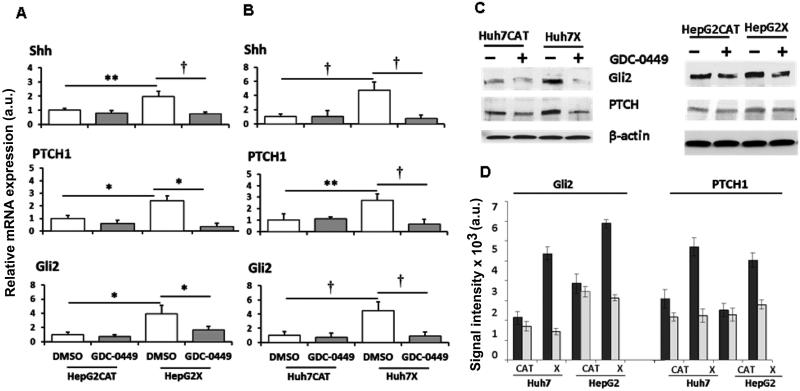
Changes in markers of Hh signaling were determined in HBx positive (X) and negative (CAT) HepG2 and Huh7 cells treated with DMSO or GDC-0449. (A and B) qRT-PCR results are shown as the mean ± SEM of triplicate experiments; *p<0.05, **p<0.01, †p<0.005. (C) Representative western blots of total extracts from the cells above. (D) Quantification of protein levels (mean expression ± S.D. of 3 assays for each marker). DMSO controls are the black bars and cells treated with 1 μM GDC-0449 are the white bars.
Fig. 2
Fig. 2
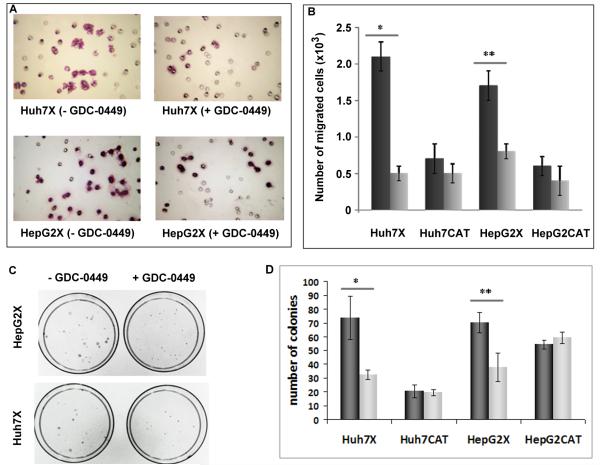
Phenotypic changes associated with Hh signaling in HBx positive and negative cells with or without GDC-0449. (A) Representative images of HBx expressing cells that migrated through Matrigel basement membrane (200x). (B) Quantification of the results in panel A (mean expression ± S.D. of 3 assays). Cells were treated with DMSO (dark bars) or with GDC-0449 (light bars): *p<0.01; **p<0.02. (C) Anchorage independent growth of Huh7X and HepG2X with or without GDC-0449. (D) Quantification of the results in panel C (mean expression ± S.D. of 3 assays). Cells were treated with DMSO (dark bars) or with GDC-0449 (light bars): *p<0.01; **p<0.03.
Fig. 3
Fig. 3
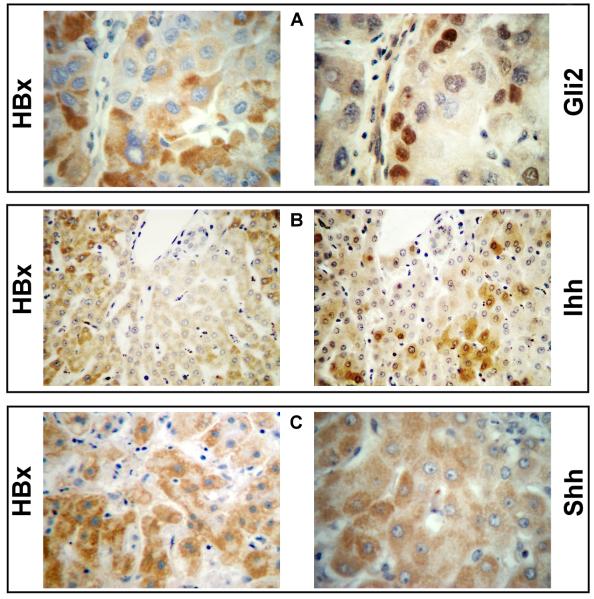
Co-staining of HBx with (A) Gli2 (x400), with (B) Ihh (x200), and with (C) Shh (x400) in nontumor sections of clinical samples from HBV infected patients.
Fig. 4
Fig. 4
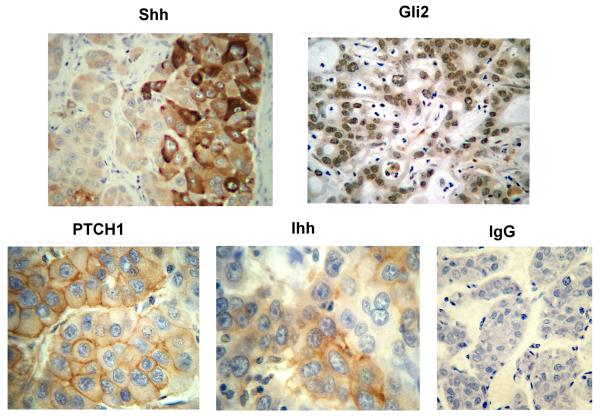
Staining for Shh and Gli2 (x200) as well as PTCH1 and Ihh (x400) in HCC samples from HBV carriers. The control panel is HCC stained with normal IgG (x200).
Fig. 5
Fig. 5
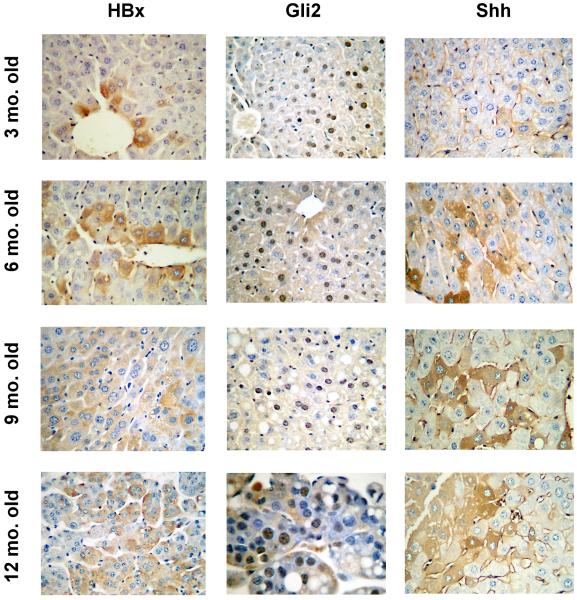
Staining for HBx, Shh, and Gli2 in the livers from 3, 6, 9 and in HCC from 12 month old HBxTg. Magnification is x200 except for the 12 month old Gli2 image which is x400.
Fig. 6
Fig. 6
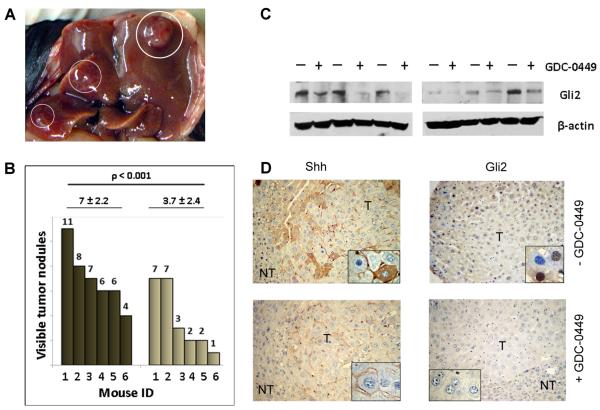
Relationship between Hh signaling and HCC in HBxTg. (A) HCC nodules (circled) on the surface of the liver. (B) The number of visible nodules observed on livers (n = 6 HBxTg per group) after injections of vehicle (dark bars) or GDC-0449 (light bars). Tumor numbers for individual mice are shown above each bar. The average tumor number is shown above each group. (C) WB for Gli2 in livers from transgenic mice treated with vehicle (−) or GDC-0449 (+). (D) Staining for Gli2 and Shh on serial sections of tumors (T) and nontumor (NT) livers from HBxTg treated with vehicle (upper panels) or GDC-0449 (lower panels). Magnification is x100 for each panel and x400 for each insert.
Fig. 7
Fig. 7
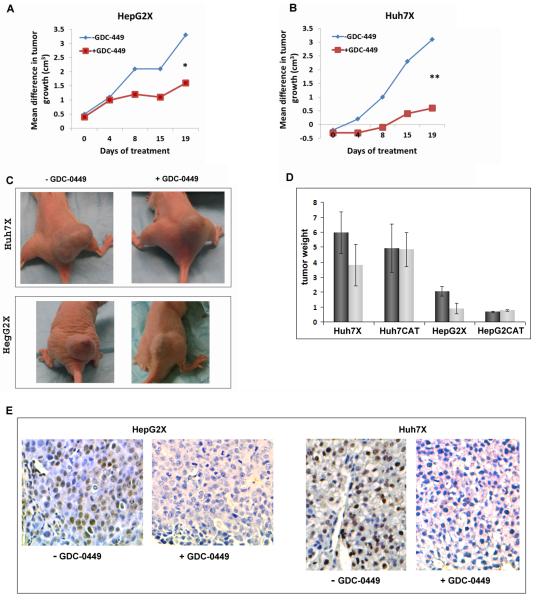
HBx expressing xenografts in nude mice treated with vehicle or GDC-0449. The mean difference in tumor size for (A) HepG2X and (B) Huh7X tumors (to evaluate the contribution of HBx only) was calculated as follows: the average size of HepG2CAT tumors without drug was subtracted from the average size of HepG2X tumors without drug and plotted for each time point. Likewise, the average size of HepG2CAT cells with drug was subtracted from the average size of the HepG2X tumors with drug. Parallel calculations were performed for Huh7 cells; *p < 0.01; **p < 0.005 at day 19. (C) Nude mice with Huh7X and HepG2X xenografts following treatment with GDC-0449 or vehicle. (D) Mean wet weights (in grams) of tumors from HBx positive and negative HepG2 and Huh7 xenografts in animals treated with drug or vehicle; *p < 0.01; **p < 0.05. (E) IHC staining for Gli2 in Huh7X and HepG2X xenografts after treatment with GDC-0449 or vehicle.

References

    1. Feitelson MA. Hepatitis B virus in hepatocarcinogenesis. J Cell Physiol. 1999;181:188–202. - PubMed
    1. Ng SA, Lee C. Hepatitis B virus X gene and hepatocarcinogenesis. J. Gastroenterol. 2011;46:974–990. - PubMed
    1. Moon EJ, Jeong CH, Jeong JW, Kim KR, Yu DY, Murakami S, et al. Hepatitis B virus X protein induces angiogenesis by stabilizing hypoxia-inducible factor-1alpha. FASEB J. 2004;18:382–384. - PubMed
    1. Zheng DL, Zhang L, Cheng N, Xu X, Deng Q, Teng XM, et al. Epigenetic modification induced by hepatitis B virus X protein viainteraction with de novo DNA methyltransferase DNMT3A. J Hepatol. 2009;50:377–387. - PubMed
    1. Beachy PA, Karhadkar SS, Berman DM. Tissue repair and stem cell renewal in carcinogenesis. Nature. 2004;432:324–331. - PubMed

Publication types

MeSH terms

Substances