


MGMT testing for glioma in clinical laboratories: discordance with methylation analyses prevents the implementation of routine immunohistochemistry
- PMID: 22986811
- PMCID: PMC11824796
- DOI: 10.1007/s00432-012-1312-1
MGMT testing for glioma in clinical laboratories: discordance with methylation analyses prevents the implementation of routine immunohistochemistry
Abstract
Purpose: Glioblastoma is a universally fatal cancer of the central nervous system which responds poorly to treatment. MGMT has potential as a predictive biomarker in glioblastoma patients to determine treatment response. However, methods of measuring MGMT are currently unsatisfactory, and as such, use of this marker has not translated well into the clinic. This paper aims to review current methodology of MGMT measurement, with a focus on immunohistochemistry as a potential way forward. TOPICS AND METHODS: Studies of glioma patients where MGMT immunohistochemistry was undertaken, as well as the literature surrounding methylation analyses and the regulation of MGMT, were reviewed.
Results: All methods of measuring MGMT were disputed in some way in the literature. A trend of discordance between methylation analyses and protein analyses was present. There is a lack of standardisation in the measurement of MGMT, and as a result, it seems that there are highly variable results.
Conclusions: No single method of MGMT analysis has emerged as a clear choice for routine clinical testing of MGMT in glioma patients. Although methylation analyses are favoured, their expense and inaccessibility are barriers to their use in routine clinical practice. More research into immunohistochemistry is needed to determine whether it can serve as a reliable and cost-effective alternative to methylation analyses.
Conflict of interest statement
We declare that there is no conflict of interest in this paper.
Figures
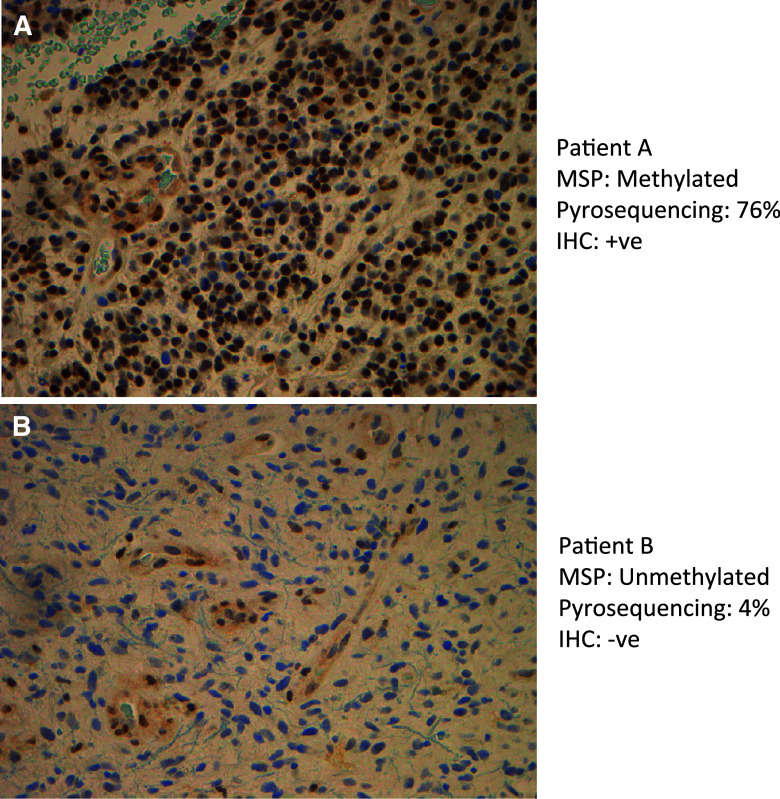
References
-
- Anda T, Shabani HK, Tsunoda K, Tokunaga Y, Kaminogo M, Shibata S, Hayashi T, Iseki M (2003) Relationship between expression of O6-methylguanine-DNA methyltransferase, glutathione-S-transferase pi in glioblastoma and the survival of the patients treated with nimustine hydrochloride: an immunohistochemical analysis. Neurol Res 25(3):241–248 - PubMed
-
- Bady P, Sciuscio D, Diserens AC, Bloch J, van den Bent MJ, Marosi C, Dietrich PY, Weller M, Mariani L, Heppner FL, McDonald DR, Lacombe D, Stupp R, Delorenzi M, Hegi ME (2012) MGMT methylation analysis of glioblastoma on the Infinium methylation BeadChip identifies two distinct CpG regions associated with gene silencing and outcome, yielding a prediction model for comparisons across datasets, tumor grades, and CIMP-status. Acta Neuropathol. doi:10.1007/s00401-012-1016-2 - PMC - PubMed
-
- Balana C, Carrato C, Ramirez JL, Cardona AF, Berdiel M, Sanchez JJ, Taron M, Hostalot C, Musulen E, Ariza A, Rosell R (2011) Tumour and serum MGMT promoter methylation and protein expression in glioblastoma patients. Clin Translat Oncol 13:677–685 - PubMed
-
- Blough MD, Zlatescu MC, Cairncross JG (2007) O6-Methylguanine-DNA methyltransferase regulation by p53 in astrocytic cells. Cancer Res 67(2):580–584. doi:10.1158/0008-5472.can-06-2782 - PubMed
-
- Brell M, Tortosa A, Verger E, Gil JM, Viñolas N, Villá S, Acebes JJ, Caral L, Pujol T, Ferrer I, Ribalta T, Graus F (2005) Prognostic significance of O6-methylguanine-DNA methyltransferase determined by promoter hypermethylation and immunohistochemical expression in Anaplastic Gliomas. Clin Cancer Res 11 (14):5167–5174. doi:10.1158/1078-0432.ccr-05-0230 - PubMed
Publication types
MeSH terms
Substances
LinkOut - more resources
Full Text Sources
Medical
Research Materials
