The dengue virus mosquito vector Aedes aegypti at high elevation in Mexico
- PMID: 22987656
- PMCID: PMC3516267
- DOI: 10.4269/ajtmh.2012.12-0244
The dengue virus mosquito vector Aedes aegypti at high elevation in Mexico
Abstract
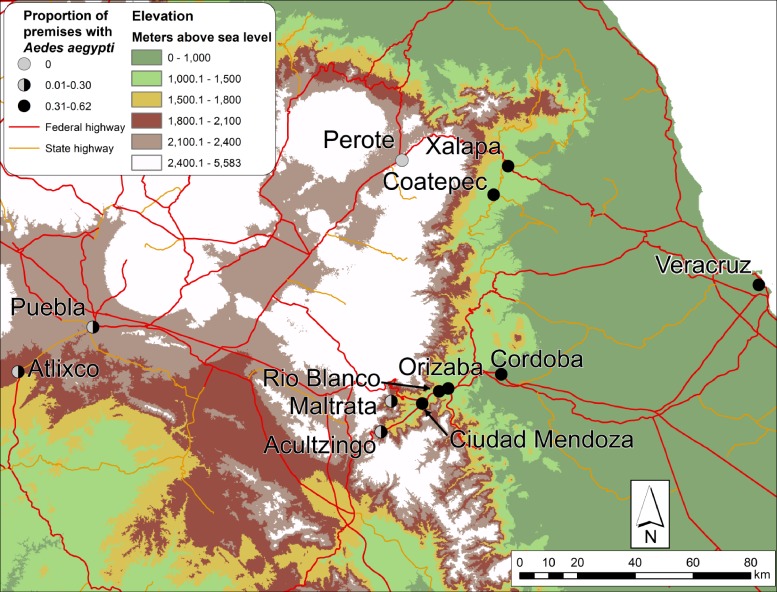
México has cities (e.g., México City and Puebla City) located at elevations > 2,000 m and above the elevation ceiling below which local climates allow the dengue virus mosquito vector Aedes aegypti to proliferate. Climate warming could raise this ceiling and place high-elevation cities at risk for dengue virus transmission. To assess the elevation ceiling for Ae. aegypti and determine the potential for using weather/climate parameters to predict mosquito abundance, we surveyed 12 communities along an elevation/climate gradient from Veracruz City (sea level) to Puebla City (∼2,100 m). Ae. aegypti was commonly encountered up to 1,700 m and present but rare from 1,700 to 2,130 m. This finding extends the known elevation range in México by > 300 m. Mosquito abundance was correlated with weather parameters, including temperature indices. Potential larval development sites were abundant in Puebla City and other high-elevation communities, suggesting that Ae. aegypti could proliferate should the climate become warmer.
Figures
References
-
- Gratz NG. Emerging and resurging vector-borne diseases. Annu Rev Entomol. 1999;44:51–75. - PubMed
-
- Gubler DJ. The global emergence/resurgence of arboviral diseases as public health problems. Arch Med Res. 2002;33:330–342. - PubMed
-
- Focks DA, Alexander N. A Multi-Country Study on the Methodology for Surveys of Aedes Aegypti Pupal Productivity: Findings and Recommendations. Geneva: World Health Organization; 2006.
Publication types
MeSH terms
LinkOut - more resources
Full Text Sources