. 2012 Dec;80(12):4216-22.
doi: 10.1128/IAI.00559-12. Epub 2012 Sep 17.

Dectin-1 is not required for controlling Candida albicans colonization of the gastrointestinal tract

Affiliations

Dectin-1 is not required for controlling Candida albicans colonization of the gastrointestinal tract

Simon Vautier et al. Infect Immun. 2012 Dec.

Abstract

Candida albicans is normally found as a commensal microbe, commonly colonizing the gastrointestinal tract in humans. However, this fungus can also cause mucosal and systemic infections once immune function is compromised. Dectin-1 is an innate pattern recognition receptor essential for the control of fungal infections in both mice and humans; however, its role in the control of C. albicans colonization of the gastrointestinal tract has not been defined. Here, we demonstrate that in mice dectin-1 is essential for the control of gastrointestinal invasion during systemic infection, with dectin-1 deficiency associating with impaired fungal clearance and dysregulated cytokine production. Surprisingly, however, following oral infection, dectin-1 was not required for the control of mucosal colonization of the gastrointestinal tract, in terms of either fungal burdens or cytokine response. Thus, in mice, dectin-1 is essential for controlling systemic infection with C. albicans but appears to be redundant for the control of gastrointestinal colonization.


Figures

Fig 1
Fig 1
Dectin-1 deficiency increases susceptibility of the GI tract during systemic infection with C. albicans SC5314. (A) Dectin-1−/− (n = 9) and wild-type (wt) (n = 10) mice were systemically infected with 2 × 10⁵ CFU of C. albicans SC5314 and monitored for survival over a period of 21 days, as described in Materials and Methods. (B) Cartoon representation of the systemic experimental infection model with sampling points. (C) Stool fungal burdens in dectin-1−/− (n = 21) and wt (n = 22) mice following systemic infection with 2 × 10⁵ CFU C. albicans SC5314. (D) Fungal burdens in GI tissues in dectin-1−/− (n = 21) and wt (n = 22) mice on day 3 postinfection. Bars represent mean values. All data are representative of at least two independent experiments. *, P < 0.05.
Fig 2
Fig 2
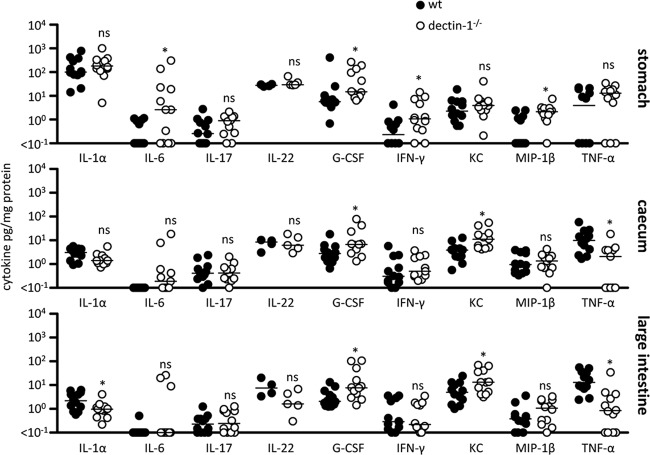
Dectin-1 deficiency leads to abnormal cytokine production in the GI tract during systemic infection with C. albicans. Cytokine levels in GI tissues in dectin-1−/− and wild-type (wt) mice on day 3 postinfection are shown. The data shown are pooled from two independent experiments (n = 12 combined) and are normalized to protein concentration. Bars represent mean values. *, P < 0.05.
Fig 3
Fig 3
Dectin-1 deficiency does not have a generalized effect on gastrointestinal histopathology during systemic infection with C. albicans. (A) Histopathology of GI tissues in dectin-1−/− and wild-type (wt) mice as shown by H&E staining. (B) Myeloperoxidase (MPO) activity in the stomach (stom), small intestine (s. int), cecum (caec.), and large intestine (l. int). (C) A representative localized lesion observed in the stomachs of dectin-1−/− mice, as visualized by PAS staining. (D) Bile acid concentrations in the small intestines of uninfected wild-type (n = 4), infected wild-type (n = 6), and dectin-1−/− mice (n = 6), as indicated. All observations were performed on day 3. See also Fig. S1 in the supplemental material.
Fig 4
Fig 4
Dectin-1 deficiency does not influence gastrointestinal tract colonization by C. albicans following oral infection. (A) Cartoon representation of the experimental oral infection model with sampling time points. (B) Stool fungal burdens in cohoused dectin-1−/− (n = 21) and wild-type (wt) (n = 20) mice following oral infection with C. albicans SC5314. (C) GI tissue fungal burdens in dectin-1−/− and wt mice on days 7, 14, and 21 (pooled data, n > 16 per group). Bars represent mean values. See also Fig. S3 in the supplemental material.
Fig 5
Fig 5
Dectin-1 deficiency does not influence cytokine responses or pathology of the gastrointestinal tract during colonization by orally administered C. albicans. (A) Cytokine levels in GI tissues in dectin-1−/− and wild-type (wt) mice (n = 5 per group). Bars represent mean values. *, P < 0.05. (B) Representative H&E staining of GI tissues in dectin-1−/− and wild-type mice. All observations were performed on day 14. See also Fig. S4 and S5 in the supplemental material.

References

    1. Brown GD. 2011. Innate antifungal immunity: the key role of phagocytes. Annu. Rev. Immunol. 29:1–21 - PMC - PubMed
    1. Carvalho A, et al. 2012. Dectin-1 isoforms contribute to distinct Th1/Th17 cell activation in mucosal candidiasis. Cell Mol. Immunol. 9:276–286 - PMC - PubMed
    1. Conti HR, Gaffen SL. 2010. Host responses to Candida albicans: Th17 cells and mucosal candidiasis. Microbes Infect. 12:518–527 - PMC - PubMed
    1. Denning TL, et al. 2011. Functional specializations of intestinal dendritic cell and macrophage subsets that control Th17 and regulatory T cell responses are dependent on the T cell/APC ratio, source of mouse strain, and regional localization. J. Immunol. 187:733–747 - PMC - PubMed
    1. Dial EJ, Romero JJ, Villa X, Mercer DW, Lichtenberger LM. 2002. Lipopolysaccharide-induced gastrointestinal injury in rats: role of surface hydrophobicity and bile salts. Shock 17:77–80 - PubMed

Publication types

LinkOut - more resources