. 2012 Oct 2;109(40):16143-8.
doi: 10.1073/pnas.1208253109. Epub 2012 Sep 17.

Platelet biogenesis and functions require correct protein O-glycosylation

Affiliations

Platelet biogenesis and functions require correct protein O-glycosylation

Yingchun Wang et al. Proc Natl Acad Sci U S A. .

Abstract

Platelets express a variety of membrane and secreted glycoproteins, but the importance of glycosylation to platelet functions is poorly understood. To explore the importance of O-glycosylation, we generated mice with a targeted deletion of Cosmc in murine endothelial/hematopoietic cells (EHC) (EHC Cosmc(-/y)). X-linked Cosmc encodes an essential chaperone that regulates protein O-glycosylation. This targeted mutation resulted in lethal perinatal hemorrhage in the majority of mice, and the surviving mice displayed severely prolonged tail-bleeding times and macrothrombocytopenia. EHC Cosmc(-/y) platelets exhibited a marked decrease in GPIb-IX-V function and agonist-mediated integrin αIIbβ3 activation, associated with loss of interactions with von Willebrand factor and fibrinogen, respectively. Significantly, three O-glycosylated glycoproteins, GPIbα, αIIb, and GPVI normally on platelet surfaces that play essential roles in platelet functions, were partially proteolyzed in EHC Cosmc(-/y) platelets. These results demonstrate that extended O-glycans are required for normal biogenesis of the platelets as well as the expression and functions of their essential glycoproteins, and that variations in O-glycosylation may contribute to altered hemostasis.


Conflict of interest statement

The authors declare no conflict of interest.

Figures
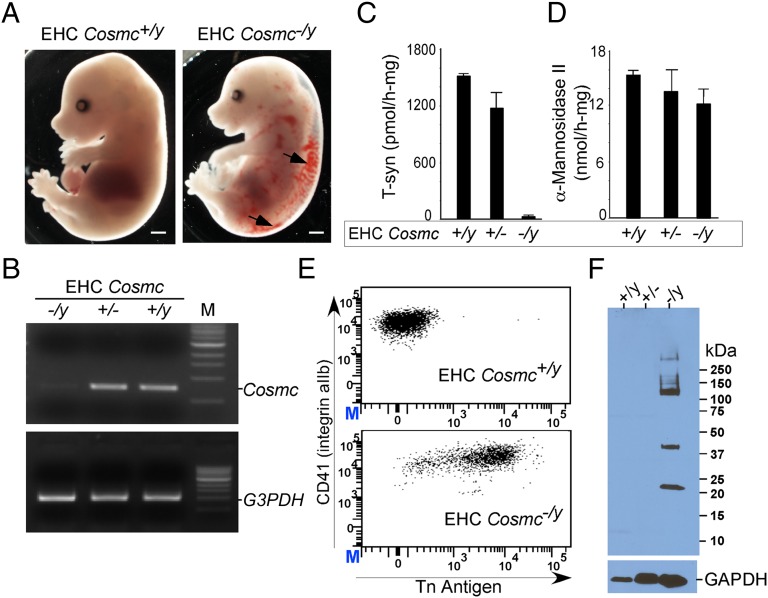
Fig. 1.
Fig. 1.
Cosmc disruption (EHC Cosmc/y) results in hemorrhage and loss of T-synthase activity. (A) E15.5 embryos (EHC Cosmc/y) reveal hemorrhaging, denoted by arrows. (Scale bars, 1 mm.) (B) RT-PCR analysis of Cosmc transcription level in different platelet genotypes. (C and D) T-synthase activity in platelets isolated from EHC Cosmc+/y, EHC Cosmc+/−, and EHC Cosmc/y. α-Mannosidase II activity shown as a control. Error bars indicate ±1 SEM of two independent experiments. (E) Flow cytometry analysis of EHC Cosmc+/y and EHC Cosmc/y platelets, stained with anti-CD41 and anti-Tn antigen antibodies. (F) Western blot of platelet lysates from wild-type mice (Cosmc+/y), EHC Cosmc+/− mice, and EHC Cosmc/y mice, using biotin labeled anti-Tn antigen antibody. GAPDH was used as a loading control.
Fig. 2.
Fig. 2.
EHC Cosmc-deficient animals have prolonged bleeding times and macrothrombocytopenia. (A) Tail-bleeding time (s) in three different mouse genotypes (n = 6–7). Cautery of mice with continued bleeding was performed at 600 s (red arrow). (B) Peripheral platelet counts in EHC Cosmc+/y, EHC Cosmc+/−, and EHC Cosmc/y mice. *P = 0.00023, **P = 0.0000002 (equal variance). Error bars indicate ± 1 SD (n = 6). (C) Panels C-1 and C-3 (EHC Cosmc+/y), and C-2 and C-4 (EHC Cosmc/y) show images of platelets (arrows) from blood smears stained by Wright-Giemsa (C-1 and C-2), or viewed by transmission electron microscopy (C-3 and C-4).
Fig. 3.
Fig. 3.
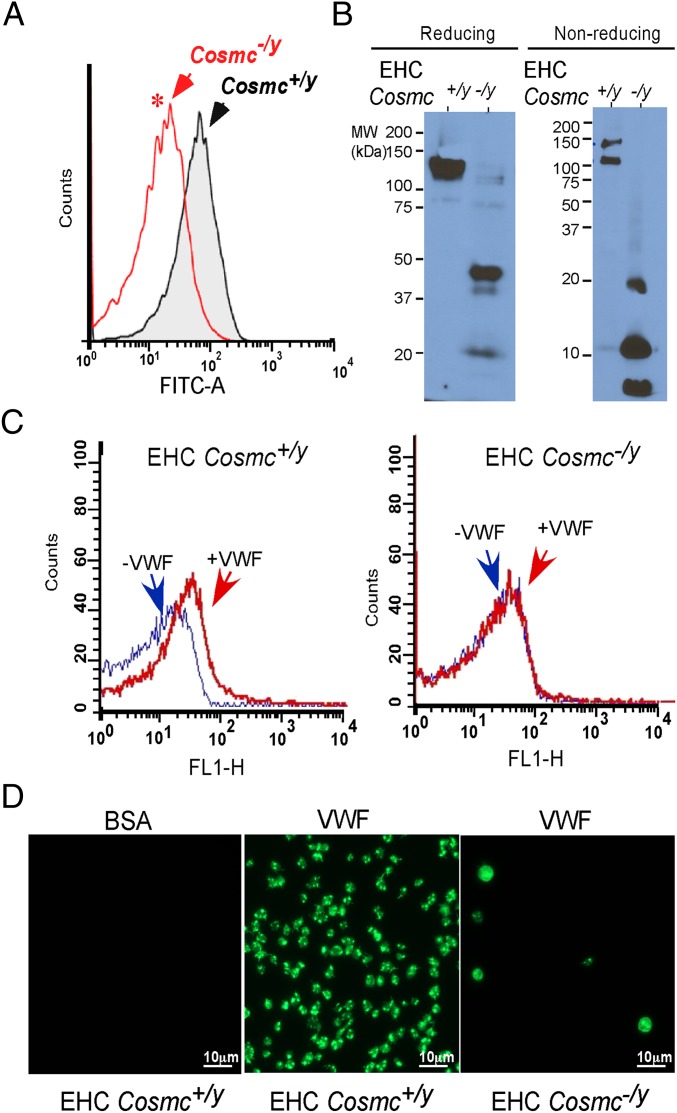
Cosmc-deficient platelets have impaired platelet GPIbα expression and function. (A) Platelet surface GPIbα expression as measured by flow cytometry (n = 4, *P = 0.0122, equal variance). (B) Western blot of GPIbα in platelet lysates in reducing and nonreducing conditions. (C) Flow cytometry of botrocetin-treated EHC Cosmc+/y and EHC Cosmc/y platelets in the presence of VWF and incubated with FITC-labeled anti-VWF antibody. (D) Botrocetin-activated EHC Cosmc+/y and EHC Cosmc/y platelets were allowed to adhere to BSA or VWF. Adherent platelets were stained with fluorescein-labeled phalloidin.
Fig. 4.
Fig. 4.
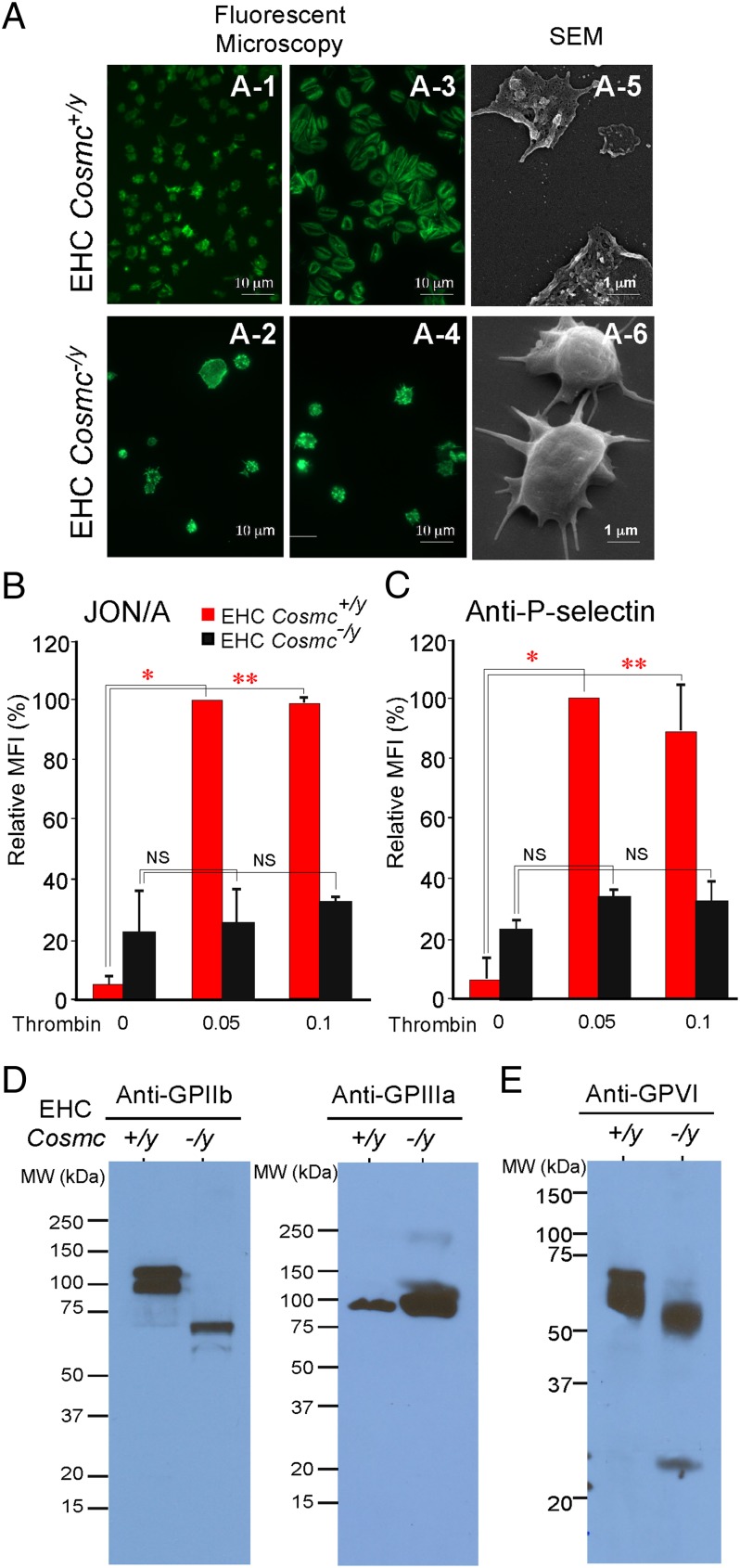
Altered expression and function of integrin αIIb and other platelet glycoproteins in Cosmc-deficient platelets. (A) Fluorescent microscopy: EHC Cosmc+/y and EHC Cosmc/y platelet binding to fibrinogen detected by fluorescein-labeled phalloidin; EHC Cosmc+/y platelets without (A-1) or with (A-3) thrombin stimulation. EHC Cosmc/y platelets without (A-2) or with (A-4) thrombin stimulation. SEM: thrombin-stimulated EHC Cosmc+/y and EHC Cosmc/y platelets (A-5 and A-6). (B and C) In the absence of Cosmc, thrombin fails to stimulate activated αIIbβ3 measured by JON/A antibody (B) and P-selectin expression on the surface of platelets (C). Comparing resting to thrombin-stimulated platelets, *P = 0.0388, **P = 0.0219 (B), *P = 0.0102, **P = 0.00037 (C), NS, not significant as noted in graph (*, unequal variance; NS and **, equal variance). (D) Western blots of EHC Cosmc+/y and EHC Cosmc/y platelets with anti-GPIIb and anti-GPIIIa antibodies. (E) Western blot of GPVI in platelet lysates in reducing conditions.

References

    1. McEver RP. Adhesive interactions of leukocytes, platelets, and the vessel wall during hemostasis and inflammation. Thromb Haemost. 2001;86:746–756. - PubMed
    1. Schulte am Esch J, 2nd, et al. Impact of O-linked glycosylation of the VWF-A1-domain flanking regions on platelet interaction. Br J Haematol. 2005;128:82–90. - PubMed
    1. Miura S, et al. Structural elements influencing von Willebrand factor (vWF) binding affinity for platelet glycoprotein Ib within a dispase-digested vWF fragment. Blood. 1994;84:1553–1558. - PubMed
    1. Carew JA, Quinn SM, Stoddart JH, Lynch DC. O-linked carbohydrate of recombinant von Willebrand factor influences ristocetin-induced binding to platelet glycoprotein 1b. J Clin Invest. 1992;90:2258–2267. - PMC - PubMed
    1. Mhawech P, Saleem A. Inherited giant platelet disorders. Classification and literature review. Am J Clin Pathol. 2000;113:176–190. - PubMed

Publication types