. 2012 Oct 2;109(40):16383-8.
doi: 10.1073/pnas.1211001109. Epub 2012 Sep 17.

Completion of the core β-oxidative pathway of benzoic acid biosynthesis in plants

Affiliations

Completion of the core β-oxidative pathway of benzoic acid biosynthesis in plants

Anthony V Qualley et al. Proc Natl Acad Sci U S A. .

Abstract

Despite the importance of benzoic acid (BA) as a precursor for a wide array of primary and secondary metabolites, its biosynthesis in plants has not been fully elucidated. BA formation from phenylalanine requires shortening of the C(3) side chain by two carbon units, which can occur by a non-β-oxidative route and/or a β-oxidative pathway analogous to the catabolism of fatty acids. Enzymes responsible for the first and last reactions of the core BA β-oxidative pathway (cinnamic acid → cinnamoyl-CoA → 3-hydroxy-3-phenylpropanoyl-CoA → 3-oxo-3-phenylpropanoyl-CoA → BA-CoA) have previously been characterized in petunia, a plant with flowers rich in phenylpropanoid/benzenoid volatile compounds. Using a functional genomics approach, we have identified a petunia gene encoding cinnamoyl-CoA hydratase-dehydrogenase (PhCHD), a bifunctional peroxisomal enzyme responsible for two consecutively occurring unexplored intermediate steps in the core BA β-oxidative pathway. PhCHD spatially, developmentally, and temporally coexpresses with known genes in the BA β-oxidative pathway, and correlates with emission of benzenoid volatiles. Kinetic analysis of recombinant PhCHD revealed it most efficiently converts cinnamoyl-CoA to 3-oxo-3-phenylpropanoyl-CoA, thus forming the substrate for the final step in the pathway. Down-regulation of PhCHD expression in petunia flowers resulted in reduced CHD enzyme activity, as well as decreased formation of BA-CoA, BA and their derived volatiles. Moreover, transgenic lines accumulated the PhCHD substrate cinnamoyl-CoA and the upstream pathway intermediate cinnamic acid. Discovery of PhCHD completes the elucidation of the core BA β-oxidative route in plants, and together with the previously characterized CoA-ligase and thiolase enzymes, provides evidence that the whole pathway occurs in peroxisomes.


Conflict of interest statement

The authors declare no conflict of interest.

Figures
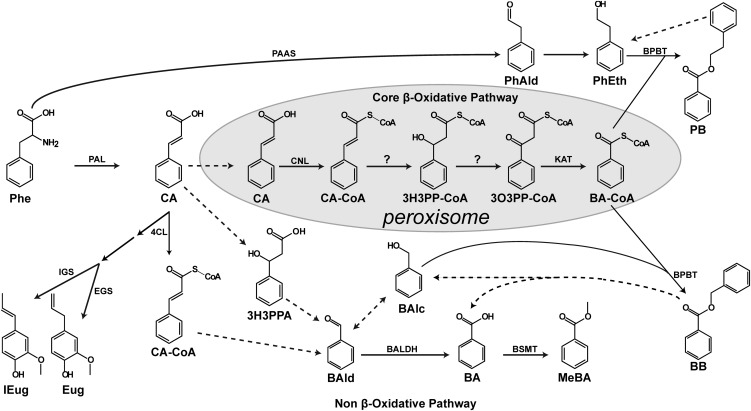
Fig. 1.
Fig. 1.
The benzoic acid biosynthetic network in plants. Solid arrows show established biochemical reactions, and dashed arrows depict possible steps not yet identified. Stacked arrows show the involvement of multiple enzymatic steps. The CoA-dependent β-oxidative pathway leading to BA-CoA formation is localized in peroxisomes and shown with a gray background. The proposed routes of the non–β-oxidative pathway in cytosol are also depicted. BA-CoA, benzoyl-CoA; BAlc, benzylalcohol; BAld, benzaldehyde; BALDH, benzaldehyde dehydrogenase; BB, benzylbenzoate; BPBT, benzoyl-CoA:benzylalcohol/2-phenylethanol benzoyltransferase; BSMT, benzoic acid/salicylic acid carboxyl methyltransferase; CA, cinnamic acid; CA-CoA, cinnamoyl-CoA; 4CL, 4-coumarate-CoA ligase; Eug, eugenol; EGS, eugenol synthase; IEug, isoeugenol; IGS, isoeugenol synthase; 3H3PPA, 3-hydroxy-3-phenylpropionic acid; 3H3PP-CoA, 3-hydroxy-3-phenylpropanoyl-CoA; KAT, 3-ketoacyl-CoA thiolase; MeBA, methylbenzoate; 3O3PP-CoA, 3-oxo-3-phenylpropanoyl-CoA; PAAS, phenylacetaldehyde synthase; PEB, phenylethylbenzoate; PhAld, phenylacetaldehyde; and PhEth, 2-phenylethanol.
Fig. 2.
Fig. 2.
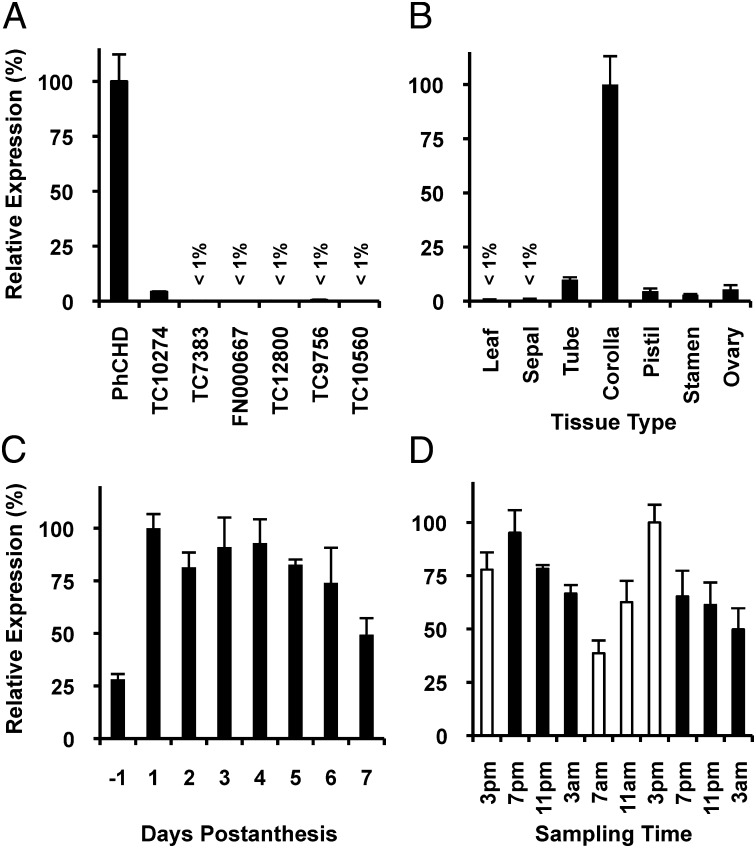
Expression profiles of PhCHD and the six other petunia MFP candidates. (A) Expression of MFP candidates in petunia corollas collected at 3:00 PM on day 2 postanthesis shown relative to the highest expressed candidate, PhCHD. (B) Tissue-specific expression of PhCHD in flowers at 3:00 PM day 2 postanthesis and leaves shown relative to transcript level in corolla. (C) Developmental PhCHD expression profile at 3:00 PM days −1 through 7 postanthesis shown relative to transcript level on day 1. (D) Rhythmic changes in PhCHD expression in corollas of flowers 3:00 PM day 1–3:00 AM day 3 postanthesis during a normal light/dark cycle shown relative to the transcript level at 3:00 PM on day 2. Black and white bars correspond to dark and light periods, respectively. All transcript levels were determined by qRT-PCR either in relation to the reference gene elongation factor 1-α (A) or as absolute amounts based on quantification from a PhCHD DNA standard (BD). All data are means ± SEM (n = 3–4 biological replicates).
Fig. 3.
Fig. 3.
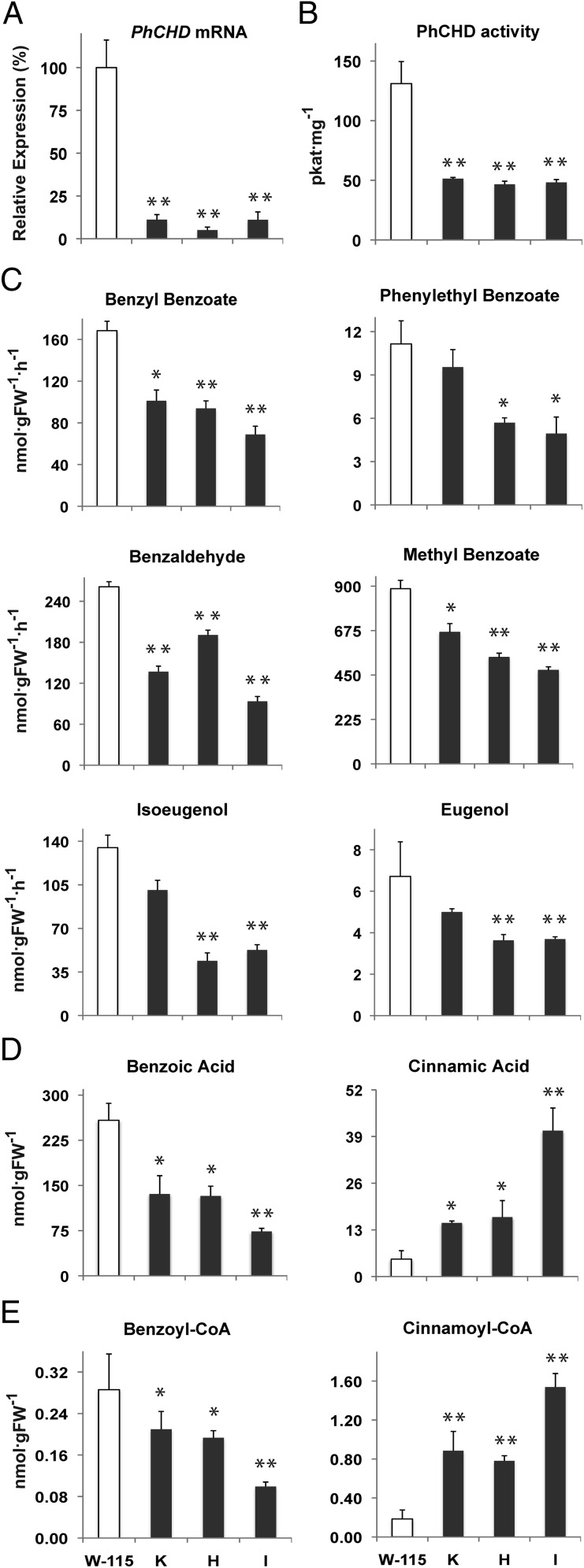
Effect of PhCHD-RNAi suppression on PhCHD expression and activity, emission of benzenoid/phenylpropanoid compounds, and internal pools of organic acids and CoA esters in corollas of petunia flowers on day 2 postanthesis. (A) PhCHD mRNA levels in tissue collected at 3:00 PM and determined by qRT-PCR. Expression values for transgenic lines are shown as a percentage of PhCHD expression in control petals set at 100%. (B) PhCHD activity in petal crude extracts at 9:00 PM. (C) Floral volatile emission measured from 4:00 to 10:00 PM. Rates are calculated hourly assuming uniform emission over 6 h. (D) Organic acid and (E) CoA-ester internal pools at 9:00 PM. All data are means ± SEM (n = 3 biological replicates). White bars represent wild-type petunia (W-115); black bars correspond to PhCHD-RNAi lines (K, H, and I). *P < 0.05 and **P < 0.01 by analysis of variance (ANOVA). FW, fresh weight.
Fig. 4.
Fig. 4.
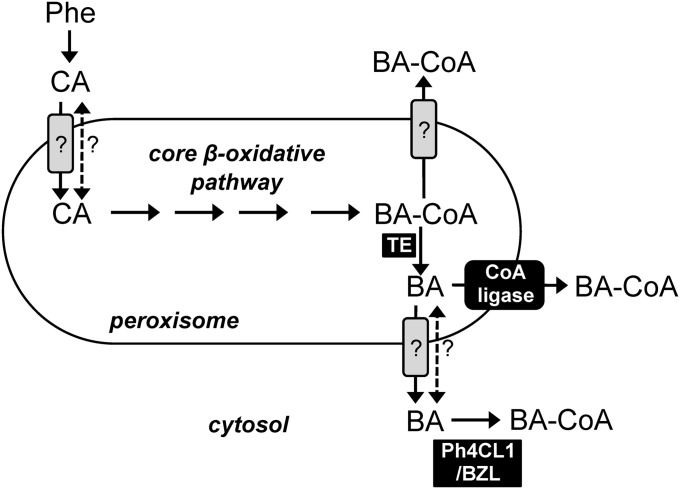
Possible routes for benzoic acid trafficking out of peroxisomes. Dashed arrow indicates hypothetical diffusion of free protonated acids. Solid arrows with gray boxes indicate putative transporter-mediated steps. Solid arrow with black box indicates a possible membrane-associated CoA ligase coupled to passage of benzoic acid across the peroxisomal membrane. BA, benzoic acid; BA-CoA, benzoyl-CoA; BZL, benzoate:CoA ligase (15); CA, cinnamic acid; Ph4CL1, petunia 4-coumarate:CoA ligase 1 (17); Phe, phenylalanine; and TE, thioesterase.

References

    1. Dudareva N, Negre F, Nagegowda DA, Orlova I. Plant volatiles: Recent advances and future perspectives. Crit Rev Plant Sci. 2006;25:417–440.
    1. Chipley J. Antimicrobials in Food. 3rd Ed. Boca Raton, FL: CRC; 2005. pp. 11–48.
    1. Quan C, Mok WM, Wang GK. Use-dependent inhibition of Na+ currents by benzocaine homologs. Biophys J. 1996;70:194–201. - PMC - PubMed
    1. Saïdana D, et al. Studies of the essential oil composition, antibacterial and antifungal activity profiles of Frankenia laevis L. from Tunisia. J Essent Oil Res. 2010;22:349–353.
    1. Veeresham C, Mamatha R, Babu CP, Srisilam K, Kokate CK. Production of taxol and its analogues from cell cultures of Taxus wallichiana. Pharm Biol. 2003;41:426–430.

Publication types

MeSH terms

LinkOut - more resources