


Associations between white matter microstructure and infants' working memory
- PMID: 22989623
- PMCID: PMC3838303
- DOI: 10.1016/j.neuroimage.2012.09.021
Associations between white matter microstructure and infants' working memory
Abstract
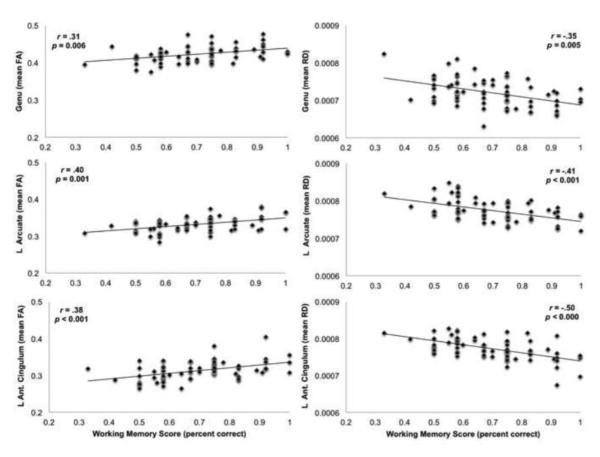
Working memory emerges in infancy and plays a privileged role in subsequent adaptive cognitive development. The neural networks important for the development of working memory during infancy remain unknown. We used diffusion tensor imaging (DTI) and deterministic fiber tracking to characterize the microstructure of white matter fiber bundles hypothesized to support working memory in 12-month-old infants (n=73). Here we show robust associations between infants' visuospatial working memory performance and microstructural characteristics of widespread white matter. Significant associations were found for white matter tracts that connect brain regions known to support working memory in older children and adults (genu, anterior and superior thalamic radiations, anterior cingulum, arcuate fasciculus, and the temporal-parietal segment). Better working memory scores were associated with higher FA and lower RD values in these selected white matter tracts. These tract-specific brain-behavior relationships accounted for a significant amount of individual variation above and beyond infants' gestational age and developmental level, as measured with the Mullen Scales of Early Learning. Working memory was not associated with global measures of brain volume, as expected, and few associations were found between working memory and control white matter tracts. To our knowledge, this study is among the first demonstrations of brain-behavior associations in infants using quantitative tractography. The ability to characterize subtle individual differences in infant brain development associated with complex cognitive functions holds promise for improving our understanding of normative development, biomarkers of risk, experience-dependent learning and neuro-cognitive periods of developmental plasticity.
Copyright © 2012 Elsevier Inc. All rights reserved.
Figures
References
-
- Baddeley A. Working memory. Science. 1992;255:556–559. - PubMed
-
- Baddeley A. Working memory: looking back and looking forward. Nat. Rev. Neurosci. 2003;4:829–839. - PubMed
-
- Beaulieu C. The basis of anisotropic water diffusion in the nervous system—A technical review. NMR Biomed. 2002;15:435–455. - PubMed
-
- Bengtsson SL, Nagy Z, Skare S, Forsman L, Forssberg H, Ullen F. Extensive piano practicing has regionally specific effects on white matter development. Nat. Neurosci. 2005;8:1148–1150. - PubMed
Publication types
MeSH terms
Grants and funding
- MH070890/MH/NIMH NIH HHS/United States
- K01 MH099411/MH/NIMH NIH HHS/United States
- HD053000/HD/NICHD NIH HHS/United States
- U54 EB005149/EB/NIBIB NIH HHS/United States
- P30-HD003110/HD/NICHD NIH HHS/United States
- T32 HD007376/HD/NICHD NIH HHS/United States
- P30 HD003110/HD/NICHD NIH HHS/United States
- T32 HD040127/HD/NICHD NIH HHS/United States
- R01 MH070890/MH/NIMH NIH HHS/United States
- U01 MH070890/MH/NIMH NIH HHS/United States
- R01 MH091645/MH/NIMH NIH HHS/United States
- 5T32HD007376/HD/NICHD NIH HHS/United States
- P50 MH064065/MH/NIMH NIH HHS/United States
- T32 NS007431/NS/NINDS NIH HHS/United States
- R01 HD053000/HD/NICHD NIH HHS/United States
- MH091645/MH/NIMH NIH HHS/United States
- MH064065/MH/NIMH NIH HHS/United States
LinkOut - more resources
Full Text Sources
Other Literature Sources
Medical
Miscellaneous
