


The genetics of dystonias
- PMID: 22989765
- PMCID: PMC4879967
- DOI: 10.1016/B978-0-12-394395-8.00002-5
The genetics of dystonias
Abstract
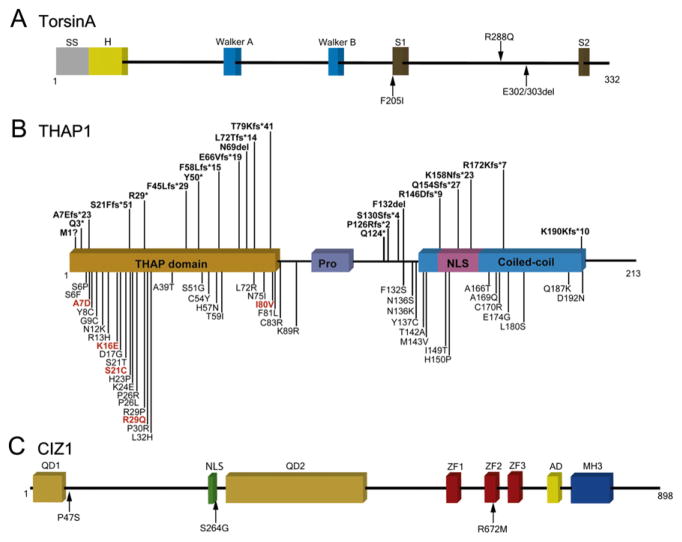
Dystonia has been defined as a syndrome of involuntary, sustained muscle contractions affecting one or more sites of the body, frequently causing twisting and repetitive movements or abnormal postures. Dystonia is also a clinical sign that can be the presenting or prominent manifestation of many neurodegenerative and neurometabolic disorders. Etiological categories include primary dystonia, secondary dystonia, heredodegenerative diseases with dystonia, and dystonia plus. Primary dystonia includes syndromes in which dystonia is the sole phenotypic manifestation with the exception that tremor can be present as well. Most primary dystonia begins in adults, and approximately 10% of probands report one or more affected family members. Many cases of childhood- and adolescent-onset dystonia are due to mutations in TOR1A and THAP1. Mutations in THAP1 and CIZ1 have been associated with sporadic and familial adult-onset dystonia. Although significant recent progress had been made in defining the genetic basis for most of the dystonia-plus and heredodegenerative diseases with dystonia, a major gap remains in understanding the genetic etiologies for most cases of adult-onset primary dystonia. Common themes in the cellular biology of dystonia include G1/S cell cycle control, monoaminergic neurotransmission, mitochondrial dysfunction, and the neuronal stress response.
Copyright © 2012 Elsevier Inc. All rights reserved.
Figures
References
-
- Alazami AM, Al-Saif A, Al-Semari A, Bohlega S, Zlitni S, Alzahrani F, Bavi P, Kaya N, Colak D, Khalak H, et al. Mutations in C2orf37, encoding a nucleolar protein, cause hypogonadism, alopecia, diabetes mellitus, mental retardation, and extrapyramidal syndrome. Am J Hum Genet. 2008;83:684–691. - PMC - PubMed
-
- Aquino D, Bizzi A, Grisoli M, Garavaglia B, Bruzzone MG, Nardocci N, Savoiardo M, Chiapparini L. Age-related iron deposition in the basal ganglia: quantitative analysis in healthy subjects. Radiology. 2009;252:165–172. - PubMed
-
- Arpa J, Cuesta A, Cruz-Martinez A, Santiago S, Sarria J, Palau F. Clinical features and genetic analysis of a Spanish family with spinocerebellar ataxia 6. Acta Neurol Scand. 1999;99:43–47. - PubMed
-
- Asmus F, Salih F, Hjermind LE, Ostergaard K, Munz M, Kuhn AA, Dupont E, Kupsch A, Gasser T. Myoclonus-dystonia due to genomic deletions in the epsilon-sarcoglycan gene. Ann Neurol. 2005;58:792–797. - PubMed
-
- Auburger G, Ratzlaff T, Lunkes A, Nelles HW, Leube B, Binkofski F, Kugel H, Heindel W, Seitz R, Benecke R, et al. A gene for autosomal dominant paroxysmal choreoathetosis/spasticity (CSE) maps to the vicinity of a potassium channel gene cluster on chromosome 1p, probably within 2 cM between D1S443 and D1S197. Genomics. 1996;31:90–94. - PubMed
Publication types
MeSH terms
Substances
Grants and funding
LinkOut - more resources
Full Text Sources
Medical
Miscellaneous
