


Lifetime of combustion-generated environmentally persistent free radicals on Zn(II)O and other transition metal oxides
- PMID: 22990982
- PMCID: PMC4303464
- DOI: 10.1039/c2em30545c
Lifetime of combustion-generated environmentally persistent free radicals on Zn(II)O and other transition metal oxides
Abstract
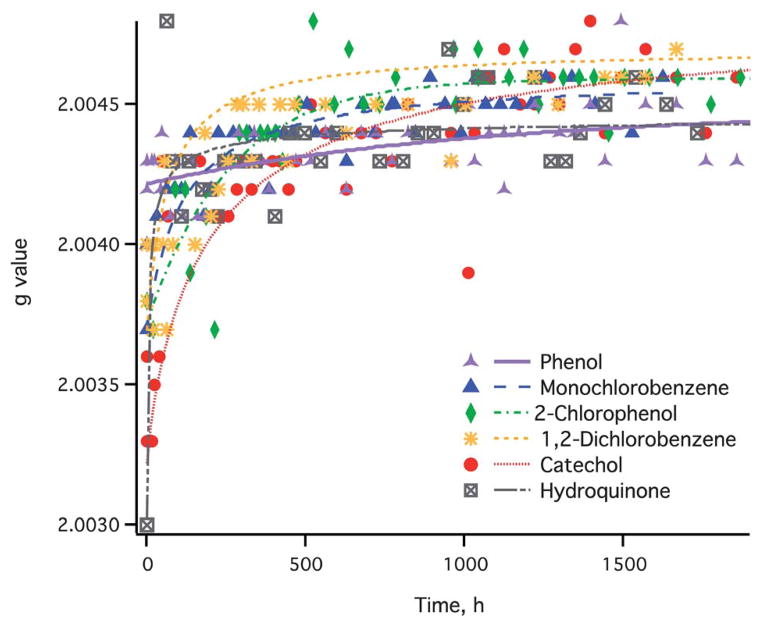
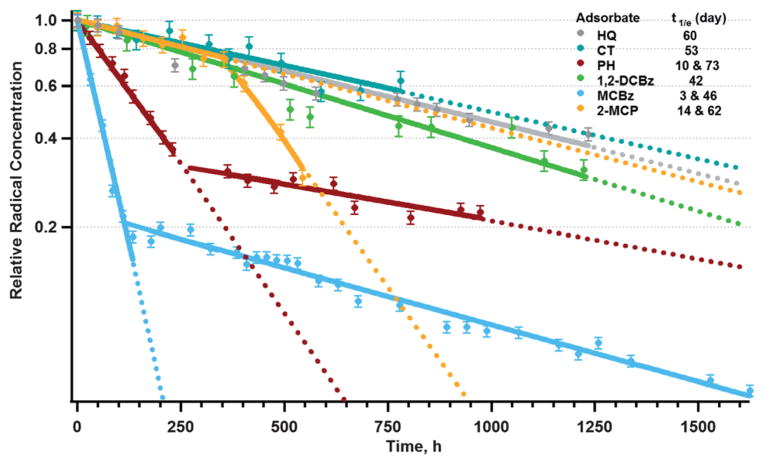
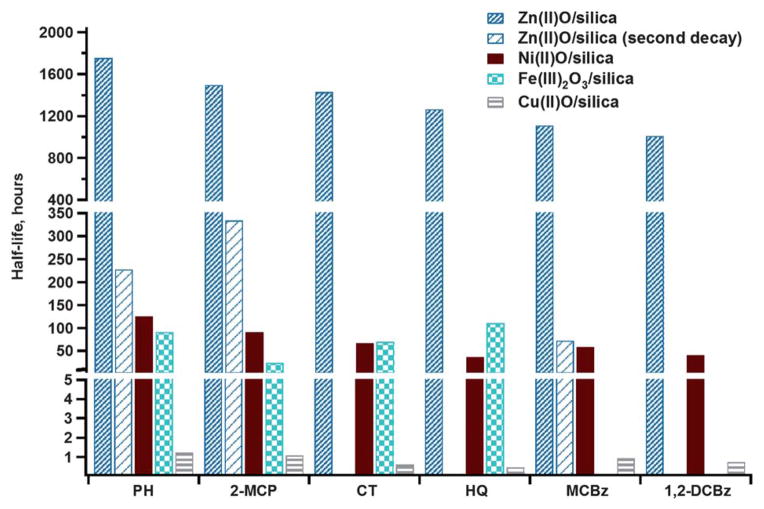
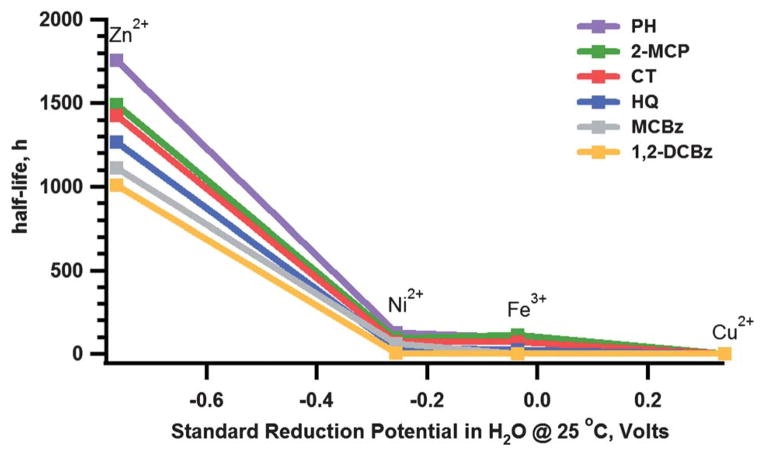
Previous studies indicated that Environmentally Persistent Free Radicals (EPFRs) are formed in the post-flame, cool zone of combustion. They result from the chemisorption of gas-phase products of incomplete combustion (particularly hydroxyl- and chlorine-substituted aromatics) on Cu(II)O, Fe(III)(2)O(3), and Ni(II)O domains of particulate matter (fly ash or soot particles). This study reports our detailed laboratory investigation on the lifetime of EPFRs on Zn(II)O/silica surface. Similarly, as in the case of other transition metals, chemisorption of the adsorbate on the Zn(II)O surface and subsequent transfer of electron from the adsorbate to the metal forms a surface-bound EPFR and a reduced metal ion center. The EPFRs are stabilized by their interaction with the metal oxide domain surface. The half-lives of EPFRs formed on Zn(II)O domains were the longest observed among the transition metal oxides studied and ranged from 3 to 73 days. These half-lives were an order of magnitude longer than those formed on nickel and iron oxides, and were 2 orders of magnitude longer compared to the EPFRs on copper oxide which have half-lives only on the order of hours. The longest-lived radicals on Zn(II)O correspond to the persistency in ambient air particles of almost a year. The half-life of EPFRs was found to correlate with the standard reduction potential of the associated metal.
Figures
References
-
- Dockery DW, Pope CA, Xu X, Spengler JD, Ware JH, Fay ME, Ferris BG, Speizer FE. N Engl J Med. 1993;329:1753–1759. - PubMed
-
- Struis RPWJ, Ludwig C, Lutz H, Scheidegger AM. Environ Sci Technol. 2004;38:3760–3767. - PubMed
-
- Gao Y, Nelson ED, Field MP, Ding Q, Li H, Sherrell RM, Gigliotti CL, Van Ry DA, Glenn TR, Eisenreich SJ. Atmos Environ. 2002;36:1077–1086.
-
- Chandler AJ, Eighmy TT, Hartlen J, Hjelmar O, Kosson DS, Sawell SE, Van der Sloot HA, Vehlow J. The International Ash Working Group (IAWG) Elsevier Science B.V; Amsterdam: 1997.
Publication types
MeSH terms
Substances
Grants and funding
LinkOut - more resources
Full Text Sources
Research Materials
Miscellaneous
