Review
. 2012 Oct;13(10):646-58.
doi: 10.1038/nrm3432. Epub 2012 Sep 20.

Assembly of allosteric macromolecular switches: lessons from PKA

Affiliations
Review

Assembly of allosteric macromolecular switches: lessons from PKA

Susan S Taylor et al. Nat Rev Mol Cell Biol. 2012 Oct.

Abstract

Protein kinases are dynamic molecular switches that have evolved to be only transiently activated. Kinase activity is embedded within a conserved kinase core, which is typically regulated by associated domains, linkers and interacting proteins. Moreover, protein kinases are often tethered to large macromolecular complexes to provide tighter spatiotemporal control. Thus, structural characterization of kinase domains alone is insufficient to explain protein kinase function and regulation in vivo. Recent progress in structural characterization of cyclic AMP-dependent protein kinase (PKA) exemplifies how our knowledge of kinase signalling has evolved by shifting the focus of structural studies from single kinase subunits to macromolecular complexes.


Conflict of interest statement

Competing interests statement

The authors declare no competing financial interests.

Figures

Figure 1
Figure 1. The catalytic subunit of PKA as a prototype for the protein kinase superfamily
a | The cyclic AMP-dependent protein kinase (PKA) catalytic core, which contains an N-lobe and a C-lobe, is shared by all eukaryotic protein kinases. b | In contrast to the conserved core, the flanking regions (that is, the amino-terminal tail (N-tail) and the carboxy-terminal tail (C-tail)) vary among protein kinases. The regulatory subunits can have a separate function (as in PKA) or be part of the kinase (as for PKG). Post-translational modifications include phosphorylation (indicated in red) and myristylation (indicated in blue). c | The sequence motifs that span the entire core are highly conserved, and the core can be segregated into 12 subdomains. d | By comparing many structures, the core hydrophobic spine architecture that is shared by all eukaryotic protein kinases can be defined. The regulatory spine (R-spine) is typically dynamically assembled following phosphorylation of the activation loop, whereas the catalytic spine (C-spine) is completed by the adenine ring of bound ATP. Both spines are anchored to the unusual hydrophobic αF-helix. e | In the C-tails of AGC kinases, which include PKA, PKC, PKG, AKT, S6 kinase (S6K) and p90 ribosomal protein S6K (RSK), there are at least three highly conserved motifs: Pro-x-x-Pro (PXXP) in the C-lobe tether, Phe-Asp-Asp-Tyr (FDDY) in the active site tether and Phe-x-x-Phe (FxxF) in the N-lobe tether. This region contains numerous motifs that contribute to catalysis and to interactions with other proteins such as SMAD3 (wich interacts with AKT), SRC (which associates via its SRC homology 3 (SH3) domain with AKT), heat shock protein 90 (HSP90; which interacts via its SH3 domain with PKC) and the prolyl isomerase PIN1 (which binds to PKC). The C-tail thus serves as a cis-regulatory element that is essential for the activity of every AGC kinase and also as a trans-regulatory element that allows communication with other proteins. The C-tail is highly regulated by phosphorylation. The activation segment contains an essential phosphorylation site (Thr197) that is conserved in most kinases. f | The N-tail is unique to PKA and also serves multiple functions. This flanking region undergoes post-translational modifications that include myristylation, phosphorylation and deamidation. Like the C-tail, it wraps around both the C-lobe and the N-lobe and is essential for activity. The myristyl moiety becomes mobilized in the type II holoenzymes and serves as a membrane anchor (not shown). The N-tail also contributes to localization and trafficking through its interactions with a novel A kinase interacting protein 1 (AKIP1). CDK2, cyclin-dependent kinase 2; CNB, cyclic nucleotide-binding domains; D/D, dimerization and docking domain; EGFR, epidermal growth factor receptor.
Figure 2
Figure 2. Assembly of full length tetrameric holoenzymes is isoform specific and involves ordering of the intrinsically disordered linker
a | The organization of the RIα and RIIβ regulatory subunits and the sequence of the linker regions for all four isoforms are shown. The amino terminus contains a dimerization and docking domain (D/D domain). In the absence of a catalytic subunit, the linker is disordered. The inhibitor site is embedded in the middle of the linker, followed by two cyclic nucleotide-binding domains (termed CNBA and CNBB). b | Following binding to the catalytic subunit, the inhibitor site docks to the active site cleft of the catalytic subunit (indicated by a red box) and the carboxy-terminal segment of the linker (C-linker) becomes ordered. The remaining portion of the linker (N-linker) has an important role in defining the quaternary structure of each holoenzyme. The linker becomes ordered differently in RIα and RIβ following their binding to the catalytic subunit. The binding of the inhibitor site and the C-linker is conserved, whereas the N-linker is positioned differently and contributes in unique ways to the organization of each tetrameric holoenzyme.
Figure 3
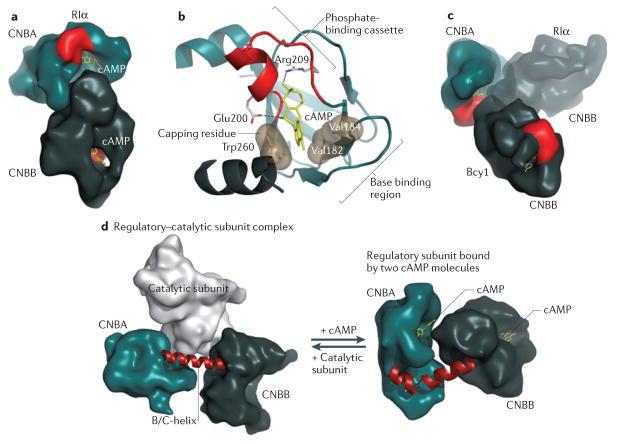
Figure 3. Molecular basis for regulation of PKA by cAMP
The cyclic nucleotide-binding domains (CNB domains) of cyclic AMP-dependent protein kinase (PKA), which are conserved throughout all species, are defined by a unique fold. a | The two CNB domains (CNBA and CNBB) in RIα in the cAMP-bound state create an extensive network of allosteric communication. b | The conserved features of each CNB domain are summarized. The phosphate-binding cassette (PBC), shown in red, is the signature motif of the CNB domain. The adenine ring of bound cAMP is capped by a hydrophobic residue from within the CNB domain or from associated domains or motifs. The base-binding region stabilizes the adenine ring by binding on the other side of cAMP. c | Although each CNB domain is highly conserved, the two domains of RIα and Bcy1 (the yeast homologue of RIα) are oriented in distinctly different ways. The overlay of the two structures is shown. d | The remarkable malleability of the regulatory subunit was first recognized when the structure of a regulatory–catalytic subunit complex was solved. On the left is the conformation of the CNB domains (amino acids 91–379 of the regulatory subunit) in the holoenzyme complex, and on the right are the CNB domains bound to two molecules of cAMP. The conformational change is mediated by the B/C-helix in CNBA, which is kinked in the cAMP-bound state and extended into a single long helix in the holoenzyme.
Figure 4
Figure 4. Assembly of tetrameric holoenzymes
Here we show how complexity is built up from regulatory–catalytic subunit heterodimers to tetrameric holoenzymes. The strategic positioning of the linker is shown in red. ac | The solved structure of RIα regulatory–catalytic subunit heterodimer showed for the first time how the catalytic subunit was inhibited and how the complex was activated by cyclic AMP,. The complex of the catalytic subunit bound to the RIα regulatory subunit defines the conformational flexibility of the two cyclic nucleotide-binding domains (CNB domains; termed CNBA and CNBB) that are located within the RIα subunit. By extending the amino-terminal segment of the linker (N-linker) it was possible to get a first glimpse of a tetrameric holoenzyme (c). d | The structure of the complex shown in (b) was used to model the full-length tetrameric holoenzyme on the basis of small angle X ray scattering (SAXS) and small angle neutron scattering (SANS) analyses as well as on the basis of previous cyclic AMP-dependent protein kinase (PKA) crystal structures. The model was validated by mutagenesis. Rotation of the model allows one to appreciate for the first time the twofold axis of symmetry that is created by the interaction of the two regulatory–catalytic subunit heterodimers. e | A cartoon of the tetramer structure shown in (d) highlights how the N-linker from one heterodimer is positioned in close proximity to the CNBA domain of the opposite dimer.
Figure 5
Figure 5. Specific motifs define isoform-specific interfaces between heterodimers
a | The conformation of the regulatory–catalytic subunit heterodimer (RIα is shown here) is similar in all isoforms, but each heterodimer assembles into distinctive quaternary structures. The structure is shown on the left and the model on the right. Two motifs, in addition to the amino-terminal linker (N-linker) motif (red) are exposed to solvent in the regulatory–catalytic subunit heterodimers, but have important isoform-specific roles in the assembly of each tetramer. The β4–β5 loop (purple) is located within the cyclic nucleotide-binding A domain (CNBA domain) of the regulatory subunits. The Phe-Asp-Asp-Tyr (FDDY) motif (yellow) resides in the carboxy-terminal tail (C-tail) of the catalytic subunit and is an integral part of the ATP-binding site. bd | The quaternary structures of RIα-, RIβ- and RIIβ-containing cyclic AMP-dependent protein kinase (PKA) holoenzymes, shown on the top, highlighting the differences in the overall architecture of each tetramer and also indicating the differences in the positioning of the dimerization and docking domain (D/D domain; shown by arrows and visualized only in RIβ (c; in brown)). The linkers are shown in red. The twofold axis of symmetry is also indicated on the lower panels. In each lower panel, rotation allows one to appreciate the twofold symmetry that is found in each tetramer and also how the two motifs, the β4–β5 loops and the FDDY motifs, contribute in novel ways to the assembly of the tetramer.
Figure 6
Figure 6. PKA is anchored to scaffolds that assemble macromolecular complexes and define foci for PKA signalling
a | Cardiomyocytes are used as an example to illustrate how cyclic AMP-dependent protein kinase (PKA) can regulate different functions in a cell. PKA signalling is mediated by complexes with different subcellular localizations. Targeting and assembly of these PKA-containing complexes is mediated by A kinase anchoring proteins (AKAPs). Most AKAPs are specific for the RII regulatory subunit (blue ovals), a few have dual specificity and can bind to either RI or RII (yellow oval and dashed R subunits) and a few, such as SKIP (which functions as an AKAP), are RI regulatory subunit-specific (red oval). By binding to different regulatory subunits, AKAPs assemble complexes that regulate diverse functions. For example, in cardiomyocytes, different PKA-containing complexes can regulate Ca2+ uptake by regulating the activity of L-type Ca2+ channels located at the plasma membrane, promote the storage of Ca2+ in the sarcoplasmic reticulum by activating Ca2+ uptake pumps or its release by activating Ca2+-release channels (which are coupled to the junction–triadin–calsequestrin complex that binds Ca2+). PKA-containing complexes can also regulate cardiomyocyte contraction when localized to the cytoskeleton, where these enzyme regulate mitochondrial activity necessary for contraction. b | Assembly of PKA at the voltage gated Ca2+ channel 1.2 (CaV1.2) is mediated by AKAP5 (also known as AKAP79 in humans or AKAP150 in mice), which interacts with the plasma membrane and brings PKA in close proximity to the tail of the channel (shown in red) that harbours a target phosphorylation site and calcineurin (CaN). PKA phosphorylates and activates the channel. After that, Ca2+ enters the cell and binds to CaN and anchored calmodulin (CaM). CaN is activated in two ways by Ca2+: by binding to the calmodulin-like B-subunit of CaN and to a separate Ca2+-bound CaM. Activated CaN can then dephosphorylate the channel, decreasing its activity. Furthermore CaN dephosphorylates the RIIβ regulatory subunit of PKA, promoting its binding to the catalytic subunit and inactivation of PKA. Dephosphorylation can also be accomplished by the phosphatase PP2A, which binds directly to the channel. Targeting of the PKA holoenzyme is mediated by an amphipathic helix in the AKAP, referred to as the A kinase-binding (AKB) motif that binds with high affinity to the dimerization and docking domain (D/D domain) of RII regulatory subunits.

References

    1. Krebs EG, Graves DJ, Fischer EH. Factors affecting the activity of muscle phosphorylase B kinase. J Biol Chem. 1959;234:2867–2873. - PubMed
    1. Shoji S, et al. Complete amino acid sequence of the catalytic subunit of bovine cardiac-muscle cyclic AMP-dependent protein-kinase. Proc Natl Acad Sci USA. 1981;78:848–851. - PMC - PubMed
    1. Barker WC, Dayhoff MO. Viral src gene products are related to the catalytic chain of mammalian cAMP-dependent protein kinase. Proc Natl Acad Sci USA. 1982;79:2836–2839. - PMC - PubMed
    1. Kannan N, et al. Evolution of allostery in the cyclic nucleotide binding module. Genome Biol. 2007;8:R264. - PMC - PubMed
    1. Pidoux G, Tasken K. Specificity and spatial dynamics of protein kinase A signaling organized by A-kinase-anchoring proteins. J Mol Endocrinol. 2010;44:271–284. - PubMed

Publication types

MeSH terms