


Lung collapse in the diving sea lion: hold the nitrogen and save the oxygen
- PMID: 22993241
- PMCID: PMC3497143
- DOI: 10.1098/rsbl.2012.0743
Lung collapse in the diving sea lion: hold the nitrogen and save the oxygen
Abstract
Lung collapse is considered the primary mechanism that limits nitrogen absorption and decreases the risk of decompression sickness in deep-diving marine mammals. Continuous arterial partial pressure of oxygen profiles in a free-diving female California sea lion (Zalophus californianus) revealed that (i) depth of lung collapse was near 225 m as evidenced by abrupt changes in during descent and ascent, (ii) depth of lung collapse was positively related to maximum dive depth, suggesting that the sea lion increased inhaled air volume in deeper dives and (iii) lung collapse at depth preserved a pulmonary oxygen reservoir that supplemented blood oxygen during ascent so that mean end-of-dive arterial was 74 ± 17 mmHg (greater than 85% haemoglobin saturation). Such information is critical to the understanding and the modelling of both nitrogen and oxygen transport in diving marine mammals.
Figures
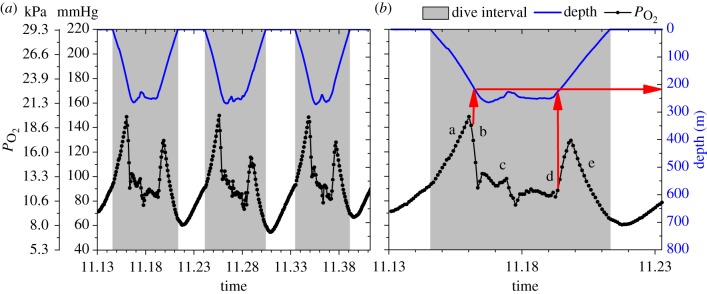
 (black line, 5 s sampling interval) and depth profiles (blue line, 1 s sampling interval) from serial deep dives of a California sea lion. (a) Characteristic
  profiles of serial deep dives. (b) Typical abrupt changes in
  occur in this dive at approximately 200 m depth during descent and ascent (indicated with red arrows), consistent with significant cessation of gas exchange at depth. Profiles were characterized by a, an initial compression hyperoxia; b, an abrupt decline at approximately 200 m depth; c, a gradual decline in
  in the bottom segment of the dive; d, a rapid increase in
  during early ascent; e, a decline in
  during ascent.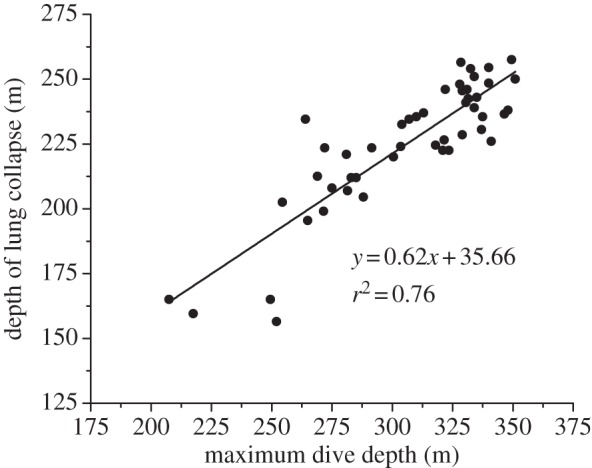
References
-
- Scholander P. F. 1940. Experimental investigations on the respiratory function in diving mammals and birds. Hvalrådets Skrifter 22, 1–131
-
- Kooyman G. L., Hammond D. D., Schroeder J. P. 1970. Bronchograms and tracheograms of seals under pressure. Science 169, 82–84 10.1126/science.169.3940.82 (doi:10.1126/science.169.3940.82) - DOI - PubMed
-
- Kooyman G. L., Schroeder J. P., Denison D. M., Hammond D. D., Wright J. J., Bergman W. P. 1972. Blood nitrogen tensions of seals during simulated deep dives. Am. J. Physiol. 223, 1016–1020 - PubMed
-
- Kooyman G. L., Sinnett E. E. 1982. Pulmonary shunts in harbor seals and sea lions during simulated dives to depth. Physiol. Zool. 55, 105–111 10.2307/30158447 (doi:10.2307/30158447) - DOI
-
- Ridgway S. H., Howard R. 1979. Dolphin lung collapse and intramuscular circulation during free diving: evidence from nitrogen washout. Science 206, 1182–1183 10.1126/science.505001 (doi:10.1126/science.505001) - DOI - PubMed
Publication types
MeSH terms
Substances
LinkOut - more resources
Full Text Sources
Medical
