


Patterns of electronic cigarette use and user beliefs about their safety and benefits: an internet survey
- PMID: 22994631
- PMCID: PMC3530631
- DOI: 10.1111/j.1465-3362.2012.00512.x
Patterns of electronic cigarette use and user beliefs about their safety and benefits: an internet survey
Abstract
Introduction and aims: As the popularity of electronic cigarettes (e-cigarettes) increases, it is becoming important to find out more about the characteristics of e-cigarette users, why and how they use the product and whether e-cigarettes are used exclusively or in combination with conventional cigarettes. The objective of this study was to investigate patterns and effects of e-cigarette use and user beliefs about e-cigarette safety and benefits.
Design and methods: E-cigarette users in Poland were recruited online and asked to participate in a web-based survey. The participants provided information on their smoking history, patterns of e-cigarette use, beliefs and attitudes regarding the product and information on concurrent use of conventional cigarettes.
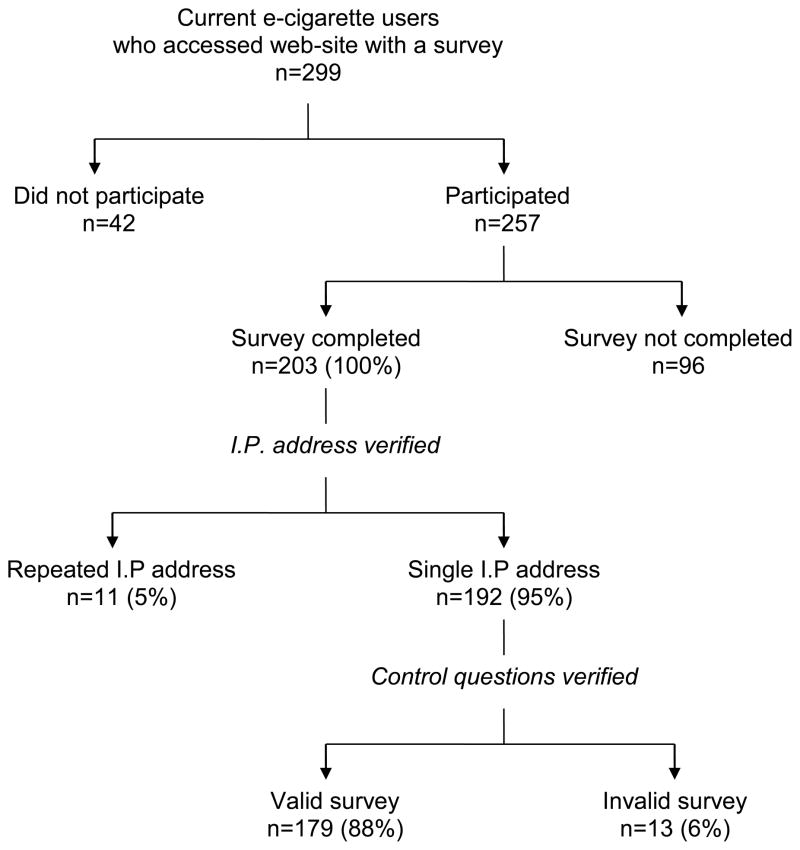
Results: The survey was completed by 179 e-cigarette users. Almost all participants used e-cigarettes daily. E-cigarettes were primarily used to quit smoking or to reduce the harm associated with smoking (both 41%), and were successful in helping the surveyed users to achieve these goals with 66% not smoking conventional cigarettes at all and 25% smoking under five cigarettes a day. Most participants (82%) did not think that e-cigarettes were completely safe, but thought that they were less dangerous than conventional cigarettes. Sixty percent believed that e-cigarettes were addictive, but less so than conventional cigarettes.
Discussion and conclusions: The participants primarily used e-cigarettes as a stop-smoking aid or as an alternative to conventional cigarettes, and the majority reported that they successfully stopped smoking. More data on e-cigarette safety and its efficacy in harm-reduction and smoking cessation are needed.
© 2012 Australasian Professional Society on Alcohol and other Drugs.
Conflict of interest statement
Figures
References
-
- Etter L. Controversy swirls around e-cigarettes. [accessed May 2011];The Wall Street Journal. 2009 Jun 2; Available at: http://online.wsj.com/article/SB124390176699074609.html.
-
- Rafter D. Smokin’ hot. [accessed May 2011];Specialty Retail Report. 2008 Fall; Available at: http://www.specialtyretail.com/2008/fall/retailer_profiles/smoking_hot_c....
-
- Yamin CK, Bitton A, Bates DW. E-cigarettes: A rapidly growing Internet phenomenon. Ann Intern Med. 2010;153:607–9. - PubMed
Publication types
MeSH terms
Grants and funding
LinkOut - more resources
Full Text Sources
Medical
Research Materials
