. 2012 Oct 16;51(41):8293-306.
doi: 10.1021/bi3009278. Epub 2012 Oct 2.

Identification and characterization of small molecule inhibitors of a plant homeodomain finger

Affiliations

Identification and characterization of small molecule inhibitors of a plant homeodomain finger

Elise K Wagner et al. Biochemistry. .

Abstract

A number of histone-binding domains are implicated in cancer through improper binding of chromatin. In a clinically reported case of acute myeloid leukemia (AML), a genetic fusion protein between nucleoporin 98 and the third plant homeodomain (PHD) finger of JARID1A drives an oncogenic transcriptional program that is dependent on histone binding by the PHD finger. By exploiting the requirement for chromatin binding in oncogenesis, therapeutics targeting histone readers may represent a new paradigm in drug development. In this study, we developed a novel small molecule screening strategy that utilizes HaloTag technology to identify several small molecules that disrupt binding of the JARID1A PHD finger to histone peptides. Small molecule inhibitors were validated biochemically through affinity pull downs, fluorescence polarization, and histone reader specificity studies. One compound was modified through medicinal chemistry to improve its potency while retaining histone reader selectivity. Molecular modeling and site-directed mutagenesis of JARID1A PHD3 provided insights into the biochemical basis of competitive inhibition.


Figures
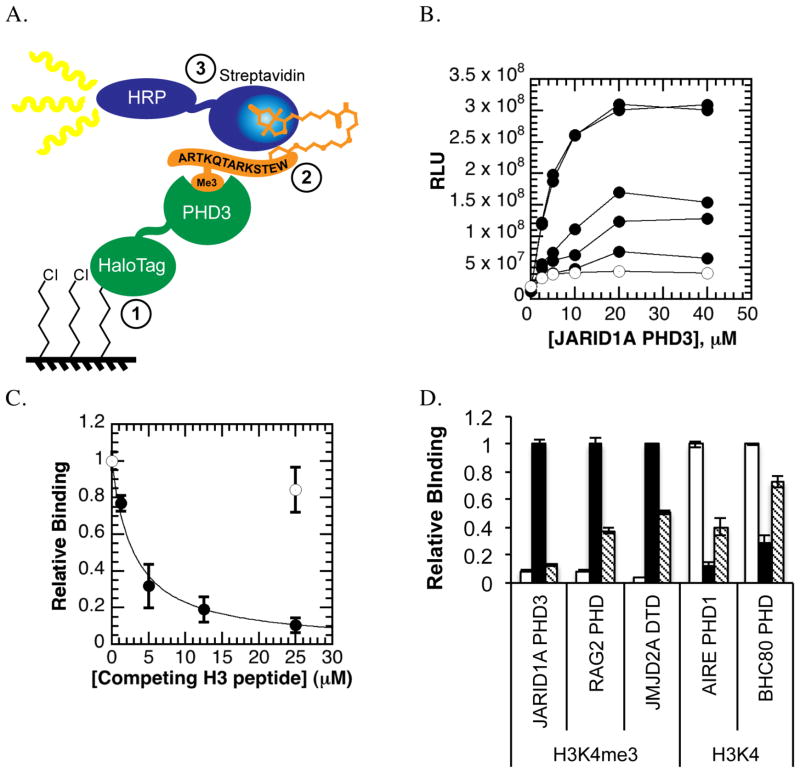
Figure 1
Figure 1. HaloTag assay design and optimization
A. HaloTag assay design. First, a HaloTag fusion to JARID1A PHD3 is covalently immobilized to the surface of a chloroalkane-coated 96-well plate. Second, biotinylated histone H3 peptides (+/− trimethylation at lysine 4) are allowed to bind the immobilized PHD finger. Finally, peptide binding is detected through a streptavidin conjugate to horseradish peroxidase (HRP) that binds biotinylated peptides and emits light when chemiluminescent substrate is added. B. Initial concentration matrix. Increasing amounts of biotinylated histone H3K4me3 peptides (0.1, 0.5, 1, 10, 15 μM, circles; 15 μM unmethylated biotinylated H3 peptide, open circles) were allowed to bind increasing concentrations of (HQ)5-HaloTag-JARID1A PHD3 (0 to 40 μM). C. Peptide displacement. Unlabeled (no biotin) H3K4me3 peptide (circles) specifically competed away binding of biotinylated H3K4me3 peptides, while a high concentration of unmethylated H3K4 peptide (open circle) did not significantly affect binding signal. D. Other histone-binding modules within the HaloTag assay. RAG2 PHD, AIRE PHD1, BHC80 PHD, and JMJD2A double tudor domain distinguish the methylation status H3K4 by binding their preferred ligand within the HaloTag assay. Peptide binding can be specifically inhibited via peptide competition (H3K4-unmodified peptide, white; H3K4me3, black; peptide competition, grey).
Figure 2
Figure 2. Primary Screening against JARID1A PHD3 with a clinical drug library
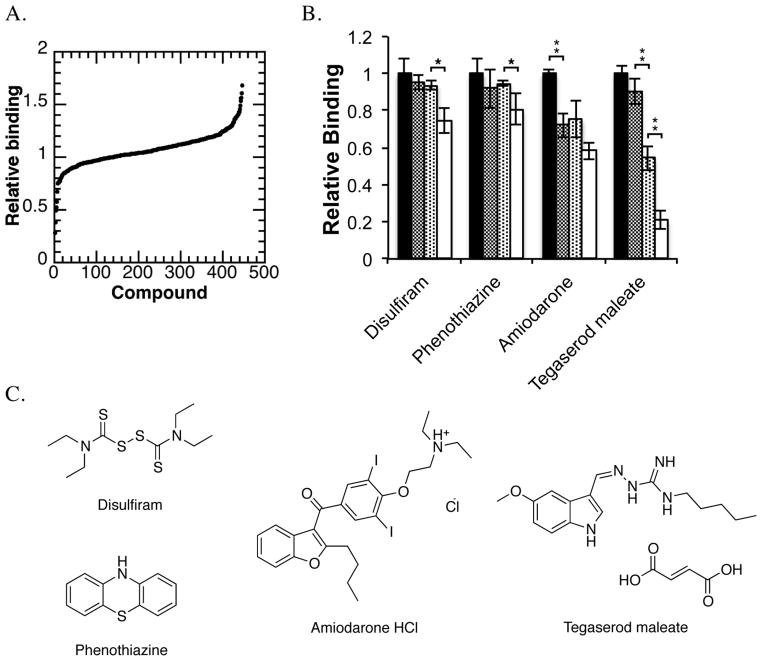
A. Primary screen sorted by relative binding. Compounds within the NIH Clinical Collection were screened at 200 μM against JARID1A PHD3 using the HaloTag assay. B. HaloTag assay concentration dependence. Increasing concentrations of selected compounds (0, 50, 100, 200 μM) were added to the HaloTag binding assay. Within this assay, tegaserod maleate, amiodarone HCl, phenothiazine, and disulfiram had a significant effect (*p<0.05, **p<0.01) on JARID1A PHD3 binding to H3K4me3 peptides C. Disulfiram, tegaserod maleate, amiodarone HCl, and phenothiazine were the only compounds identified from small molecule screening that significantly inhibited JARID1A PHD3 binding of H3K4me3 peptide within the HaloTag assay.
Figure 3
Figure 3. Dose dependence studies of hit compounds against JARID1A PHD3
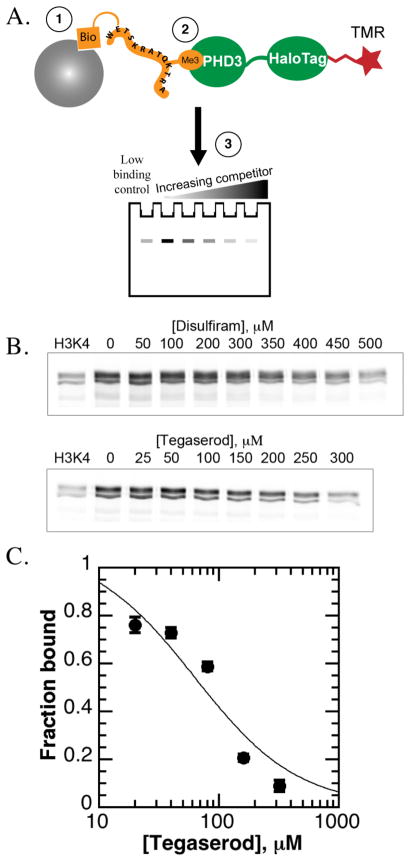
A. Affinity pull down design. Increasing concentrations of compound were added to a solution of TMR-labeled (HQ)5-HaloTag-JARID1A PHD3 binding to biotinylated histone peptides immobilized to streptavidin-agarose beads. B. Disulfiram and tegaserod maleate only cause concentration-dependent loss of binding of JARID1A PHD3 to H3K4me3 peptides within the affinity pull down assay (representative data). C. Tegaserod maleate only caused concentration-dependent losses in histone peptide binding within the fluorescence polarization assay.
Figure 4
Figure 4. Evaluating compound specificity towards other histone reader domains
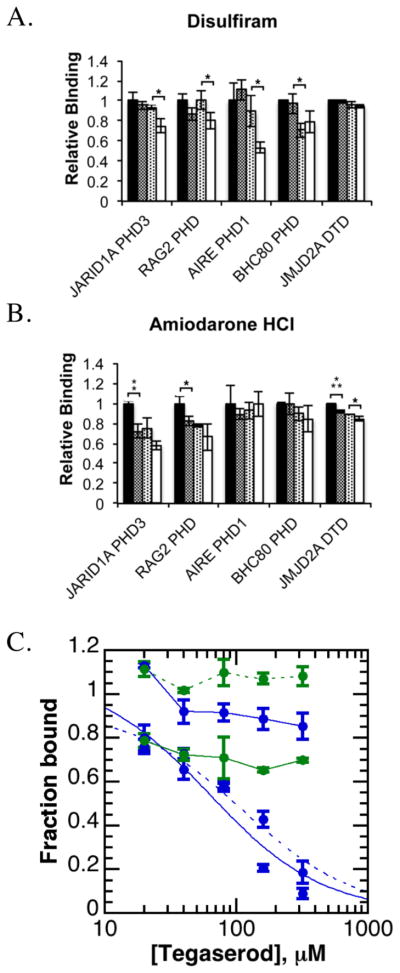
A. Disulfiram caused a concentration-dependent loss of histone peptide binding for PHD fingers in the HaloTag assay when assayed at 0, 50, 100, and 200 μM (*p<0.05). B. Amiodarone HCl caused significant (by p-value, *p<0.05, **p<0.01, ***p<0.001) reductions in histone peptide binding for only H3K4me3-binding domains in the HaloTag assay when tested at 0, 50, 100, and 200 μM. C. Tegaserod maleate inhibited JMJD2A DTD (dotted blue curve) and JARID1A PHD3 (solid blue curve) within the fluorescence polarization assay, but not RAG2 PHD (solid blue line), ING2 PHD (dotted blue line), AIRE PHD1 (solid green line), or BHC80 (dotted green line).
Figure 5
Figure 5. Disulfiram ejects structural zinc from JARID1A PHD3
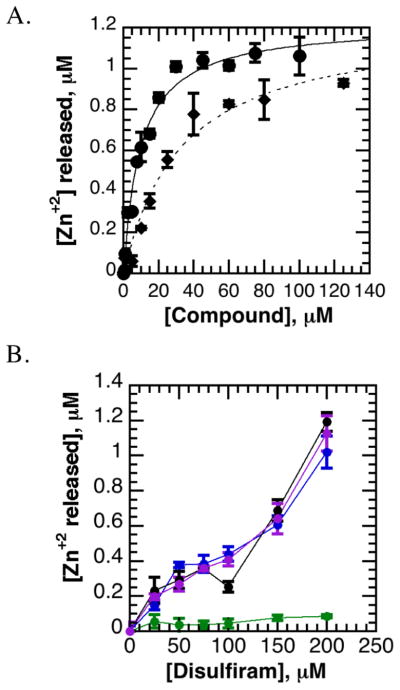
A. Disulfiram ejects zinc from JARID1A PHD3 in a dose-dependent manner. Zinc release from JARID1A PHD3 was monitored through PAR. Disulfiram (solid curve) causes zinc release at lower concentrations than methyl methanethiosulfonate (MMTS, dotted curve). B. PHD fingers are differentially sensitive to zinc ejection by disulfiram. AIRE PHD1 (black) and BHC80 PHD (purple) were similarly susceptible to zinc loss as JARID1A PHD3 (blue) within the PAR assay, while RAG2 PHD (green) was more resilient to disulfiram.
Figure 6
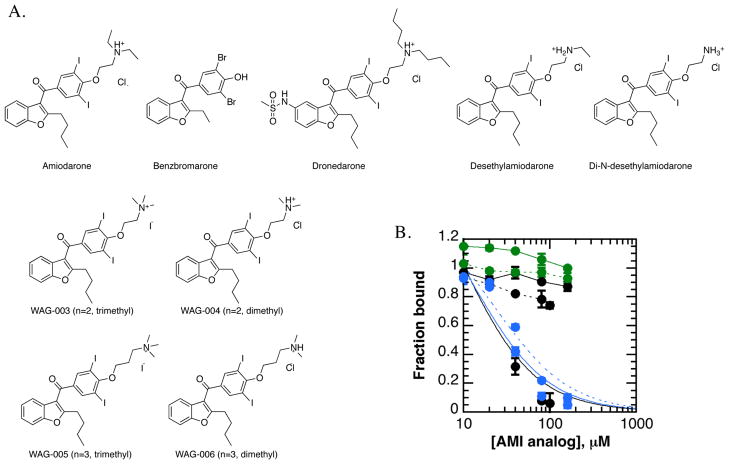
Figure 6. Analogs of amiodarone inhibit JARID1A PHD3 binding of H3K4me3 more potently than amiodarone
A. Amiodarone analogs studied included benzbromarone, dronedarone, metabolites of amiodarone, and four synthetic analogs. B. Amiodarone analogs inhibit JARID1A PHD3 more potently than amiodarone. Of the compounds assayed, the metabolite di-N-desethylamiodarone (black curve) and the synthetic trimethyl-amiodarone analogs (blue curves; n=2 solid, n=3 dotted) inhibit JARID1A PHD3 within the fluorescence polarization assay, but not amiodarone (black, solid), desethylamiodarone (black, dotted) or dimethyl-amiodarone synthetic analogs (green; n=2 solid, n=3 dotted).
Figure 7
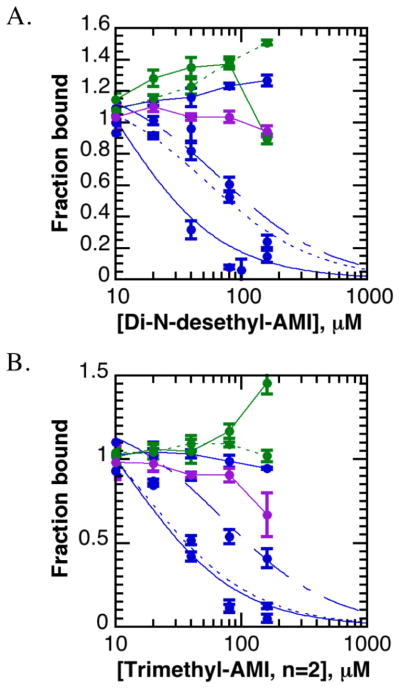
Figure 7. Amiodarone analogs are specific for trimethyl-lysine reader domains
A–B. Di-N-desethylamiodarone (A) and trimethyl-amiodarone (n=2) (B) are most potent against specific H3K4me3-reader domains. JMJD2A DTD (dotted blue curve) is similarly inhibited as JARID1A PHD3 (solid blue curve), followed by ING2 PHD (dashed blue curve). AIRE PHD1 (solid green line), BHC80 PHD (dotted green line), RAG2 PHD (solid blue line), and UHRF1 TTD (purple line) were not inhibited by these compounds.
Figure 8
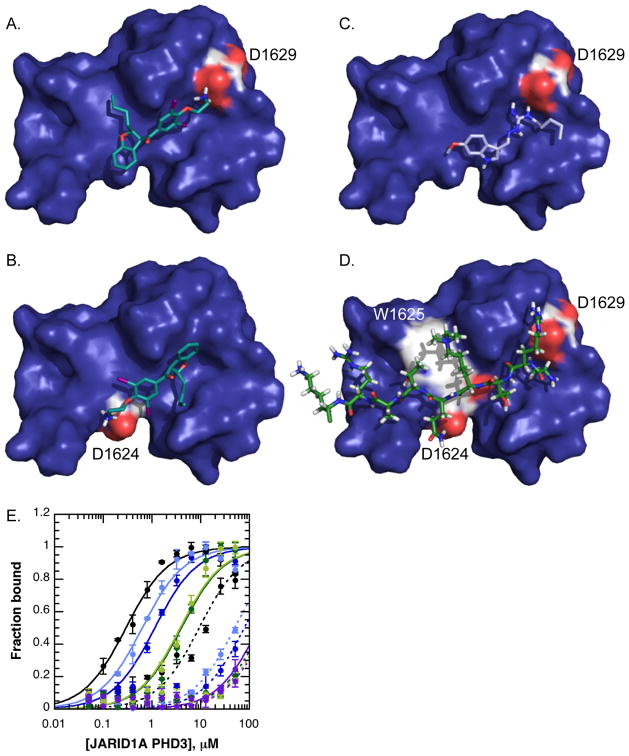
Figure 8. Molecular modeling of small molecule inhibitors reveals candidate residues important for interactions with JARID1A PHD3
A–B. Di-N-desethylamiodarone docked favorably to two positions on JARID1A PHD3, where the amine interacts with either D1629 (A) or D1624 (B). C. Tegaserod docked almost exclusively to this position, where the dibiguanidine group is coordinated in part by D1629. D. H3K4me3 peptide binding in relation to D1624 and D1629 reveals probable hydrogen bonds (D1624) and ionic bonds (D1629) between JARID1A PHD3 and histone H3. E. Affinity binding curves with WT, D1624, and D1629 mutants reveals defects in histone peptide binding via fluorescence polarization, consistent with structural predictions. WT JARID1A PHD3 is in black, D1624A in dark blue, D1624N in light blue, D1629A in dark green, D1629N in light green, and W1625A in purple. Binding of H3K4me3 peptide is shown by solid lines, and H3K4-unmethylated in dashed lines.
Figure 9
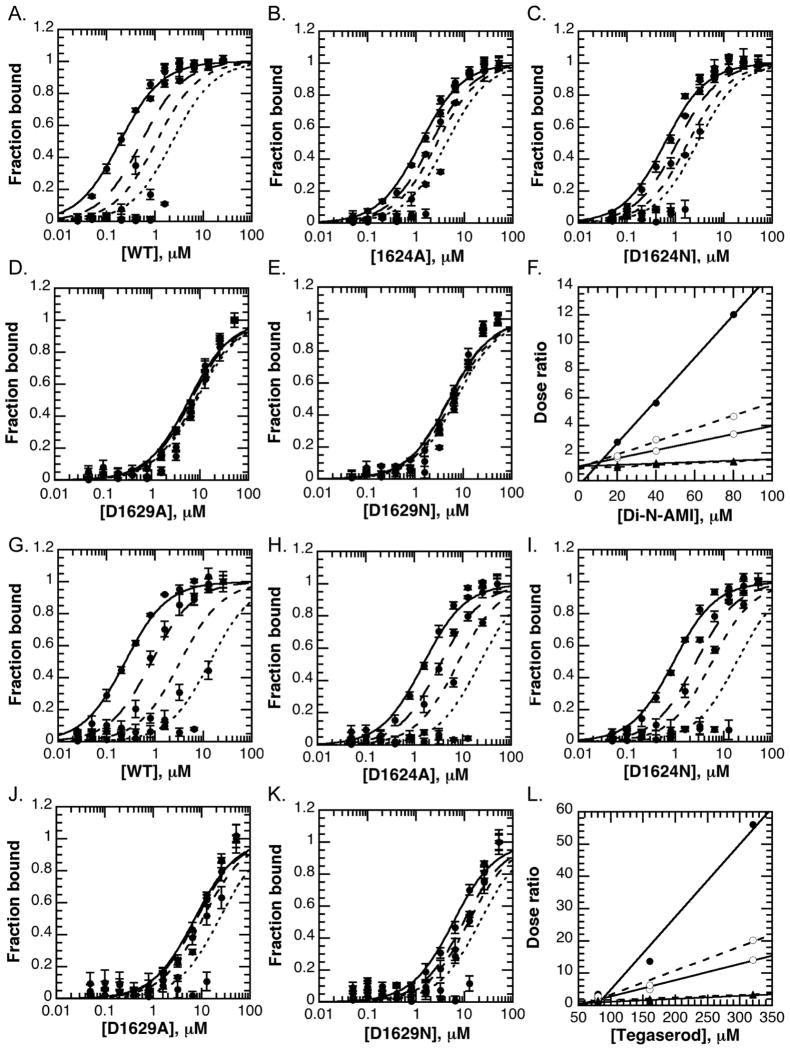
Figure 9. Analysis of JARID1A PHD3 mutants reveals that D1629 provides a major contribution to di-N-desethylamiodarone and tegaserod binding JARID1A PHD3
A.–E. Di-N-desethylamiodarone induces a dose response for D1624, but not D1629 mutants. Increasing concentrations of GST-JARID1A PHD3 clones were titrated against solutions containing fixed concentrations of di-N-desethylamiodarone (0, 20, 40, 80 μM; solid to finer dashed curves with increasing inhibitor). Shifts in apparent Kd are observed for WT and D1624 mutants, but not D1629 mutants. F. Dose ratio analysis for di-N-desethylamiodarone suggests that D1629 contributes to the interaction between di-N-desethylamiodarone and JARID1A PHD3, much more so than D1624. G.–K. Tegaserod induces a dose response for D1624, but not D1629 mutants. Increasing concentrations of GST-JARID1A PHD3 clones were titrated against solutions containing fixed concentrations of tegaserod maleate (0, 80, 160, 320 μM; solid to finer dashed curves with increasing inhibitor). Shifts in apparent Kd are observed for WT and D1624 mutants, but not D1629 mutants. L. Dose ratio analysis for tegaserod suggests that D1629 plays a major contribution to tegaserod maleate binding JARID1A PHD3, and less so D1624.
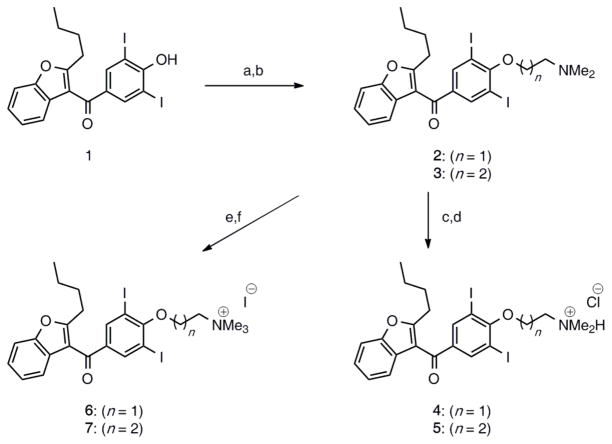
Scheme 1
Scheme 1. Synthesis of amiodarone analogs
Synthesis of amiodarone derivatives 4–7. Reagents and conditions: (a) 1, K2CO3, toluene/H2O (2:1), 60 °C, then 2-chloro-N,N-dimethylethanamine hydrochloride, reflux 22 h, 66% (n = 1); (b) 1, K2CO3, toluene/H2O (2:1), 60 °C, then 3-chloro-N,N-dimethylpropan-1-amine hydrochloride, reflux 17 h, 92% (n = 2); (c) 2, conc. HCl, toluene, rt, 1 h, 63%; (d) 3, conc. HCl, toluene, rt, 1 h, 50%; (e) 2, MeI, CH2Cl2, rt, 17 h, 76%; (f) 3, MeI, CH2Cl2, rt, 2 h, 81%.

References

    1. Felsenfeld G, Groudine M. Controlling the double helix. Nature. 2003;421:448–453. - PubMed
    1. Jenuwein T. Translating the Histone Code. Science. 2001;293:1074–1080. - PubMed
    1. Kouzarides T. Chromatin Modifications and Their Function. Cell. 2007;128:693–705. - PubMed
    1. Sanchez R, Zhou MM. The PHD finger: a versatile epigenome reader. Trends Biochem Sci. 2011;36:364–372. - PMC - PubMed
    1. Peña PV, Davrazou F, Shi X, Walter KL, Verkhusha VV, Gozani O, Zhao R, Kutateladze TG. Molecular mechanism of histone H3K4me3 recognition by plant homeodomain of ING2. Nature 2006 - PMC - PubMed

Publication types

MeSH terms

LinkOut - more resources