


The impact of frailty status on survival after transcatheter aortic valve replacement in older adults with severe aortic stenosis: a single-center experience
- PMID: 22995885
- PMCID: PMC3717525
- DOI: 10.1016/j.jcin.2012.06.011
The impact of frailty status on survival after transcatheter aortic valve replacement in older adults with severe aortic stenosis: a single-center experience
Abstract
Objectives: This study sought to evaluate the impact of frailty in older adults undergoing transcatheter aortic valve replacement (TAVR) for symptomatic aortic stenosis.
Background: Frailty status impacts prognosis in older adults with heart disease; however, the impact of frailty on prognosis after TAVR is unknown.
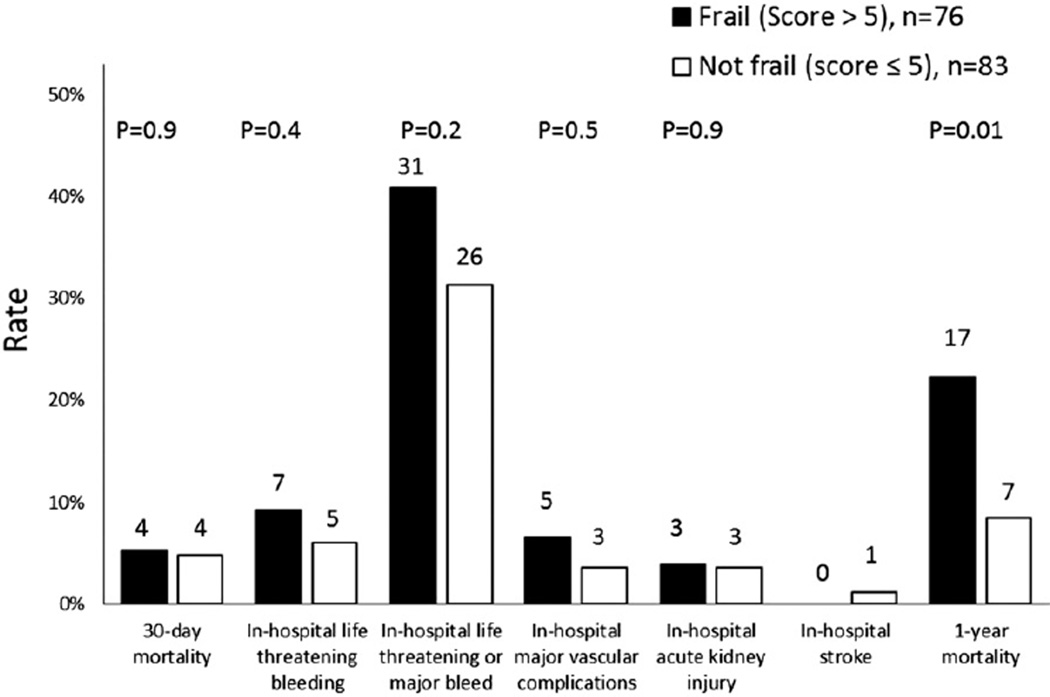
Methods: Gait speed, grip strength, serum albumin, and activities of daily living status were collected at baseline and used to derive a frailty score among patients who underwent TAVR procedures at a single large-volume institution. The cohort was dichotomized on the basis of median frailty score into frail and not frail groups. The impact of frailty on procedural outcomes (stroke, bleeding, vascular complications, acute kidney injury, and mortality at 30 days) and 1-year mortality was evaluated.
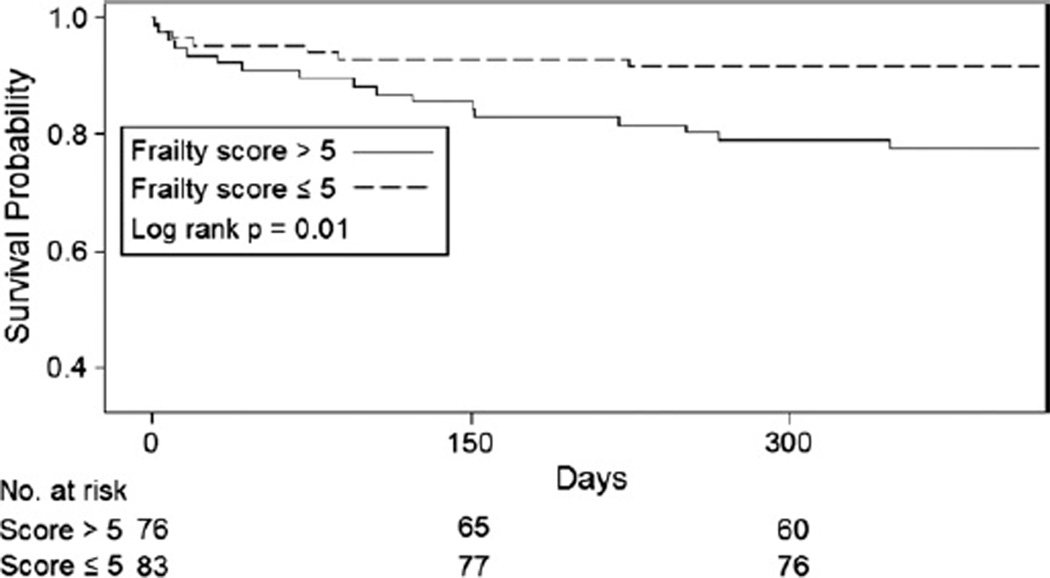
Results: Frailty status was assessed in 159 subjects who underwent TAVR (age 86 ± 8 years, Society of Thoracic Surgery Risk Score 12 ± 4). Baseline frailty score was not associated with conventionally ascertained clinical variables or Society of Thoracic Surgery score. Although high frailty score was associated with a longer post-TAVR hospital stay when compared with lower frailty score (9 ± 6 days vs. 6 ± 5 days, respectively, p = 0.004), there were no significant crude associations between frailty status and procedural outcomes, suggesting adequacy of the standard selection process for identifying patients at risk for periprocedural complications after TAVR. Frailty status was independently associated with increased 1-year mortality (hazard ratio: 3.5, 95% confidence interval: 1.4 to 8.5, p = 0.007) after TAVR.
Conclusions: Frailty was not associated with increased periprocedural complications in patients selected as candidates to undergo TAVR but was associated with increased 1-year mortality after TAVR. Further studies will evaluate the independent value of this frailty composite in older adults with aortic stenosis.
Trial registration: ClinicalTrials.gov NCT00530894.
Copyright © 2012 American College of Cardiology Foundation. Published by Elsevier Inc. All rights reserved.
Figures
Comment in
-
Working toward a frailty index in transcatheter aortic valve replacement: a major move away from the "eyeball test".JACC Cardiovasc Interv. 2012 Sep;5(9):982-3. doi: 10.1016/j.jcin.2012.07.002. JACC Cardiovasc Interv. 2012. PMID: 22995886 No abstract available.
References
-
- Fried LP, Tangen CM, Walston J, et al. Frailty in older adults: evidence for a phenotype. J Gerontol A Biol Sci Med Sci. 2001;56:M146–M156. - PubMed
-
- Purser JL, Kuchibhatla MN, Fillenbaum GG, Harding T, Peterson ED, Alexander KP. Identifying frailty in hospitalized older adults with significant coronary artery disease. J Am Geriatr Soc. 2006;54:1674–1681. - PubMed
-
- Ekerstad N, Swahn E, Janzon M, et al. Frailty is independently associated with short-term outcomes for elderly patients with non-ST-segment elevation myocardial infarction Circulation. 2011;124:2397–2404. - PubMed
-
- Makary MA, Segev DL, Pronovost PJ, et al. Frailty as a predictor of surgical outcomes in older patients. J Am Coll Surg. 2010;210:901–908. - PubMed
-
- Afilalo J, Eisenberg MJ, Morin JF, et al. Gait speed as an incremental predictor of mortality and major morbidity in elderly patients undergoing cardiac surgery. J Am Coll Cardiol. 2010;56:1668–1676. - PubMed
Publication types
MeSH terms
Substances
Associated data
Grants and funding
LinkOut - more resources
Full Text Sources
Medical
