Sugar-sweetened beverages and genetic risk of obesity
- PMID: 22998338
- PMCID: PMC3518794
- DOI: 10.1056/NEJMoa1203039
Sugar-sweetened beverages and genetic risk of obesity
Abstract
Background: Temporal increases in the consumption of sugar-sweetened beverages have paralleled the rise in obesity prevalence, but whether the intake of such beverages interacts with the genetic predisposition to adiposity is unknown.
Methods: We analyzed the interaction between genetic predisposition and the intake of sugar-sweetened beverages in relation to body-mass index (BMI; the weight in kilograms divided by the square of the height in meters) and obesity risk in 6934 women from the Nurses' Health Study (NHS) and in 4423 men from the Health Professionals Follow-up Study (HPFS) and also in a replication cohort of 21,740 women from the Women's Genome Health Study (WGHS). The genetic-predisposition score was calculated on the basis of 32 BMI-associated loci. The intake of sugar-sweetened beverages was examined prospectively in relation to BMI.
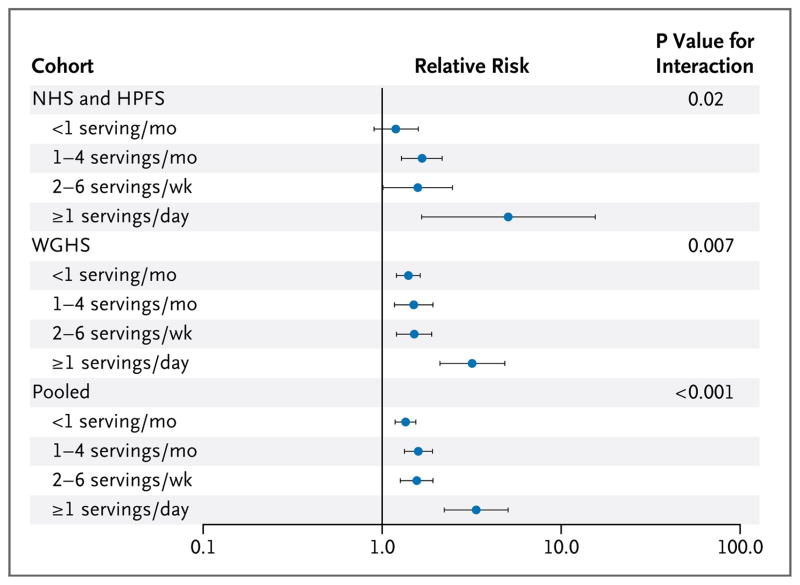
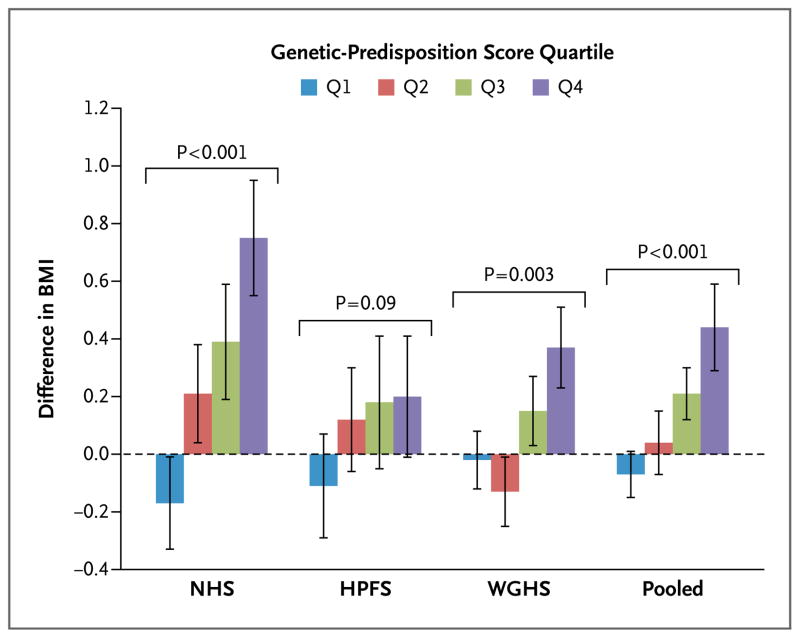
Results: In the NHS and HPFS cohorts, the genetic association with BMI was stronger among participants with higher intake of sugar-sweetened beverages than among those with lower intake. In the combined cohorts, the increases in BMI per increment of 10 risk alleles were 1.00 for an intake of less than one serving per month, 1.12 for one to four servings per month, 1.38 for two to six servings per week, and 1.78 for one or more servings per day (P<0.001 for interaction). For the same categories of intake, the relative risks of incident obesity per increment of 10 risk alleles were 1.19 (95% confidence interval [CI], 0.90 to 1.59), 1.67 (95% CI, 1.28 to 2.16), 1.58 (95% CI, 1.01 to 2.47), and 5.06 (95% CI, 1.66 to 15.5) (P=0.02 for interaction). In the WGHS cohort, the increases in BMI per increment of 10 risk alleles were 1.39, 1.64, 1.90, and 2.53 across the four categories of intake (P=0.001 for interaction); the relative risks for incident obesity were 1.40 (95% CI, 1.19 to 1.64), 1.50 (95% CI, 1.16 to 1.93), 1.54 (95% CI, 1.21 to 1.94), and 3.16 (95% CI, 2.03 to 4.92), respectively (P=0.007 for interaction).
Conclusions: The genetic association with adiposity appeared to be more pronounced with greater intake of sugar-sweetened beverages. (Funded by the National Institutes of Health and others.).
Figures
Comment in
-
Calories from soft drinks--do they matter?N Engl J Med. 2012 Oct 11;367(15):1462-3. doi: 10.1056/NEJMe1209884. Epub 2012 Sep 21. N Engl J Med. 2012. PMID: 22998341 No abstract available.
-
Sugar-sweetened beverages, genetic risk, and obesity.N Engl J Med. 2013 Jan 17;368(3):286-7. doi: 10.1056/NEJMc1213563. N Engl J Med. 2013. PMID: 23323907 No abstract available.
-
Sugar-sweetened beverages, genetic risk, and obesity.N Engl J Med. 2013 Jan 17;368(3):285. doi: 10.1056/NEJMc1213563. N Engl J Med. 2013. PMID: 23323908 No abstract available.
-
[Sugar-sweetened beverages and genetic risk of obesity].Rev Clin Esp (Barc). 2013 Apr;213(3):163. doi: 10.1016/j.rce.2012.12.001. Rev Clin Esp (Barc). 2013. PMID: 23700594 Spanish. No abstract available.
References
-
- McCarthy MI. Genomics, type 2 diabetes, and obesity. N Engl J Med. 2010;363:2339–50. - PubMed
Publication types
MeSH terms
Substances
Grants and funding
- 5P30DK46200/DK/NIDDK NIH HHS/United States
- P01 CA087969/CA/NCI NIH HHS/United States
- R01 HL043851/HL/NHLBI NIH HHS/United States
- P01 CA055075/CA/NCI NIH HHS/United States
- U54 CA155626/CA/NCI NIH HHS/United States
- R01 EY015473/EY/NEI NIH HHS/United States
- U19 HL069757/HL/NHLBI NIH HHS/United States
- R01 HL088521/HL/NHLBI NIH HHS/United States
- DK080140/DK/NIDDK NIH HHS/United States
- U54CA155626/CA/NCI NIH HHS/United States
- HL073168/HL/NHLBI NIH HHS/United States
- HL34594/HL/NHLBI NIH HHS/United States
- R01 DK058845/DK/NIDDK NIH HHS/United States
- U01 HG004728/HG/NHGRI NIH HHS/United States
- EY015473/EY/NEI NIH HHS/United States
- HL69757/HL/NHLBI NIH HHS/United States
- P01 DK070756/DK/NIDDK NIH HHS/United States
- T32 HL007575/HL/NHLBI NIH HHS/United States
- CA87969/CA/NCI NIH HHS/United States
- DK58845/DK/NIDDK NIH HHS/United States
- HL088521/HL/NHLBI NIH HHS/United States
- R01 DK091718/DK/NIDDK NIH HHS/United States
- CA49449/CA/NCI NIH HHS/United States
- U01HG004399/HG/NHGRI NIH HHS/United States
- CA047988/CA/NCI NIH HHS/United States
- P30 DK046200/DK/NIDDK NIH HHS/United States
- DK091718/DK/NIDDK NIH HHS/United States
- K24 DK080140/DK/NIDDK NIH HHS/United States
- R01 HL034594/HL/NHLBI NIH HHS/United States
- U01HG004728-02/HG/NHGRI NIH HHS/United States
- R01 HL071981/HL/NHLBI NIH HHS/United States
- R01 CA047988/CA/NCI NIH HHS/United States
- R01 CA049449/CA/NCI NIH HHS/United States
- CA055075/CA/NCI NIH HHS/United States
- R01 HL073168/HL/NHLBI NIH HHS/United States
- U01 CA049449/CA/NCI NIH HHS/United States
- HL071981/HL/NHLBI NIH HHS/United States
- U01 HL069757/HL/NHLBI NIH HHS/United States
- U01 HG004399/HG/NHGRI NIH HHS/United States
- DK70756/DK/NIDDK NIH HHS/United States
- DK46200/DK/NIDDK NIH HHS/United States
- R01 AI112339/AI/NIAID NIH HHS/United States
LinkOut - more resources
Full Text Sources
Other Literature Sources
Medical