


Phospholipase Cζ rescues failed oocyte activation in a prototype of male factor infertility
- PMID: 22999959
- PMCID: PMC3540263
- DOI: 10.1016/j.fertnstert.2012.08.035
Phospholipase Cζ rescues failed oocyte activation in a prototype of male factor infertility
Abstract
Objective: To determine the effect of infertility-linked sperm phospholipase Cζ (PLCζ) mutations on their ability to trigger oocyte Ca(2+) oscillations and development, and also to evaluate the potential therapeutic utility of wild-type, recombinant PLCζ protein for rescuing failed oocyte activation and embryo development.
Design: Test of a novel therapeutic approach to male factor infertility.
Setting: University medical school research laboratory.
Patient(s): Donated unfertilized human oocytes from follicle reduction.
Intervention(s): Microinjection of oocytes with recombinant human PLCζ protein or PLCζ cRNA and a Ca(2+)-sensitive fluorescent dye.
Main outcome measure(s): Measurement of the efficacy of mutant and wild-type PLCζ-mediated enzyme activity, oocyte Ca(2+) oscillations, activation, and early embryo development.
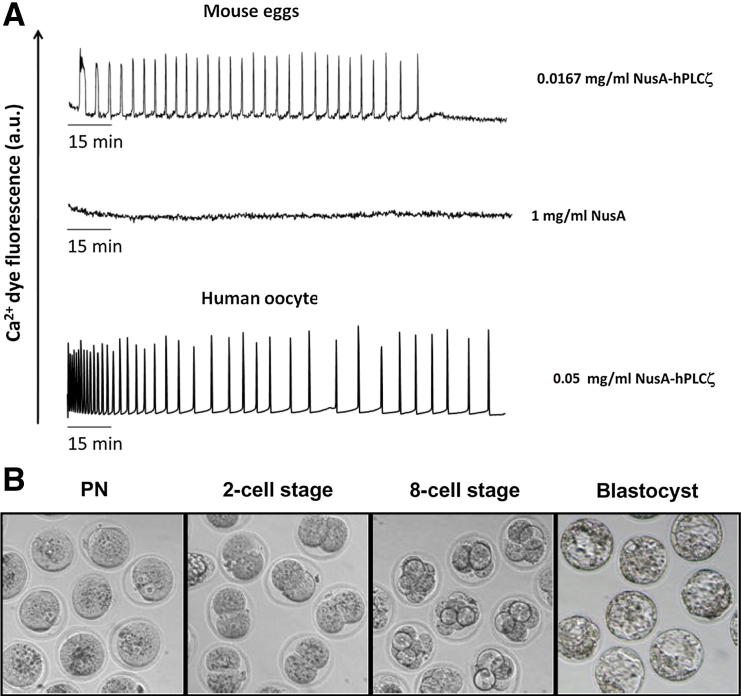
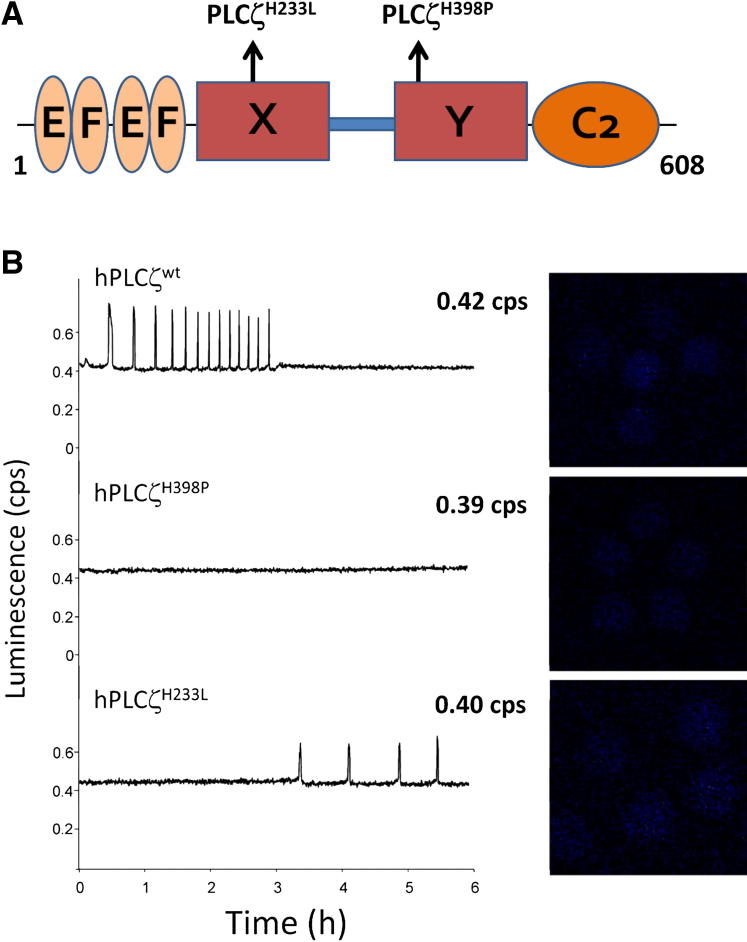
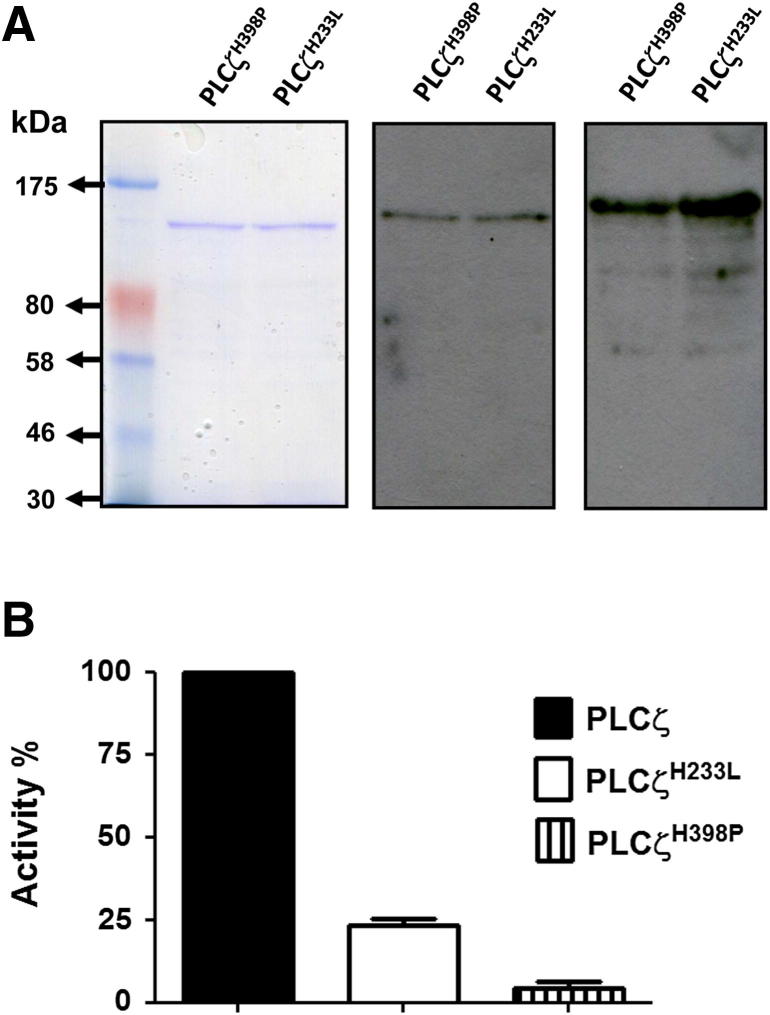
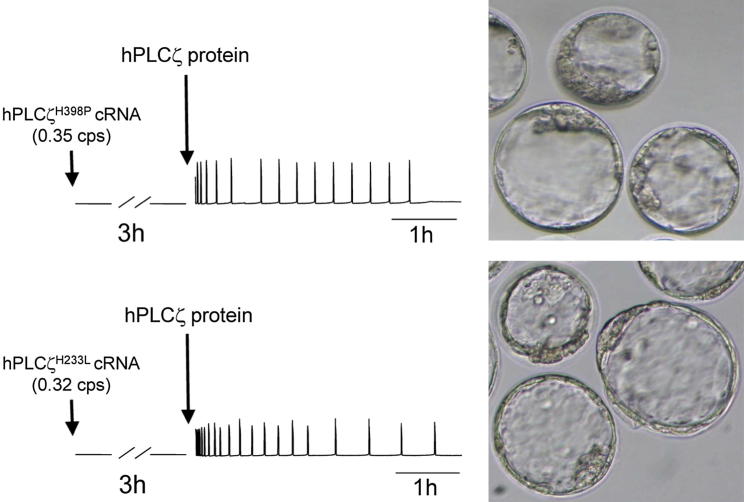
Result(s): In contrast to the wild-type protein, mutant forms of human sperm PLCζ display aberrant enzyme activity and a total failure to activate unfertilized oocytes. Subsequent microinjection of recombinant human PLCζ protein reliably triggers the characteristic pattern of cytoplasmic Ca(2+) oscillations at fertilization, which are required for normal oocyte activation and successful embryo development to the blastocyst stage.
Conclusion(s): Dysfunctional sperm PLCζ cannot trigger oocyte activation and results in male factor infertility, so a potential therapeutic approach is oocyte microinjection of active, wild-type PLCζ protein. We have demonstrated that recombinant human PLCζ can phenotypically rescue failed activation in oocytes that express dysfunctional PLCζ, and that this intervention culminates in efficient blastocyst formation.
Copyright © 2013 American Society for Reproductive Medicine. Published by Elsevier Inc. All rights reserved.
Figures
References
-
- Kline D., Kline J.T. Repetitive calcium transients and the role of calcium in exocytosis and cell cycle activation in the mouse egg. Dev Biol. 1992;149:80–89. - PubMed
-
- Swann K., Yu Y. The dynamics of calcium oscillations that activate mammalian eggs. Int J Dev Biol. 2008;52:585–594. - PubMed
-
- Nomikos M., Swann K., Lai F.A. Starting a new life: sperm PLC-zeta mobilizes the Ca2+ signal that induces egg activation and embryo development: an essential phospholipase C with implications for male infertility. Bioessays. 2011;34:126–134. - PubMed
-
- Saunders C.M. PLC zeta: a sperm-specific trigger of Ca2+ oscillations in eggs and embryo development. Development. 2002;129:3533–3544. - PubMed
-
- Cox L.J., Larman M.G., Saunders C.M., Hashimoto K., Swann K., Lai F.A. Sperm phospholipase Cζ from humans and cynomolgus monkeys triggers Ca2+ oscillations, activation and development of mouse oocytes. Reproduction. 2002;124:611–623. - PubMed
Publication types
MeSH terms
Substances
Grants and funding
LinkOut - more resources
Full Text Sources
Other Literature Sources
Medical
Miscellaneous
