


Neurobehavioral assessment of infants born at term and in utero exposure to serotonin reuptake inhibitors
- PMID: 22999988
- PMCID: PMC3921021
- DOI: 10.1016/j.earlhumdev.2012.08.001
Neurobehavioral assessment of infants born at term and in utero exposure to serotonin reuptake inhibitors
Abstract
Background: Some studies report neurobehavioral symptoms in neonates exposed to serotonin reuptake inhibitors (SRIs) in utero. However, maternal psychiatric illness during the last trimester of pregnancy, as a confounding factor, has not always been assessed.
Aims: In this prospective study we compared neurobehavioral complications among neonates who were born to euthymic women who either took or did not take an SRI during the last trimester of pregnancy.
Study design: Exposed and unexposed infants were assessed for: 1) temperament as measured by the Neonatal Behavioral Assessment Scale (NBAS); 2) activity via Actiwatch electronic monitoring; 3) sleep state using trained observer ratings; and 4) perinatal complications through medical record review. T-tests, Fisher's exact tests, and analyses of covariance were used to assess the relationship between clinical and neurobehavioral factors and exposure status.
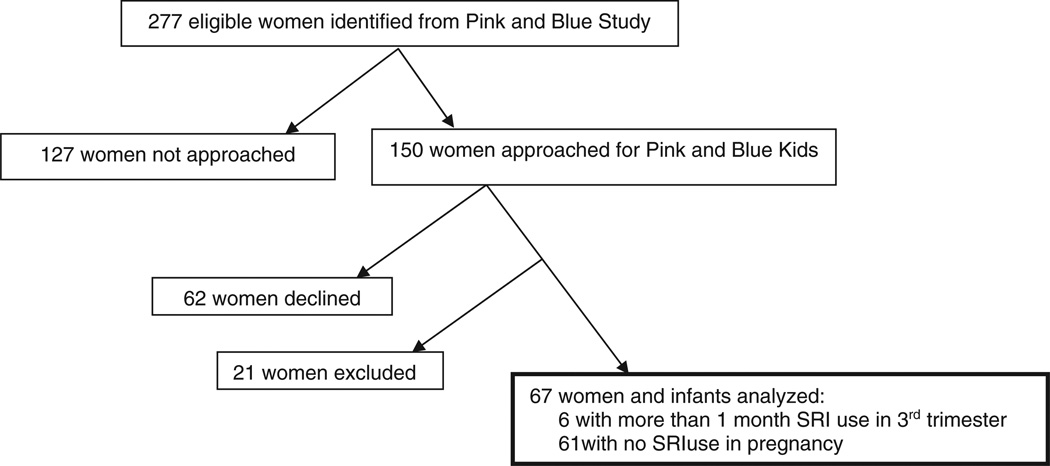
Subjects: 67 infants (61 controls and 6 exposed to SRIs).
Outcome measures: Neonatal Assessment Behavioral Scale, APGAR scores, infant sleep state (% sleep, % wakeful), startles and tremulousness, gestational age, birth weight, and head circumference.
Results: Infants exposed to SRIs in the third trimester had poorer motor development, lower 5-minute APGAR scores, and shorter mean gestational age as compared to unexposed infants.
Conclusion: Results of this study show differences in autonomic and gross motor activity between neonates who were or were not exposed to SRIs in utero after controlling for active maternal psychiatric illness. Future longitudinal work should compare longer term outcomes of exposed and unexposed infants of depressed mothers.
Copyright © 2012 Elsevier Ltd. All rights reserved.
Conflict of interest statement
Dr. Yonkers has the following conflicts to disclose: she has received study medication from Pfizer for an NIMH trial, she has received support from Eli Lilly for an investigator-initiated grant and has received royalties from Up to Date. All other investigators do not have any conflicts of interest.
Comment in
-
Validation of actigraphic sleep/wake judgments for infants.Early Hum Dev. 2013 Apr;89(4):237. doi: 10.1016/j.earlhumdev.2013.02.003. Epub 2013 Mar 1. Early Hum Dev. 2013. PMID: 23465305 No abstract available.
References
-
- Cooper WO, Willy ME, Pont SJ, Ray WA. Increasing use of antidepressants in pregnancy. Am J Obstet Gynecol. 2007;196(6):544.e1. - PubMed
-
- Laine K, Heikkinen T, Ekblad U, Kero P. Effects of exposure to selective serotonin reuptake inhibitors during pregnancy on serotonergic symptoms in newborns and cord blood monoamine and prolactin concentrations. Arch Gen Psychiatry. 2003;60:720–726. - PubMed
-
- Zeskind P, Stephens L. Maternal selective serotonin reuptake inhibitor use during pregnancy and newborn neurobehavior. Pediatrics. 2004;113(2):368–375. - PubMed
-
- Costei A, Kozer E, Ho T, Ito S, Koren G. Perinatal outcome following third trimester exposure to paroxetine. Arch Pediatr Adolesc Med. 2002;156:1129–1132. - PubMed
-
- Sanz E, De-las-Cuevas C, Kiuru A, Bate A, Edwards R. Selective serotonin reuptake inhibitors in pregnant women and neonatal withdrawal syndrome: a database analysis. Lancet. 2005;365:482–487. - PubMed
Publication types
MeSH terms
Substances
Grants and funding
LinkOut - more resources
Full Text Sources
Other Literature Sources
Medical
