


Comment
doi: 10.1105/tpc.112.240911.
Epub 2012 Sep 21.
Why wiry? Tomato mutants reveal connections among small RNAs, auxin response factors, virus infection, and leaf morphology
Affiliations
- PMID: 23001038
- PMCID: PMC3480282
- DOI: 10.1105/tpc.112.240911
Item in Clipboard
Comment
Why wiry? Tomato mutants reveal connections among small RNAs, auxin response factors, virus infection, and leaf morphology
Plant Cell.
2012 Sep.
No abstract available
Figures
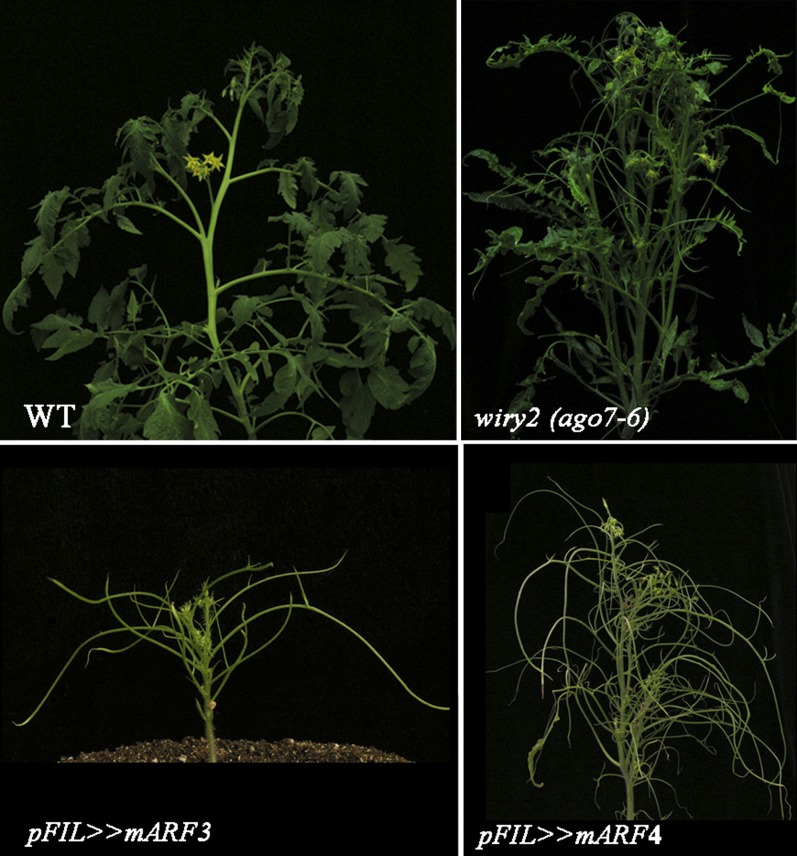
The tomato wiry phenotype can be recapitulated by ta-siRNA-insensitive ARFs. Top row, wild-type tomato plant (left) and wiry mutant (right); bottom row, transgenic plants expressing ARF3 insensitive to ta-siRNAs (left) and ARF4 insensitive to ta-siRNAs (right). (Figure courtesy of Tamar Yifhar and Yossi Capua.)
Comment on
-
Failure of the tomato trans-acting short interfering RNA program to regulate AUXIN RESPONSE FACTOR3 and ARF4 underlies the wiry leaf syndrome.Plant Cell. 2012 Sep;24(9):3575-89. doi: 10.1105/tpc.112.100222. Epub 2012 Sep 21. Plant Cell. 2012. PMID: 23001036 Free PMC article.
References
-
- Lesley J.W., Lesley M.M. (1928). The “wiry” tomato. A recessive mutant form resembling a plant affected with mosaic disease. J. Hered. 8: 337–344
-
- Rubio-Somoza I., Cuperus J.T., Weigel D., Carrington J.C. (2009). Regulation and functional specialization of small RNA-target nodes during plant development. Curr. Opin. Plant Biol. 12: 622–627 - PubMed
-
- Yifhar T., Pekker I., Peled D., Friedlander G., Pistunov A., Sabban M., Wachsman G., Alvarez J.P., Amsellem Z., Eshed Y. (2012). Failure of the tomato trans-acting short interfering RNA program to regulate AUXIN RESPONSE FACTOR3 and ARF4 underlies the wiry leaf syndrome. Plant Cell 24: 3575–3589 - PMC - PubMed
Publication types
MeSH terms
Substances
LinkOut - more resources
Full Text Sources
