A pooled analysis of smoking and colorectal cancer: timing of exposure and interactions with environmental factors
- PMID: 23001243
- PMCID: PMC3493822
- DOI: 10.1158/1055-9965.EPI-12-0692
A pooled analysis of smoking and colorectal cancer: timing of exposure and interactions with environmental factors
Abstract
Background: Considerable evidence suggests that cigarette smoking is associated with a higher risk of colorectal cancer (CRC). What is unclear, however, is the impact of quitting smoking on risk attenuation and whether other risk factors for CRC modify this association.
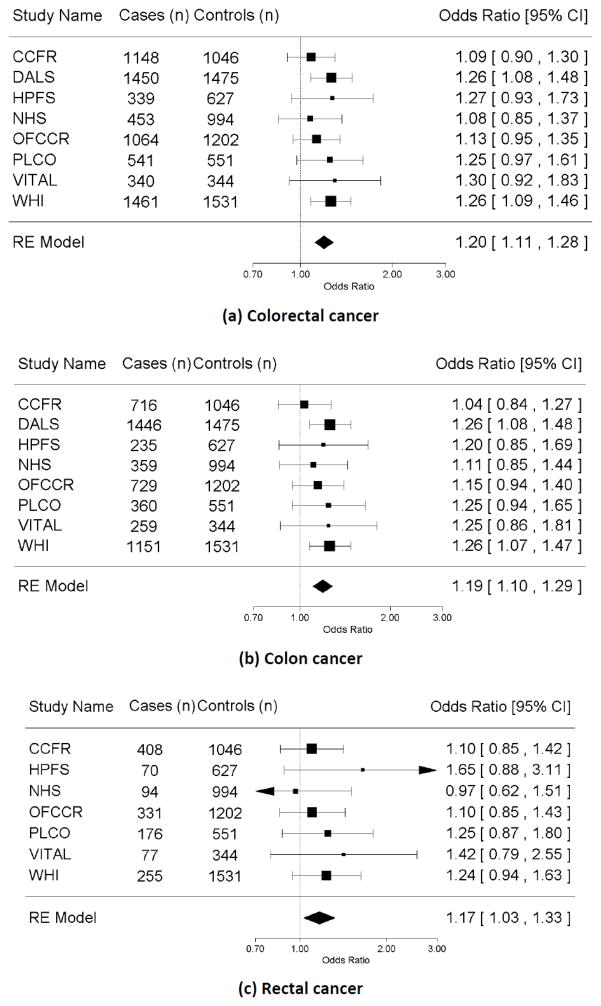
Methods: We conducted a pooled analysis of eight studies, including 6,796 CRC cases and 7,770 controls, to evaluate the association between cigarette smoking history and CRC risk and to investigate potential effect modification by other risk factors.
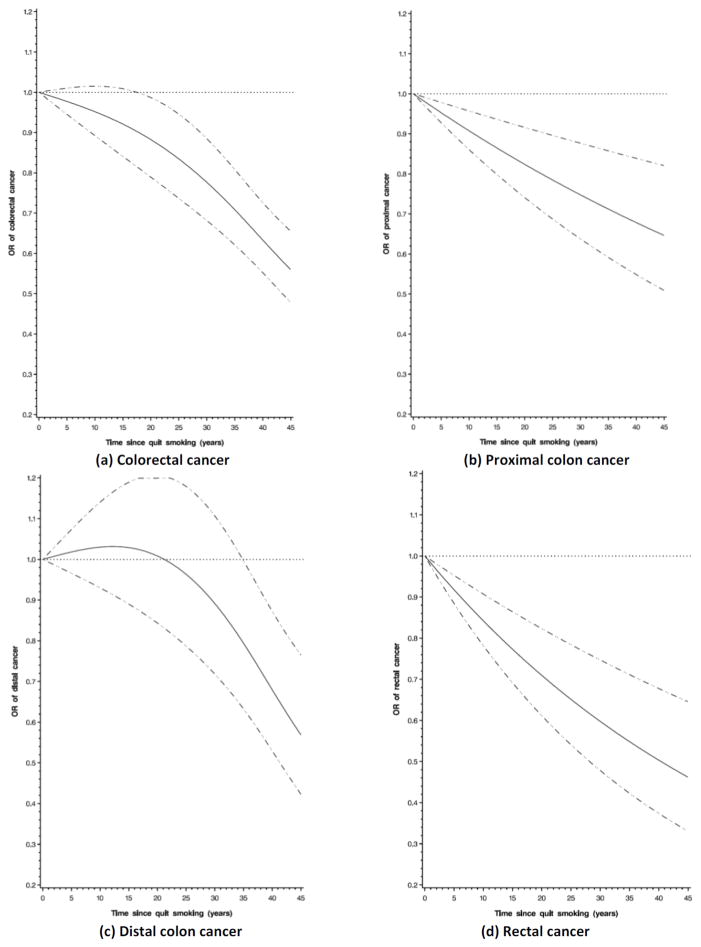
Results: Current smokers [OR, 1.26; 95% confidence interval (CI), 1.11-1.43] and former smokers (OR, 1.18; 95% CI, 1.09-1.27), relative to never smokers, showed higher risks of CRC. Former smokers remained at higher CRC risk, relative to never smokers, for up to about 25 years after quitting. The impact of time since quitting varied by cancer subsite: The excess risk due to smoking decreased immediately after quitting for proximal colon and rectal cancer but not until about 20 years post-quitting for distal colon cancer. Furthermore, we observed borderline statistically significant additive interactions between smoking status and body mass index [BMI; relative excess risk due to interaction (RERI]), 0.15; 95% CI, -0.01 to 0.31; P = 0.06] and significant additive interaction between smoking status and fruit consumption (RERI, 0.16; 95% CI, 0.01-0.30; P = 0.04).
Conclusion: CRC risk remained increased for about 25 years after quitting smoking, and the pattern of decline in risk varied by cancer subsite. BMI and fruit intake modified the risk associated with smoking.
Impact: These results contribute to a better understanding of the mechanisms through which smoking impacts CRC etiology.
©2012 AACR.
Conflict of interest statement
Andrew T. Chan declares a minor conflict of interest in his role as a consultant/advisory board member of Bayer HealthCare, Pfizer Inc. and Millenium Pharmaceuticals
Figures
References
-
- Ferlay JSH, Bray F, Forman D, Mathers C, Parkin DM. Cancer Incidence and Mortality Worldwide: IARC CancerBase No 10 [Internet] 2008. GLOBOCAN 2008 v1.2.
-
- Schottenfeld D, Fraumeni JF. Cancer epidemiology and prevention. 3. Oxford ; New York: Oxford University Press; 2006.
-
- Parkin DM, Bray F, Ferlay J, Pisani P. Global cancer statistics, 2002. CA Cancer J Clin. 2005;55:74–108. - PubMed
-
- Bingham S, Riboli E. Diet and cancer--the European Prospective Investigation into Cancer and Nutrition. Nat Rev Cancer. 2004;4:206–15. - PubMed
-
- PROJECTIONS OF TOBACCO PRODUCTION, CONSUMPTION AND TRADE TO THE YEAR 2010. FOOD AND AGRICULTURE ORGANIZATION OF THE UNITED NATIONS; 2003.
Publication types
MeSH terms
Grants and funding
- P01 CA 087969/CA/NCI NIH HHS/United States
- P01 CA087969/CA/NCI NIH HHS/United States
- K05 CA154337/CA/NCI NIH HHS/United States
- HHSN268201100003C/WH/WHI NIH HHS/United States
- TL1 TR000422/TR/NCATS NIH HHS/United States
- HHSN271201100004C/AG/NIA NIH HHS/United States
- HHSN268201100002C/WH/WHI NIH HHS/United States
- ImNIH/Intramural NIH HHS/United States
- U01 CA097735/CA/NCI NIH HHS/United States
- P50 CA127003/CA/NCI NIH HHS/United States
- HHSN268201100004C/WH/WHI NIH HHS/United States
- U19 CA148107/CA/NCI NIH HHS/United States
- R01 CA059045/CA/NCI NIH HHS/United States
- HHSN268201100001I/HL/NHLBI NIH HHS/United States
- P01CA055075/CA/NCI NIH HHS/United States
- P30 CA015704/CA/NCI NIH HHS/United States
- HHSN268201100004I/HL/NHLBI NIH HHS/United States
- P01 CA055075/CA/NCI NIH HHS/United States
- P50 CA 127003/CA/NCI NIH HHS/United States
- HHSN268201100046C/HL/NHLBI NIH HHS/United States
- CAPMC/ CIHR/Canada
- R01 CA048998/CA/NCI NIH HHS/United States
- R25 CA094880/CA/NCI NIH HHS/United States
- U01 CA137088/CA/NCI NIH HHS/United States
- R01 CA137178/CA/NCI NIH HHS/United States
- U01 CA074794/CA/NCI NIH HHS/United States
- (R01 CA48998/CA/NCI NIH HHS/United States
- CA-95-011/CA/NCI NIH HHS/United States
- HHSN268201100003I/HL/NHLBI NIH HHS/United States
- HHSN268201100002I/HL/NHLBI NIH HHS/United States
- U01 CA074783/CA/NCI NIH HHS/United States
- U01 CA074800/CA/NCI NIH HHS/United States
- HHSN268201100001C/WH/WHI NIH HHS/United States
LinkOut - more resources
Full Text Sources
Medical