


Review
doi: 10.1038/nrc3366.
Controlling escape from angiogenesis inhibitors
Affiliations
- PMID: 23001349
- PMCID: PMC3969886
- DOI: 10.1038/nrc3366
Item in Clipboard
Review
Controlling escape from angiogenesis inhibitors
Nat Rev Cancer.
2012 Oct.
Abstract
Selective inhibition of vascular endothelial growth factor (VEGF) increases the efficacy of chemotherapy and has beneficial effects on multiple advanced cancers, but response is often limited and the disease eventually progresses. Changes in the tumour microenvironment--hypoxia among them--that result from vascular pruning, suppressed angiogenesis and other consequences of VEGF inhibition can promote escape and tumour progression. New therapeutic approaches that target pathways that are involved in the escape mechanisms add the benefits of blocking tumour progression to those of slowing tumour growth by inhibiting angiogenesis.
Figures
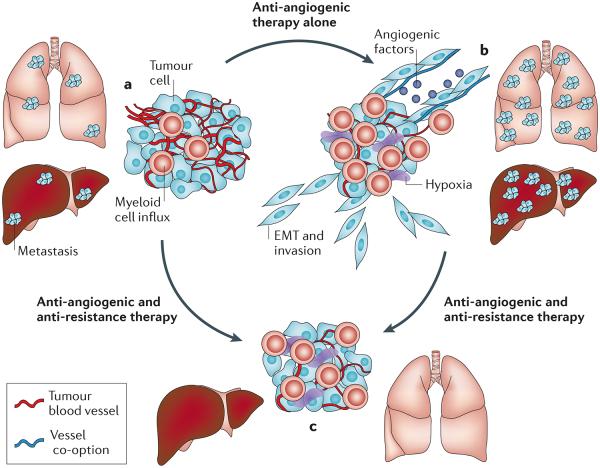
A schematic representation of the development and resolution of resistance to angiogenesis inhibitors, based on evidence from preclinical studies, is shown. a | Before treatment with an angiogenesis inhibitor the tumour is highly vascular, rapidly growing and accompanied by metastases. b | After treatment with an inhibitor of vascular endothelial growth factor (VEGF) signalling, the main tumour is smaller and less vascular but is more hypoxic, has more myeloid cells and is more invasive. Tumour growth continues without angiogenesis by co-option of normal blood vessels. Tumour cells undergo epithelial–mesenchymal transition (EMT), become more mesenchymal, invade surrounding tissues and metastasize. c | After inhibition of the pathways involved in tumour progression together with VEGF signalling, the tumour is smaller, has a ball-like shape, is less invasive and has no metastases.
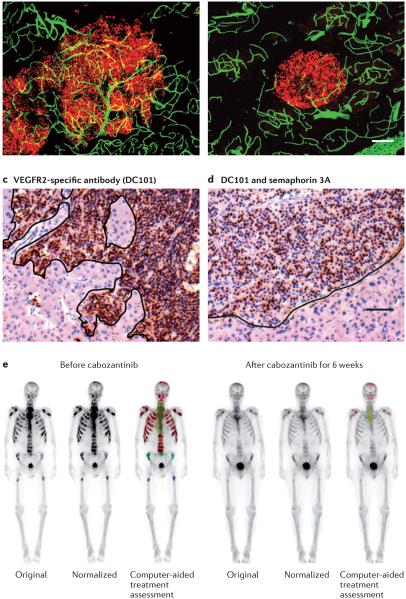
Pancreatic neuroendocrine tumours from RIP1-Tag2 transgenic mice are shown (parts a–d). Tumour cells stained for SV40 T- antigen are indicated (shown in red in parts a,b; shown in brown in parts c,d). Blood vessels stained for CD31 are shown (green in parts a,b). The scale bar shown in part b (80 μm) also applies to part a. The scale bar in part d (50 μm) also applies to part c. The irregular borders of invasive tumours treated with a vascular endothelial growth factor (VEGF)-specific antibody (part a) or a VEGF receptor 2 (VEGFR2)-specific antibody DC101 (part c) contrast with the smooth borders of tumours treated with cabozantinib, which is a small-molecule tyrosine kinase inhibitor targeting VEGF receptors and MET (part b), or with VEGFR2-specific antibody plus semaphorin 3A124 (part d) (parts a and b are similar to data reported in REF. 125). Bone scans of a patient with castration-resistant metastatic prostate cancer before and after treatment with cabozantinib are shown (part e)166. Metastases are highlighted and are coloured (red, green and blue) by computer-aided normalization and enhancement algorithms. Parts c and d reproduced, with permission, from REF. © Am. Soc. Clin. Investigation (2012). Part e reproduced, with permission, from REF. © Lippincott Williams & Wilkins (2012).
References
-
- Ferrara N, Kerbel RS. Angiogenesis as a therapeutic target. Nature. 2005;438:967–974. - PubMed
-
- Ferrara N, Mass RD, Campa C, Kim R. Targeting VEGF-A to treat cancer and age-related macular degeneration. Annu. Rev. Med. 2007;58:491–504. - PubMed
-
- Ellis LM, Hicklin DJ. VEGF-targeted therapy: mechanisms of anti-tumour activity. Nature Rev. Cancer. 2008;8:579–591. - PubMed
-
- Jain RK. Normalization of tumor vasculature: an emerging concept in antiangiogenic therapy. Science. 2005;307:58–62. - PubMed
Publication types
MeSH terms
Substances
Grants and funding
LinkOut - more resources
Full Text Sources
Other Literature Sources
Molecular Biology Databases
