. 2012 Dec;78(24):8523-30.
doi: 10.1128/AEM.01954-12. Epub 2012 Sep 21.

Prevalence and diversity of viruses in the entomopathogenic fungus Beauveria bassiana

Affiliations

Prevalence and diversity of viruses in the entomopathogenic fungus Beauveria bassiana

Noemí Herrero et al. Appl Environ Microbiol. 2012 Dec.

Abstract

Viruses have been discovered in numerous fungal species, but unlike most known animal or plant viruses, they are rarely associated with deleterious effects on their hosts. The knowledge about viruses among entomopathogenic fungi is very limited, although their existence is suspected because of the presence of virus-like double-stranded RNA (dsRNA) in isolates of several species. Beauveria bassiana is one of the most-studied species of entomopathogenic fungi; it has a cosmopolitan distribution and is used as a biological control agent against invertebrates in agriculture. We analyzed a collection of 73 isolates obtained at different locations and from different habitats in Spain and Portugal, searching for dsRNA elements indicative of viral infections. The results revealed that the prevalence of viral infections is high; 54.8% of the isolates contained dsRNA elements with viral characteristics. The dsRNA electropherotypes of infected isolates indicated that virus diversity was high in the collection analyzed and that mixed virus infections occurred in fungal isolates. However, a hybridization experiment indicated that dsRNA bands that are similar in size do not always have similar sequences. Particular virus species or dsRNA profiles were not associated with locations or types of habitats, probably because of the ubiquity and efficient dispersion of this fungus as an airborne species. The sequence of one of the most common dsRNA elements corresponded to the 5.2-kbp genome of a previously undescribed member of the Totiviridae family, termed B. bassiana RNA virus 1 (BbRV1).


Figures
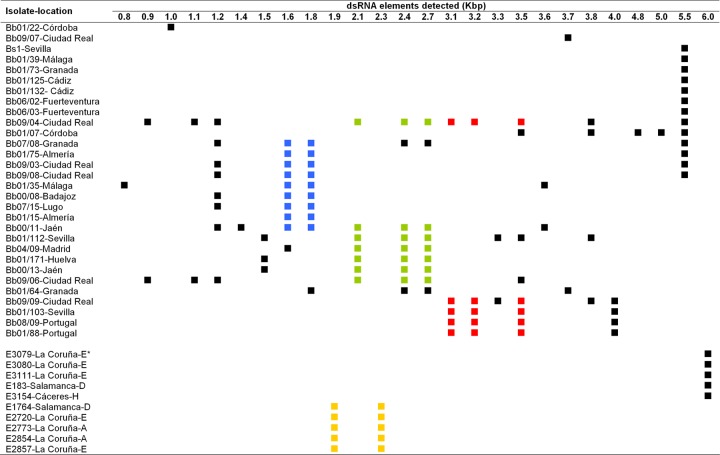
Fig 1
Fig 1
dsRNA electropherotypes observed in soil (Bb and Bs isolates) and endophytic (E isolates, bottom) isolates of B. bassiana. The squares indicate the presence in an isolate of a dsRNA molecule of the size shown at the top of each column. Similar sets of two or three dsRNA elements observed in different isolates are indicated by identical colors.
Fig 2
Fig 2
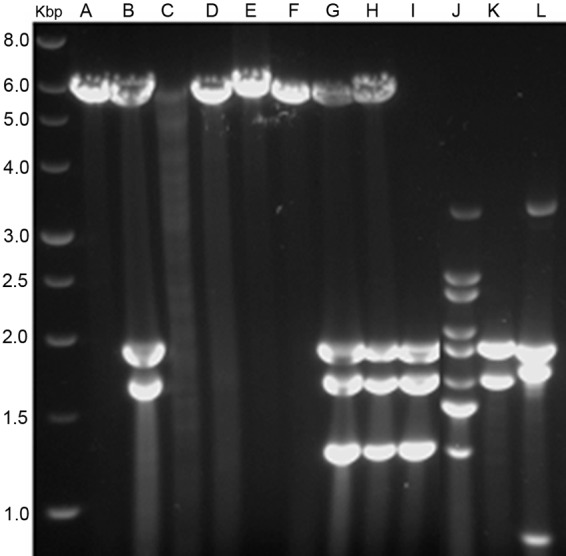
Electrophoretic profiles of dsRNA elements present in several isolates of B. bassiana. Lanes: A, isolate EABb 01/39-Su; B, EABb 01/75-Su; C, EABb 01/33-Su; D, EABb 01/132-Su; E, EABb 06/02-Su; F, EABb 06/03-Su; G, EABb 09/03-Su; H, EABb 09/08-Su; I, EABb 00/08-Su; J, EABb 00/11-Su; K, EABb 01/15-Su; L, EABb 01/35-Su. Lane Kbp contains molecular size markers, and the values on the left are sizes in kilobase pairs.
Fig 3
Fig 3
Genome organization of BbRV1. The 5,228-bp genome contains two ORFs that overlap by one nucleotide. ORF1 encodes a putative CP, and ORF2 encodes a putative RdRp. aa, amino acids.
Fig 4
Fig 4
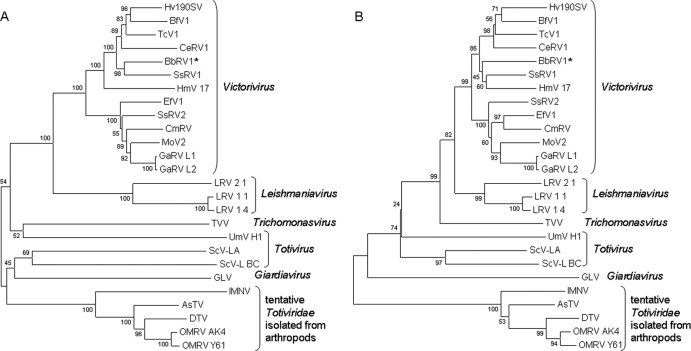
Phylogenetic analysis of BbRV1. Multiple alignments of amino acid sequences of the CP (A) and RdRp (B) of viruses of the family Totiviridae were performed. The unrooted neighbor-joining phylogenetic trees shown were made with MEGA software. The values at nodes are bootstrap values as percentages estimated by 1,000 replicates. The accession numbers of the sequences used in the analyses are given in Table S1 in the supplemental material.
Fig 5
Fig 5
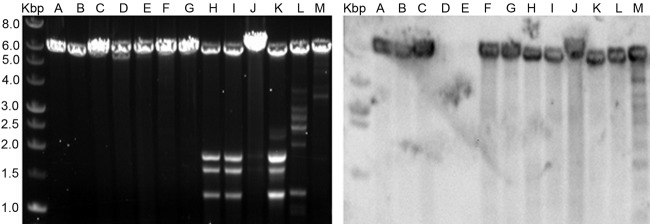
Northern blot hybridization of dsRNA elements of about 5.5 kbp present in several B. bassiana isolates using a probe complementary to the 5′ end of BbRV1. The left panel shows the electrophoretic profiles of 13 isolates, and the right panel shows the resulting hybridization with a chemiluminescent BbRV1 probe. The letters at the top indicate different isolates as follows: A, EABb 06/2-Su; B, EABb 06/03-Su; C, EABb 01/125-Su; D, EABb 01/132-Su; E, EABb 01/39-Su; F, EABb 01/73-Su; G, Bs1; H, EABb 09/03-Su; I, EABb 09/08-Su; J, EABb 01/75-Su; K, EABb 07/08-Su; L, EABb 09/04-Su; M, EABb 01/07-Su. Lanes Kbp contain molecular size markers, and the values on the left are sizes in kilobase pairs. The isolate used to clone and sequence BbRV1 is EABb 06/2-Su (lanes A), which was obtained in Fuerteventura, Canary Islands.

References

    1. Airaudi D, Marchisio VF. 1996. Fungal biodiversity in the air of Turin. Mycopathologia 136:95–102 - PubMed
    1. Bruenn JA. 1993. A closely-related group of RNA-dependent RNA polymerases from double-stranded-RNA viruses. Nucleic Acids Res. 21:5667–5669 - PMC - PubMed
    1. Castrillo LA, Griggs MH, Vandenberg JD. 2004. Vegetative compatibility groups in indigenous and mass-released strains of the entomopathogenic fungus Beauveria bassiana: likelihood of recombination in the field. J. Invertebr. Pathol. 86:26–37 - PubMed
    1. Chiba S, et al. 2009. A novel bipartite double-stranded RNA mycovirus from the white root rot fungus Rosellinia necatrix: molecular and biological characterization, taxonomic considerations, and potential for biological control. J. Virol. 83:12801–12812 - PMC - PubMed
    1. Chiba S, et al. 2011. Widespread endogenization of genome sequences of non-retroviral RNA viruses into plant genomes. PLoS Pathog. 7:e1002146 doi: - DOI - PMC - PubMed

Publication types

Substances

Associated data

LinkOut - more resources