


The role of grasslands in food security and climate change
- PMID: 23002270
- PMCID: PMC3478061
- DOI: 10.1093/aob/mcs209
The role of grasslands in food security and climate change
Abstract
Background: Grasslands are a major part of the global ecosystem, covering 37 % of the earth's terrestrial area. For a variety of reasons, mostly related to overgrazing and the resulting problems of soil erosion and weed encroachment, many of the world's natural grasslands are in poor condition and showing signs of degradation. This review examines their contribution to global food supply and to combating climate change.
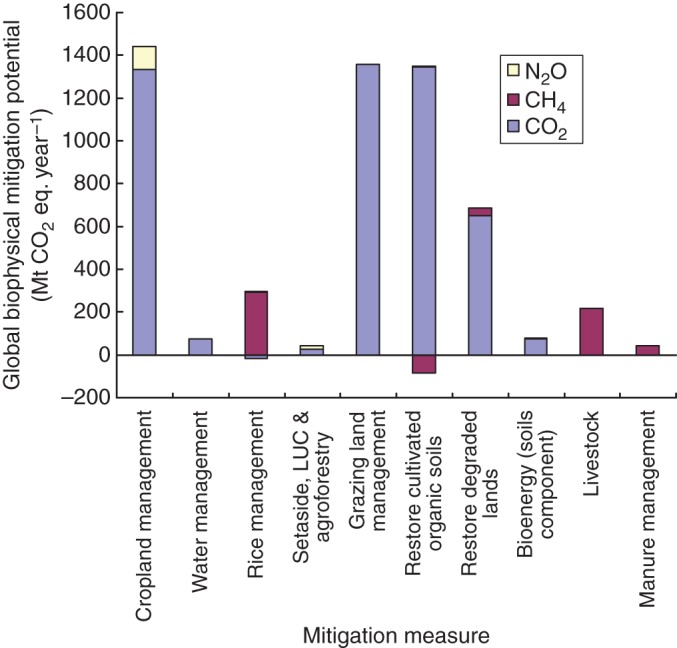
Scope: Grasslands make a significant contribution to food security through providing part of the feed requirements of ruminants used for meat and milk production. Globally, this is more important in food energy terms than pig meat and poultry meat. Grasslands are considered to have the potential to play a key role in greenhouse gas mitigation, particularly in terms of global carbon storage and further carbon sequestration. It is estimated that grazing land management and pasture improvement (e.g. through managing grazing intensity, improved productivity, etc) have a global technical mitigation potential of almost 1·5 Gt CO(2) equivalent in 2030, with additional mitigation possible from restoration of degraded lands. Milk and meat production from grassland systems in temperate regions has similar emissions of carbon dioxide per kilogram of product as mixed farming systems in temperate regions, and, if carbon sinks in grasslands are taken into account, grassland-based production systems can be as efficient as high-input systems from a greenhouse gas perspective.
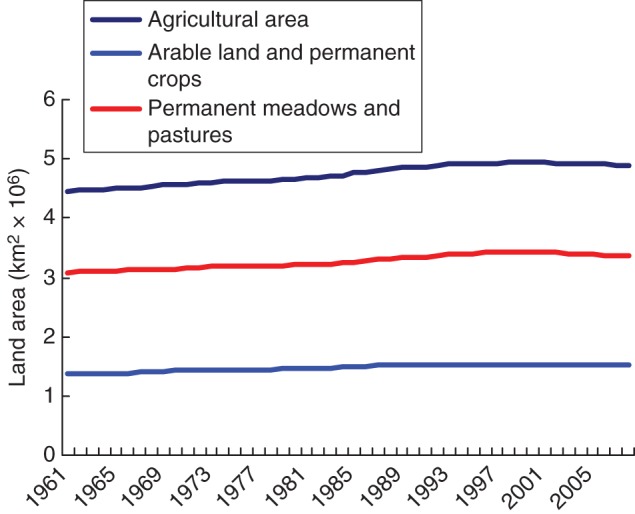
Conclusions: Grasslands are important for global food supply, contributing to ruminant milk and meat production. Extra food will need to come from the world's existing agricultural land base (including grasslands) as the total area of agricultural land has remained static since 1991. Ruminants are efficient converters of grass into humanly edible energy and protein and grassland-based food production can produce food with a comparable carbon footprint as mixed systems. Grasslands are a very important store of carbon, and they are continuing to sequester carbon with considerable potential to increase this further. Grassland adaptation to climate change will be variable, with possible increases or decreases in productivity and increases or decreases in soil carbon stores.
Figures
References
-
- Ammann C, Flechard CR, Leifeld J, Neftel A, Fuhrer J. The carbon budget of newly established temperate grassland depends on management intensity. Agriculture Ecosystems & Environment. 2007;121:5–20.
-
- Bloor JMG, Pichon P, Falcimagne R, Leadley P, Soussana JF. Effects of warming, summer drought, and CO2 enrichment on aboveground biomass production, flowering phenology, and community structure in an upland grassland ecosystem. Ecosystems. 2010;13:888–900.
-
- Buringh P, Dudal R. Agricultural land use in space and time. In: Wolman MG, Fournier FGA, editors. Land transformation in agriculture. New York, NY: John Wiley and Sons; 1987. pp. 9–45.
-
- Ciais P, Reichstein M, Viovy N, et al. Europe-wide reduction in primary productivity caused by the heat and drought in 2003. Nature. 2005;437:529–533. - PubMed
-
- Council for Agricultural Science and Technology (CAST) Animal agriculture and global food supply. Ames, IA, USA: CAST; 1999. Task Force Report no. 135, July 1999.
Publication types
MeSH terms
LinkOut - more resources
Full Text Sources
Medical
Miscellaneous
