


Trajectories of internalizing problems in war-affected Sierra Leonean youth: examining conflict and postconflict factors
- PMID: 23002719
- PMCID: PMC3656826
- DOI: 10.1111/j.1467-8624.2012.01861.x
Trajectories of internalizing problems in war-affected Sierra Leonean youth: examining conflict and postconflict factors
Abstract
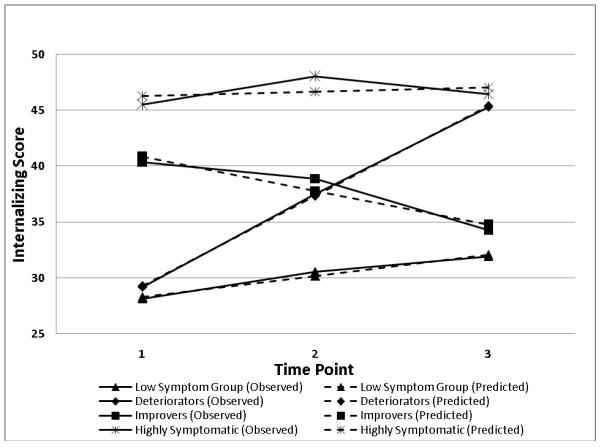
Three waves of data from a prospective longitudinal study in Sierra Leone were used to examine internalizing trajectories in 529 war-affected youth (ages 10-17 at baseline; 25% female). Latent class growth analyses identified 4 trajectories: A large majority of youth maintained lower levels of internalizing problems (41.4%) or significantly improved over time (47.6%) despite very limited access to care, but smaller proportions continued to report severe difficulties 6 years postwar (4.5%) or their symptoms worsened (6.4%). Continued internalizing problems were associated with loss of a caregiver, family abuse and neglect, and community stigma. Despite the comparative resilience of most war-affected youth in the face of extreme adversity, there remains a compelling need for interventions that address family- and community-level stressors.
© 2012 The Authors. Child Development © 2012 Society for Research in Child Development, Inc.
Figures
References
-
- Adjukovic M, Adjukovic D. Impact of displacement on psychological wellbeing of refugee children. International Review of Psychiatry. 1998;10:186–195.
-
- Ahmad A. Posttraumatic stress among children in Kurdistan. Acta Paediatrica. 2008;97(7):884–888. - PubMed
-
- Allwood MA, Bell-Dolan D, Husain SA. Children’s trauma and adjustment reactions to violent and nonviolent war experiences. Journal of the American Academy of Child and Adolescent Psychiatry. 2002;41(4):450–457. - PubMed
-
- Annan J, Brier M. The risk of return: Intimate partner violence in Northern Uganda’s armed conflict. Social Science & Medicine. 2010;70(1):152–159. - PubMed
-
- Barenbaum J, Ruchkin V, Schwab-Stone M. The psychological aspects of children exposed to war: Practice and policy initiatives. Journal of Child Psychology and Psychiatry. 2004;45(1):41–62. - PubMed
Publication types
MeSH terms
Grants and funding
LinkOut - more resources
Full Text Sources
Medical
