


Expression of IL-20 in synovium and lesional skin of patients with psoriatic arthritis: differential response to alefacept treatment
- PMID: 23006144
- PMCID: PMC3580512
- DOI: 10.1186/ar4038
Expression of IL-20 in synovium and lesional skin of patients with psoriatic arthritis: differential response to alefacept treatment
Abstract
Introduction: Psoriatic arthritis (PsA) is an inflammatory joint disease associated with psoriasis. Alefacept (a lymphocyte function-associated antigen (LFA)-3 Ig fusion protein that binds to CD2 and functions as an antagonist to T-cell activation) has been shown to result in improvement in psoriasis but has limited effectiveness in PsA. Interleukin-20 (IL-20) is a key proinflammatory cytokine involved in the pathogenesis of psoriasis. The effects of alefacept treatment on IL-20 expression in the synovium of patients with psoriasis and PsA are currently unknown.
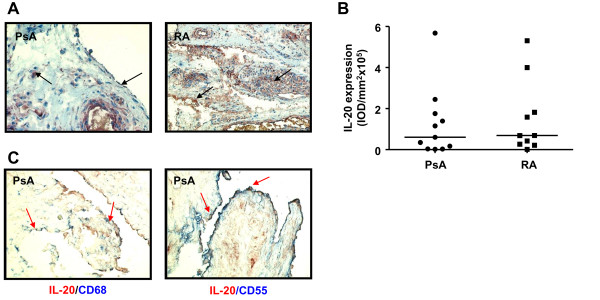
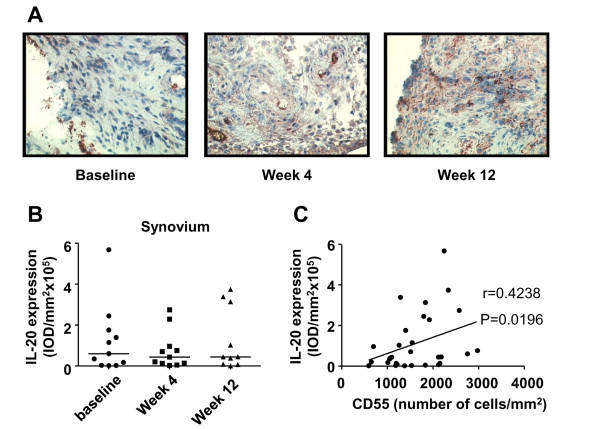
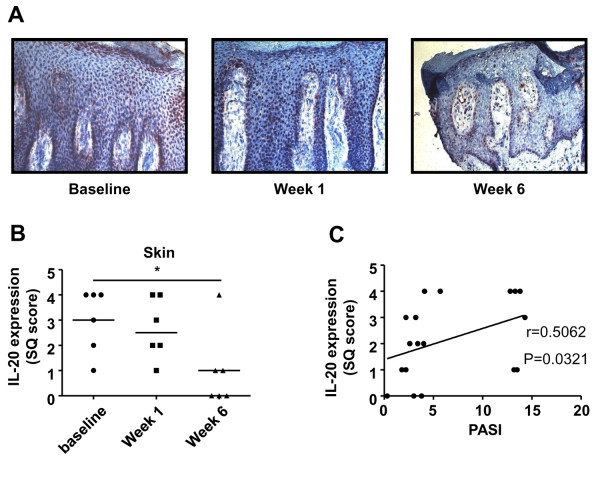
Methods: Eleven patients with active PsA and chronic plaque psoriasis were treated with alefacept (7.5 mg per week for 12 weeks) in an open-label study. Skin biopsies were taken before and after 1 and 6 weeks, whereas synovial biopsies were obtained before and 4 and 12 weeks after treatment. Synovial biopsies from patients with rheumatoid arthritis (RA) (n = 10) were used as disease controls. Immunohistochemical analysis was performed to detect IL-20 expression, and stained synovial tissue sections were evaluated with digital image analysis. Double staining was performed with IL-20 and CD68 (macrophages), and conversely with CD55 (fibroblast-like synoviocytes, FLSs) to determine the phenotype of IL-20-positive cells in PsA synovium. IL-20 expression in skin sections (n = 6) was analyzed semiquantitatively.
Results: IL-20 was abundantly expressed in both PsA and RA synovial tissues. In inflamed PsA synovium, CD68+ macrophages and CD55+ FLSs coexpressed IL-20, and its expression correlated with the numbers of FLSs. IL-20 expression in lesional skin of PsA patients decreased significantly (P = 0.04) 6 weeks after treatment and correlated positively with the Psoriasis Area and Severity Index (PASI). IL-20 expression in PsA synovium was not affected by alefacept.
Conclusions: Conceivably, the relatively limited effectiveness of alefacept in PsA patients (compared with anti-tumor necrosis factor (TNF) therapy) might be explained in part by persistent FLS-derived IL-20 expression.
Figures
References
-
- Krueger GG, Papp KA, Stough DB, Loven KH, Gulliver WP, Ellis CN. A randomized, double-blind, placebo-controlled phase III study evaluating efficacy and tolerability of 2 courses of alefacept in patients with chronic plaque psoriasis. J Am Acad Dermatol. 2002;47:821–833. doi: 10.1067/mjd.2002.127247. - DOI - PubMed
-
- Kraan MC, van Kuijk AW, Dinant HJ, Goedkoop AY, Smeets TJ, de Rie MA, Dijkmans BA, Vaishnaw AK, Bos JD, Tak PP. Alefacept treatment in psoriatic arthritis: reduction of the effector T cell population in peripheral blood and synovial tissue is associated with improvement of clinical signs of arthritis. Arthritis Rheum. 2002;46:2776–2784. doi: 10.1002/art.10543. - DOI - PubMed
Publication types
MeSH terms
Substances
LinkOut - more resources
Full Text Sources
Medical
Research Materials
Miscellaneous
