


Evolution of peripheral nerve function in humans: novel insights from motor nerve excitability
- PMID: 23006483
- PMCID: PMC3630785
- DOI: 10.1113/jphysiol.2012.240820
Evolution of peripheral nerve function in humans: novel insights from motor nerve excitability
Abstract
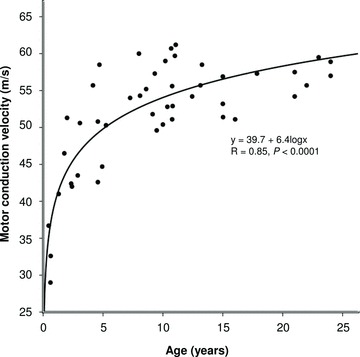
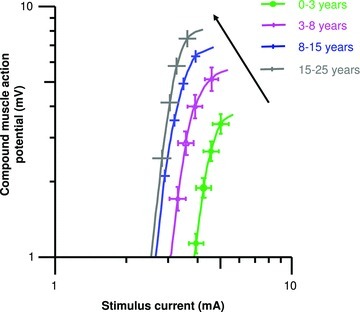
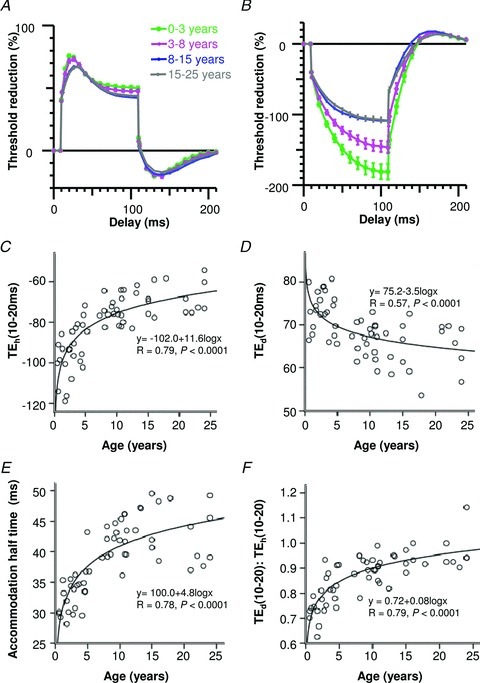
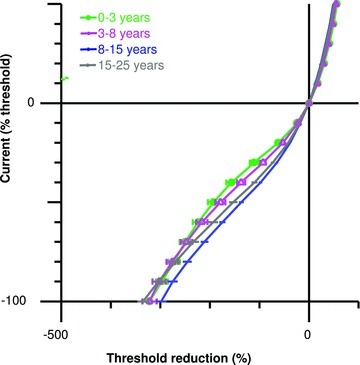
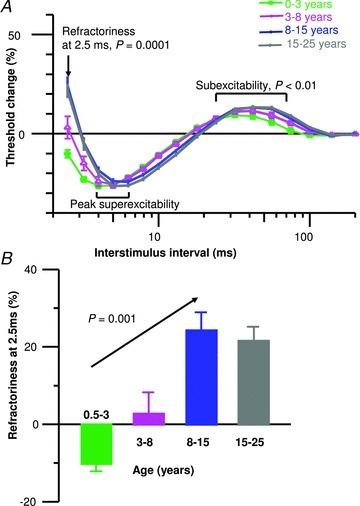
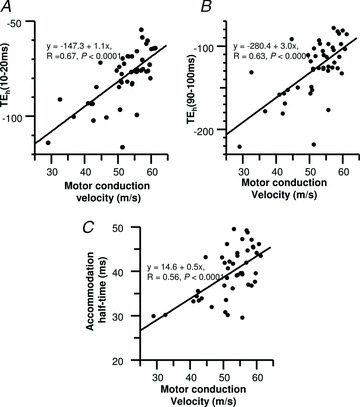
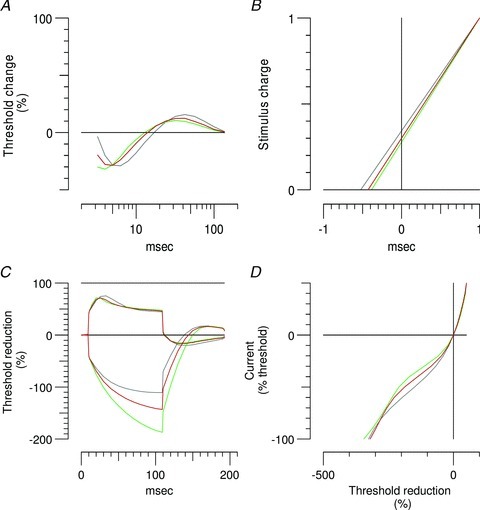
While substantial alterations in myelination and axonal growth have been described during maturation, their interactions with the configuration and activity of axonal membrane ion channels to achieve impulse conduction have not been fully elucidated. The present study utilized axonal excitability techniques to compare the changes in nerve function across healthy infants, children, adolescents and adults. Multiple excitability indices (stimulus-response curve, strength-duration time constant, threshold electrotonus, current-threshold relationship and recovery cycle) combined with conventional neurophysiological measures were investigated in 57 subjects (22 males, 35 females; age range 0.46-24 years), stimulating the median motor nerve at the wrist. Maturational changes in conduction velocity were paralleled by significant alterations in multiple excitability parameters, similarly reaching steady values in adolescence. Maturation was accompanied by reductions in threshold (P < 0.005) and rheobase (P = 0.001); depolarizing and hyperpolarizing electrotonus progressively reduced (P < 0.001), or 'fanned-in'; resting current-threshold slope increased (P < 0.0001); accommodation to depolarizing currents prolonged (P < 0.0001); while greater threshold changes in refractoriness (P = 0.001) and subexcitability (P < 0.01) emerged. Taken together, the present findings suggest that passive membrane conductances and the activity of K(+) conductances decrease with formation of the axo-glial junction and myelination. In turn, these functional alterations serve to enhance the efficiency and speed of impulse conduction concurrent with the acquisition of motor skills during childhood, and provide unique insight into the evolution of postnatal human peripheral nerve function. Significantly, these findings bring the dynamics of axonal development to the clinical domain and serve to further illuminate pathophysiological mechanisms that occur during development.
Figures
References
-
- Baer RD, Johnson EW. Motor nerve conduction velocities in normal children. Arch Phys Med Rehabil. 1965;46:698–704. - PubMed
-
- Bhat MA, Rios JC, Lu Y, Garcia-Fresco GP, Ching W, St Martin M, Li J, Einheber S, Chesler M, Rosenbluth J, Salzer JL, Bellen HJ. Axon-glia interactions and the domain organization of myelinated axons requires neurexin IV/Caspr/Paranodin. Neuron. 2001;30:369–383. - PubMed
-
- Boerio D, Greensmith L, Bostock H. Excitability properties of motor axons in the maturing mouse. J Peripher Nerv Syst. 2009;14:45–53. - PubMed
Publication types
MeSH terms
Substances
LinkOut - more resources
Full Text Sources
Other Literature Sources
