


Quality of online health information about oral contraceptives from Hebrew-language websites
- PMID: 23006798
- PMCID: PMC3475130
- DOI: 10.1186/2045-4015-1-38
Quality of online health information about oral contraceptives from Hebrew-language websites
Abstract
Background: The Internet is a frequently used source of health information. Adolescents in particular seem to be receptive to online health information (OHI) and often incorporate such information in their decision-making processes. Yet, OHI is often incomplete, inaccurate, or unreliable. This study assessed the quality of Hebrew online (non-user-generated) content on oral contraceptives (OC), with regard to accuracy/completeness, credibility, and usability.
Methods: Twenty-nine websites in Hebrew, including those of the four Israeli HMOs, were identified and evaluated. The websites were categorized as: HMO, health portal, contraception-specific, promotional-commercial, and life style and women's health. A set of established content parameters was selected by a family planning expert to assess accuracy/completeness. The Health on the Net Foundation Code of Conduct (HONcode) principles were used to assess the websites' reliability. Usability was assessed by applying items selected from the Minervation Validation and the University of Michigan's 'Website Evaluation checklist' scale. Mean scores, standard deviations (SD), and ranges were calculated for all websites and for category-specific websites. Correlation between dimensions and Inter-rater reliability were also examined.
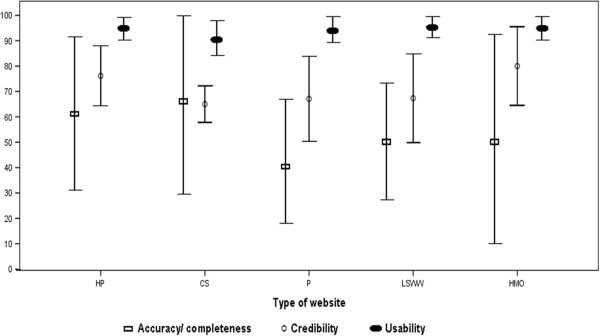
Results: The mean score for accuracy/completeness was 50.9% for all websites (SD=30.1%, range 8-100%). Many websites failed to provide complete information, or provided inaccurate information regarding what to do when a pill is missed and when to use back-up methods. The average credibility score for all websites was 70.6% (SD=15.1, range=38=98%). The credibility parameters that were most commonly absent were funding source, authoring, date of content creation and last modification, explicit reference to evidence-based information, and references and citations. The average usability score for all websites was 94.5% (SD=6.9%, range 79-100%). A weak correlation was found between the three quality parameters assessed.
Conclusions: Wide variation was noted in the quality of Hebrew-language OC websites. HMOs' websites scored highest on credibility and usability, and contraceptive-specific websites exhibited the greatest accuracy/completeness. The findings highlight the need to establish quality guidelines for health website content, train health care providers in assisting their patients to seek high quality OHI, and strengthen e-health literacy skills among online-information seekers, including perhaps health professionals.
Figures
References
-
- Borzekowski DL, Rickert VI. Adolescent cybersurfing for health information: a new resource that crosses barriers. Arch Pediatr Adolesc Med. 2001;155:813–817. - PubMed
LinkOut - more resources
Full Text Sources
