Review
. 2012 Oct;12(10):709-19.
doi: 10.1038/nri3285.

Tools to therapeutically harness the human antibody response

Affiliations
Review

Tools to therapeutically harness the human antibody response

Patrick C Wilson et al. Nat Rev Immunol. 2012 Oct.

Abstract

The natural human antibody response is a rich source of highly specific, neutralizing and self-tolerant therapeutic reagents. Recent advances have been made in isolating and characterizing monoclonal antibodies that are generated in response to natural infection or vaccination. Studies of the human antibody response have led to the discovery of crucial epitopes that could serve as new targets in vaccine design and in the creation of potentially powerful immunotherapies. With a focus on influenza virus and HIV, herein we summarize the technological tools used to identify and characterize human monoclonal antibodies and describe how these tools might be used to fight infectious diseases.


Conflict of interest statement

The authors declare no competing financial interests.

Figures
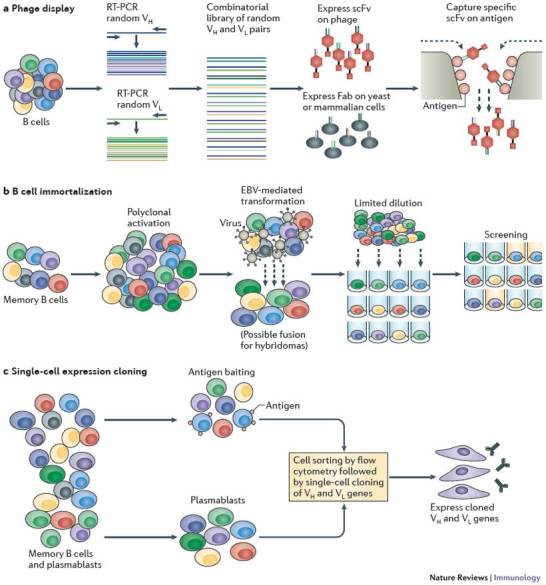
Figure 1
Figure 1. Methodologies commonly used to isolate human monoclonal antibodies.
Three general approaches and variations therein are typically used to isolate monoclonal antibodies from humans. The particular method used depends on various factors but is largely driven by the types of samples obtained. a | Samples with rare specific memory B cells require a higher throughput methodology, such as phage display, to identify the rarest specificities. b | Epstein–Barr virus (EBV)-mediated transformation or other B cell immortalization strategies can be used for most samples in which an immunological history is known. c | In instances in which an effective antigen bait is available that will allow for the detection of B cells with specific receptors using flow cytometry, single-cell expression cloning can be used. Finally, if there is an ongoing or recent immune response to vaccination or infection then the population of activated plasmablasts will contain a high frequency of specific cells that can be used to generate abundant human monoclonal antibodies by expression cloning.
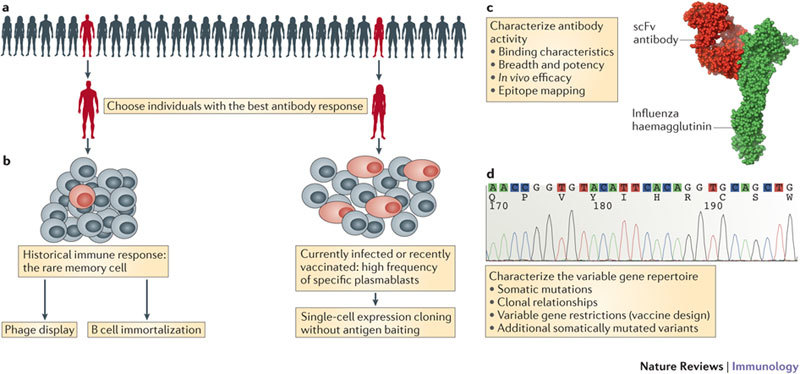
Figure 2
Figure 2. Summary of the processes typical of human monoclonal antibody isolation and analysis.
To maximize the chances of identifying relevant human monoclonal antibodies with both potent and broad reactivity to variant forms of a particular virus or other pathogen, a number of issues must be taken into consideration when the studies are designed. The factors summarized in this figure are detailed within the body text and include the following. a | First, an appropriate cohort must be chosen, such as HIV long-term non-progressors, influenza pandemic survivors, currently or recently infected individuals, vaccinated individuals, and people with a wider breadth or higher potency of serum neutralization than the general population. b | Second, an appropriate methodology must be chosen to generate a library of monoclonal antibodies. c | Third, the relevant resources, reagents and methodologies must be applied to characterize the activity of the antibodies isolated. Examples of such characterizations include: screening for appropriate binding characteristics using enzyme-linked immunosorbent assays (ELISAs) and surface plasmon resonance; determining the breadth and potency of neutralization activity in vitro; testing the in vivo efficacy of protective antibodies in animal models; and mapping epitopes by escape-mutant analysis, target-antigen mutagenesis, competition assays using monoclonal antibodies of known specificity, functional assays and X-ray crystallography. The space-filling diagram denoting the structure of an antibody Fab fragment bound to influenza virus haemagglutinin exemplifies how epitopes are determined using crystallography. d | The biological information gleaned from analysing the highly unique antibody variable gene sequences can be used to further understand the immune responses, as well as to identify additional antibodies that have similar specificities but that differ in fine specificity and efficacy owing to differentially accumulated immunoglobulin somatic mutations. The graph depicts typical nucleotide sequence data.
Figure 3
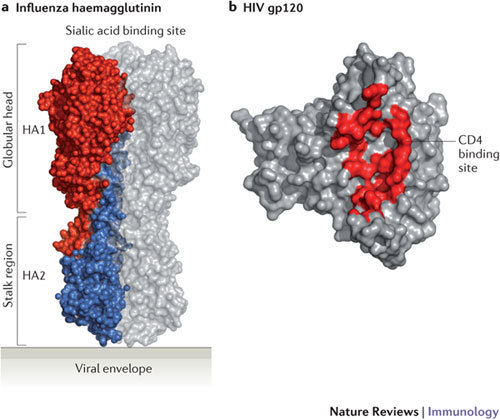
Figure 3. Structures of influenza haemagglutinin and HIV gp120.
a | The figure shows a space-filling model of a haemagglutinin trimer from the 2009 pandemic H1N1 influenza virus strain (the structural data were obtained from the Protein Data Bank (PDB ID: 3LZG)). The HA1 and HA2 subunits of one trimer — as well as how they contribute to the haemagglutinin globular head region versus the more conserved haemagglutinin stalk region — are indicated. b | The figure shows a top-down view of a space-filling model of HIV gp120 (PDB ID: 2NY6), and indicates the crucial CD4 binding site, as determined by the Kwong group.

References

    1. Casadevall A, Dadachova E, Pirofski LA. Passive antibody therapy for infectious diseases. Nature Rev. Microbiol. 2004;2:695–703. doi: 10.1038/nrmicro974. - DOI - PubMed
    1. Kohler G, Milstein C. Continuous cultures of fused cells secreting antibody of predefined specificity. Nature. 1975;256:495–497. - PubMed
    1. Winter G, Harris WJ. Humanized antibodies. Immunol. Today. 1993;14:243–246. doi: 10.1016/0167-5699(93)90039-N. - DOI - PubMed
    1. Carter PJ. Potent antibody therapeutics by design. Nature Rev. Immunol. 2006;6:343–357. doi: 10.1038/nri1837. - DOI - PubMed
    1. Chan AC, Carter PJ. Therapeutic antibodies for autoimmunity and inflammation. Nature Rev. Immunol. 2010;10:301–316. doi: 10.1038/nri2761. - DOI - PubMed

Publication types