


It's all about location, location, location: children's memory for the "where" of personally experienced events
- PMID: 23010356
- PMCID: PMC3478447
- DOI: 10.1016/j.jecp.2012.06.007
It's all about location, location, location: children's memory for the "where" of personally experienced events
Abstract
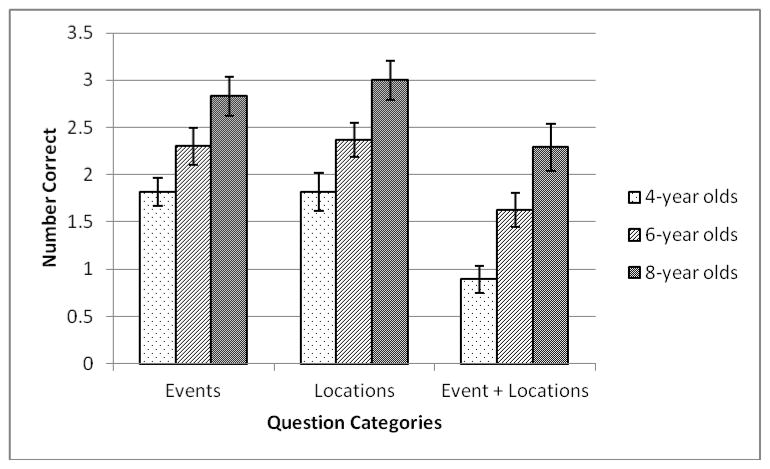
Episodic memory is defined as the ability to recall specific past events located in a particular time and place. Over the preschool and into the school years, there are clear developmental changes in memory for when events took place. In contrast, little is known about developmental changes in memory for where events were experienced. In the current research, we tested 4-, 6-, and 8-year-old children's memories for specific laboratory events, each of which was experienced in a unique location. We also tested the children's memories for the conjunction of the events and their locations. Age-related differences were observed in all three types of memory (event, location, and conjunction of event and location), with the most pronounced differences being in memory for conjunctions of events and their locations. The results have implications for our understanding of the development of episodic memory, including suggestions of protracted development of the ability to contextualize events in their spatial locations.
Copyright © 2012 Elsevier Inc. All rights reserved.
Figures
References
-
- Ackerman BP. Children’s retrieval deficit. In: Brainerd CJ, Pressley M, editors. Basic processes in memory development: Progress in cognitive development research. New York: Springer-Verlag; 1985. pp. 1–46.
-
- Addis DR, McIntosh AR, Moscovitch M, Crawley AP, McAndrews MP. Characterizing spatial and temporal features of autobiographical memory retrieval networks: A partial least squares approach. NeuroImage. 2004;23:1460–1471. - PubMed
-
- Bahrick HP. The anatomy of free recall. Memory & Cognition. 1974;2:484–490. - PubMed
-
- Baker-Ward L, Gordon BN, Ornstein PA, Larus DM, Clubb PA. Young children’s long-term retention of a pediatric examination. Child Development. 1993;64(5):1519–1533. - PubMed
-
- Bellezza FS. The spatial-arrangement mnemonic. Journal of Educational Psychology. 1983;75:830–837.
Publication types
MeSH terms
Grants and funding
LinkOut - more resources
Full Text Sources
Miscellaneous
