. 2012 Dec;120(12):1692-8.
doi: 10.1289/ehp.1205188. Epub 2012 Sep 24.

Hyaluronan activation of the Nlrp3 inflammasome contributes to the development of airway hyperresponsiveness

Affiliations

Hyaluronan activation of the Nlrp3 inflammasome contributes to the development of airway hyperresponsiveness

Feifei Feng et al. Environ Health Perspect. 2012 Dec.

Retraction in

Abstract

Background: The role of the Nlrp3 inflammasome in nonallergic airway hyperresponsiveness (AHR) has not previously been reported. Recent evidence supports both interleukin (IL) 1β and short fragments of hyaluronan (HA) as contributors to the biological response to inhaled ozone.

Objective: Because extracellular secretion of IL-1β requires activation of the inflammasome, we investigated the role of the inflammasome proteins ASC, caspase1, and Nlrp3 in the biological response to ozone and HA.

Methods: C57BL/6J wild-type mice and mice deficient in ASC, caspase1, or Nlrp3 were exposed to ozone (1 ppm for 3 hr) or HA followed by analysis of airway resistance, cellular inflammation, and total protein and cytokines in bronchoalveolar lavage fluid (BALF). Transcription levels of IL-1β and IL-18 were determined in two populations of lung macrophages. In addition, we examined levels of cleaved caspase1 and cleaved IL-1β as markers of inflammasome activation in isolated alveolar macrophages harvested from BALF from HA-treated mice.

Results: We observed that genes of the Nlrp3 inflammasome were required for development of AHR following exposure to either ozone or HA fragments. These genes are partially required for the cellular inflammatory response to ozone. The expression of IL-1β mRNA in alveolar macrophages was up-regulated after either ozone or HA challenge and was not dependent on the Nlrp3 inflammasome. However, soluble levels of IL-1β protein were dependent on the inflammasome after challenge with either ozone or HA. HA challenge resulted in cleavage of macrophage-derived caspase1 and IL-1β, suggesting a role for alveolar macrophages in Nlrp3-dependent AHR.

Conclusions: The Nlrp3 inflammasome is required for the development of ozone-induced reactive airways disease.


Conflict of interest statement

The authors declare they have no actual or potential competing financial interests.

Figures
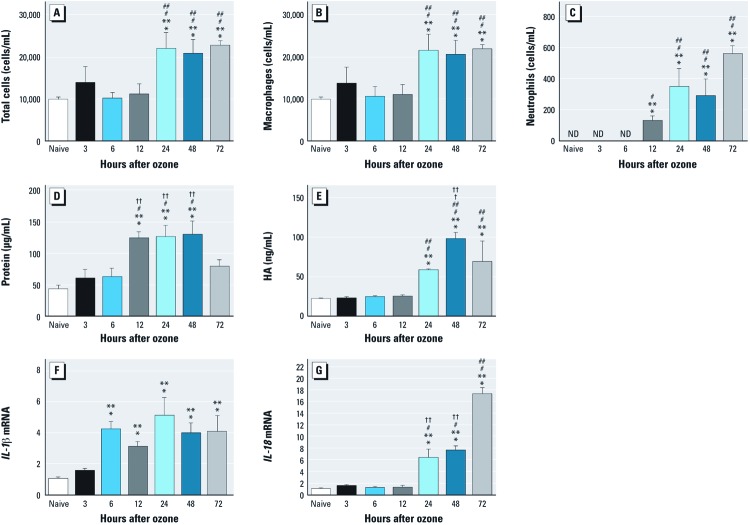
Figure 1
Figure 1
Biological response measured by cellular inflammation (A–C), total protein (D), HA (E), and cytokines (F,G) in BALF from WT mice exposed to ozone (1 ppm for 3 hr) and followed over a 72‑hr time course. (A) Total number of inflammatory cells. (B) Number of macrophages. (C) Number of neutrophils. (D) Total protein. (E) HA production. Significant increases were observed at 24, 48, and 72 hr after exposure to ozone compared with naive (unexposed mice). No increases in the number of total cells and macrophages or the level of HA were detected at 3, 6, or 12 hr after exposure; however, the number of neutrophils began to increase at 12 hr and reached its highest level at 72 hr. (F, G) Expression of IL‑1β mRNA (F) and IL‑18 mRNA (G) in alveolar macrophages. (F)IL‑1β mRNA was up‑regulated at 6 hr and remained at that level throughout the 72‑hr time course. (G) IL‑18 mRNA increased beginning at 24 hr and peaked at 72 hr. Data are presented as mean ± SE (n = 5–8) and are representative of two similar experiments. *p < 0.05 vs. naive. **p< 0.05 vs. 12 hr. p < 0.05 vs. 24 hr. ††p< 0.05 vs. 72 hr.
Figure 2
Figure 2
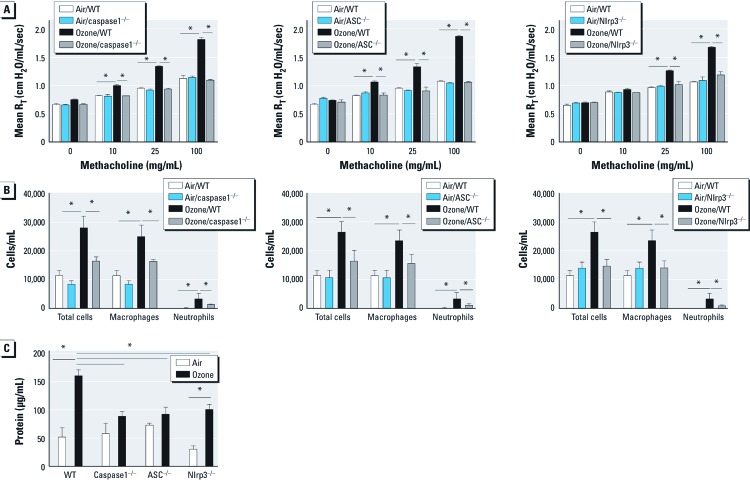
The role of Nlrp3 inflammasome in response to ozone. WT mice and inflammasome-deficient mice exposed to ozone (1 ppm × 3 hr) and phenotyped for airway responsiveness after methacholine challenge (A–C), cell infiltration (B), and BAL protein level (C) measured at 24 hr after exposure. (A–C) caspase1 (A), ASC (B), and Nlrp3 (C) are necessary for the development of ozone-induced AHR. (B) Total cells, macrophages, and neutrophils in BALF from ozone-exposed WT mice were higher than those from caspase1-, ASC-, and Nlrp3-deficient mice. (C) The level of BAL protein was higher after ozone exposure and was completely dependent on caspase1 and ASC, and partially dependent on Nlrp3. Data are presented as mean ± SE (n = 5) and are representative of two similar experiments. *p < 0.05.
Figure 3
Figure 3
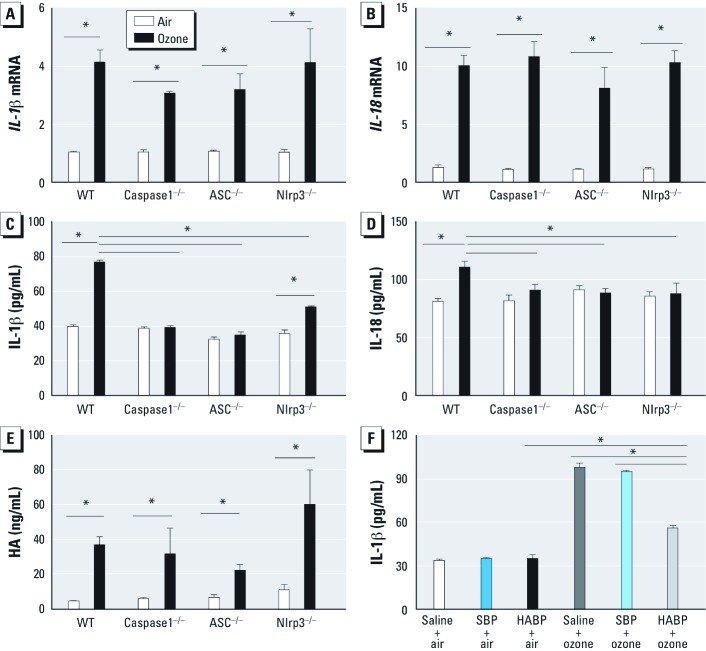
IL‑1β, IL‑18, and HA in BALF from WT mice and inflammasome-deficient mice 24 hr after exposure to ozone (1 ppm × 3 hr). (A–B) The transcription levels of IL‑1β (A) and IL‑18 (B) in alveolar macrophages were up‑regulated in ozone-exposed mice compared with air-exposed mice, and were not dependent on the Nlrp3 inflammasome. (C–D) Increases in IL‑1β (C) and IL‑18 (D) proteins were completely dependent on ASC and caspase-1, IL‑1β was partially dependent on Nlrp3, and IL‑18 was completely dependent on Nlrp3. (E) Ozone exposure enhanced the level of soluble HA in BAL; the level of HA was not dependent on Nlrp3 inflammasomes. (F) The level of secreted IL‑1β in BAL was increased after ozone exposure, but was partially decreased by HABP compared with air, saline, and scrambled-binding peptide (SBP) controls. Data are presented as mean ± SE (n= 5) and are representative of two similar experiments. *p < 0.05.
Figure 4
Figure 4
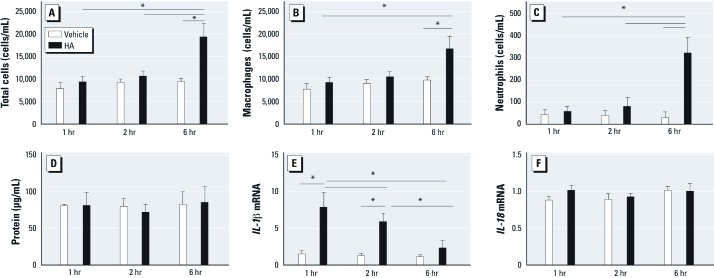
Time course of biological responses to HA (50 µL; 25 µg/mouse) or vehicle instilled intratracheally into isoflurane-anesthetized WT mice; responses were observed BALF at 1, 2, and 6 hr after HA treatment. (A–C) No increases were observed in total cells (A), macrophages (B), or neutrophils (B) until 6 hr after treatment. (D) No increases were detected in protein after HA treatment compared with vehicle at these time points. (E) IL‑1β mRNA in alveolar macrophages was up‑regulated 1 hr and 2 hr after HA treatment compared with vehicle, but values decreased to near baseline at 6 hr. (F) The transcription level of IL‑18 was not significantly different after HA treatment at the three time points. Data are presented as mean ± SE (n = 5) and are representative of two similar experiments. *p < 0.05.
Figure 5
Figure 5
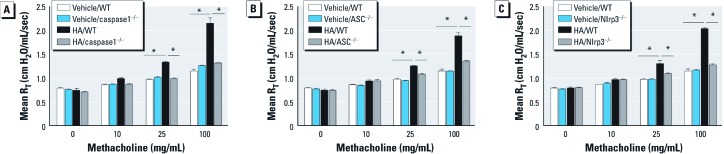
The role of the Nlrp3 inflammasome in airway response to HA in WT and inflammasome-deficient mice 2 hr after challenge with short-fragment HA (25 µg/mouse). Compared with WT mice, mice deficient in caspase1 (A), ASC (B), or Nlrp3 (C) were protected from HA-induced AHR. Data are presented as mean ± SE (n = 5) and are representative of two similar experiments. *p < 0.05.
Figure 6
Figure 6
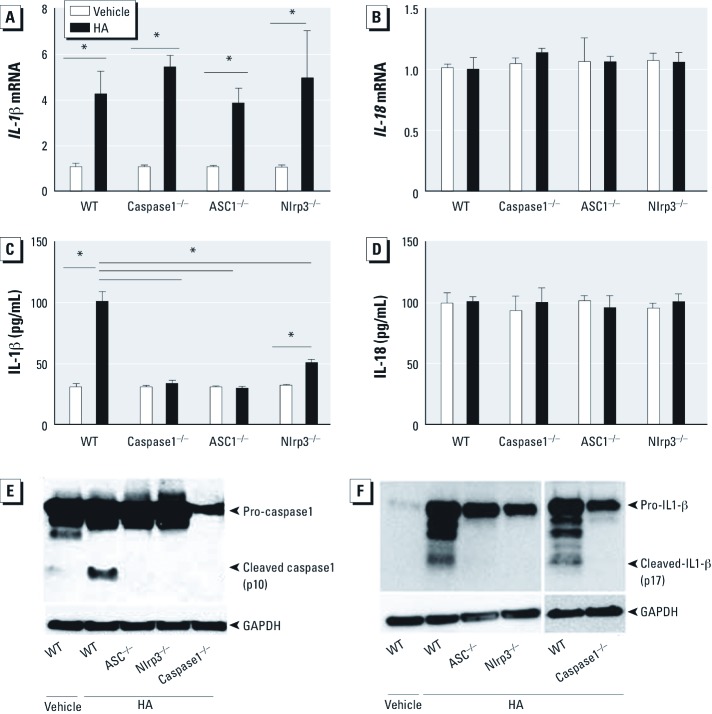
IL‑1β and IL‑18 mRNA (A,B) and protein (C,D), cleaved caspase1 (E), and cleaved IL‑1β (F) in alveolar macrophages from WT and inflammasome-deficient mice 2 hr after challenge with short-fragment HA (25 µg/mouse). (A) IL‑1β transcription was increased in alveolar macrophages from HA-treated mice compared with vehicle controls and was not dependent on the Nlrp3 inflammasome; however, IL‑18 mRNA expression (B) was not affected by HA. (C) After HA treatment, IL‑1β in BALF from WT mice was higher than that from Nlrp3 inflammasome-deficient mice. (D) The IL‑18 protein level was not increased. HA challenge results in cleavage of pro-caspase1 and cleavage of pro-IL‑1β in WT mice. (E,F) Western blot analysis for cleaved caspase1 (E) and cleaved IL‑1β (F) identified cleavage only in HA-exposed WT mice but not in ASC–/–, Nlrp3–/–, or caspase1–/– mice. Data are presented as mean ± SE (n = 5) and are representative of two similar experiments. *p< 0.05.

Comment in

  • Findings of Research Misconduct.
    [No authors listed] [No authors listed] Fed Regist. 2019 Nov 7;84(216):60097-60098. Fed Regist. 2019. PMID: 37547121 Free PMC article. No abstract available.

References

    1. Al-Hegelan M, Tighe RM, Castillo C, Hollingsworth JW. Ambient ozone and pulmonary innate immunity. Immunol Res. 2011;49(1–3):173–191. - PMC - PubMed
    1. Backus GS, Howden R, Fostel J, Bauer AK, Cho HY, Marzec J, et al. Protective role of interleukin-10 in ozone-induced pulmonary inflammation. Environ Health Perspect. 2010;118:1721–1727. - PMC - PubMed
    1. Barker BR, Taxman DJ, Ting JP. Cross-regulation between the IL-1β/IL-18 processing inflammasome and other inflammatory cytokines. Curr Opin Immunol. 2011;23(5):591–597. - PMC - PubMed
    1. Bauernfeind F, Bartok E, Rieger A, Franchi L, Nunez G, Hornung V. Cutting edge: reactive oxygen species inhibitors block priming, but not activation, of the NLRP3 inflammasome. J Immunol. 2011;187(2):613–617. - PMC - PubMed
    1. Bell M, McDermott A, Zeger S, Samet J, Dominici F. Ozone and short-term mortality in 95 US urban communities, 1987–2000. JAMA. 2004;292(19):2372–2378. - PMC - PubMed

Publication types