


Arginine de novo and nitric oxide production in disease states
- PMID: 23011059
- PMCID: PMC3517635
- DOI: 10.1152/ajpendo.00284.2012
Arginine de novo and nitric oxide production in disease states
Abstract
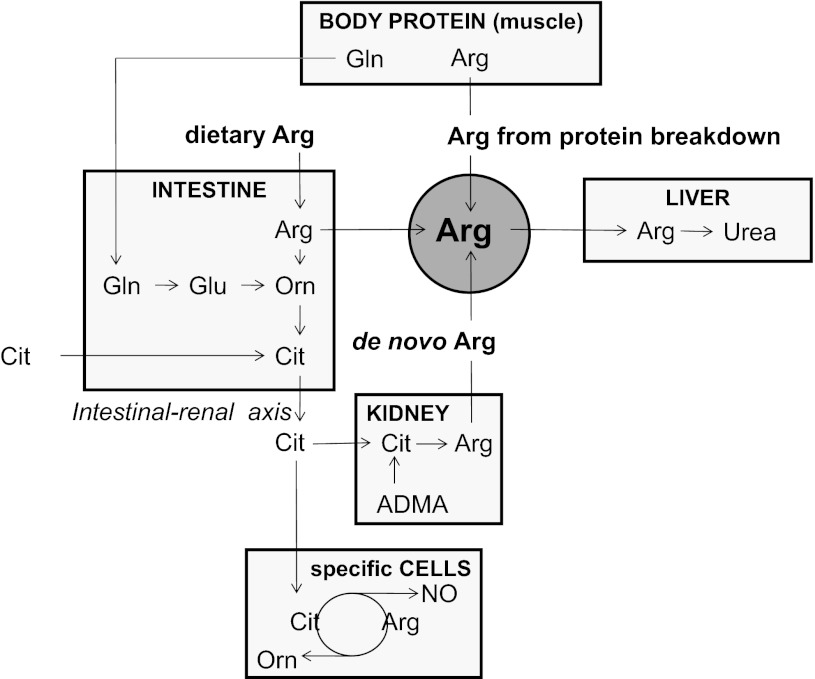
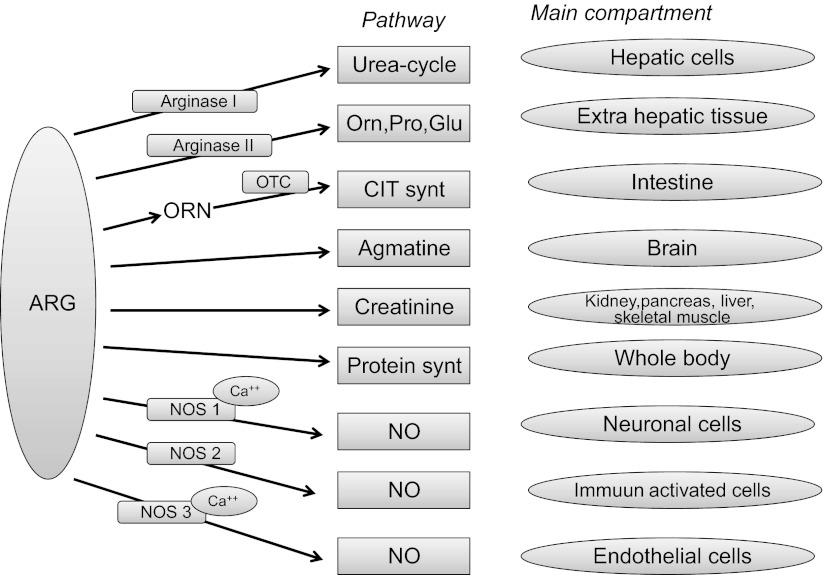
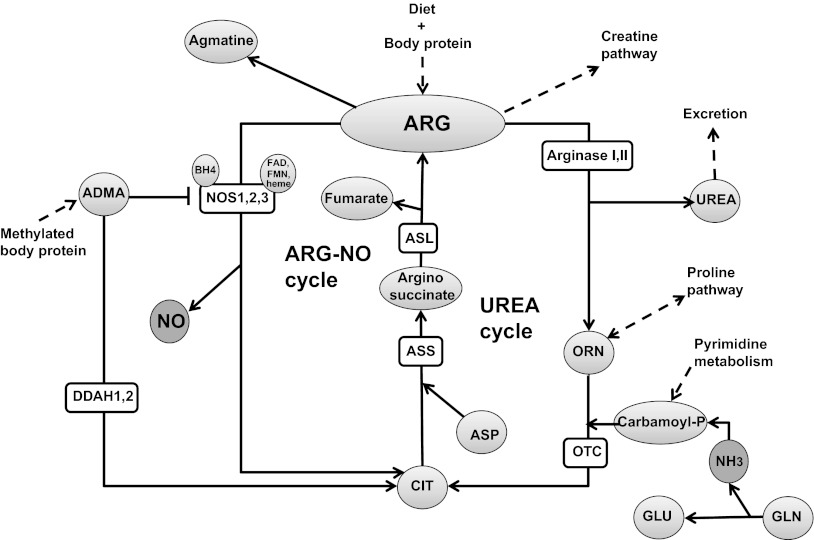
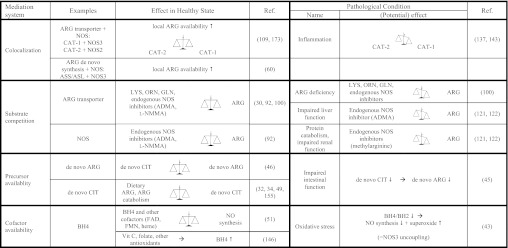
Arginine is derived from dietary protein intake, body protein breakdown, or endogenous de novo arginine production. The latter may be linked to the availability of citrulline, which is the immediate precursor of arginine and limiting factor for de novo arginine production. Arginine metabolism is highly compartmentalized due to the expression of the enzymes involved in arginine metabolism in various organs. A small fraction of arginine enters the NO synthase (NOS) pathway. Tetrahydrobiopterin (BH4) is an essential and rate-limiting cofactor for the production of NO. Depletion of BH4 in oxidative-stressed endothelial cells can result in so-called NOS3 "uncoupling," resulting in production of superoxide instead of NO. Moreover, distribution of arginine between intracellular transporters and arginine-converting enzymes, as well as between the arginine-converting and arginine-synthesizing enzymes, determines the metabolic fate of arginine. Alternatively, NO can be derived from conversion of nitrite. Reduced arginine availability stemming from reduced de novo production and elevated arginase activity have been reported in various conditions of acute and chronic stress, which are often characterized by increased NOS2 and reduced NOS3 activity. Cardiovascular and pulmonary disorders such as atherosclerosis, diabetes, hypercholesterolemia, ischemic heart disease, and hypertension are characterized by NOS3 uncoupling. Therapeutic applications to influence (de novo) arginine and NO metabolism aim at increasing substrate availability or at influencing the metabolic fate of specific pathways related to NO bioavailability and prevention of NOS3 uncoupling. These include supplementation of arginine or citrulline, provision of NO donors including inhaled NO and nitrite (sources), NOS3 modulating agents, or the targeting of endogenous NOS inhibitors like asymmetric dimethylarginine.
Figures
References
-
- Aliev G, Palacios HH, Lipsitt AE, Fischbach K, Lamb BT, Obrenovich ME, Morales L, Gasimov E, Bragin V. Nitric oxide as an initiator of brain lesions during the development of Alzheimer disease. Neurotox Res 16: 293–305, 2009 - PubMed
-
- Annane D, Sanquer S, Sebille V, Faye A, Djuranovic D, Raphael JC, Gajdos P, Bellissant E. Compartmentalised inducible nitric-oxide synthase activity in septic shock. Lancet 355: 1143–1148, 2000 - PubMed
-
- Antoniades C, Bakogiannis C, Leeson P, Guzik TJ, Zhang MH, Tousoulis D, Antonopoulos AS, Demosthenous M, Marinou K, Hale A, Paschalis A, Psarros C, Triantafyllou C, Bendall J, Casadei B, Stefanadis C, Channon KM. Rapid, direct effects of statin treatment on arterial redox state and nitric oxide bioavailability in human atherosclerosis via tetrahydrobiopterin-mediated endothelial nitric oxide synthase coupling. Circulation 124: 335–345, 2011 - PMC - PubMed
Publication types
MeSH terms
Substances
Grants and funding
LinkOut - more resources
Full Text Sources
Other Literature Sources
Medical
