. 2013 Feb;38(3):423-36.
doi: 10.1038/npp.2012.197. Epub 2012 Sep 26.

Disrupted-in-schizophrenia-1 Gln31Leu polymorphism results in social anhedonia associated with monoaminergic imbalance and reduction of CREB and β-arrestin-1,2 in the nucleus accumbens in a mouse model of depression

Affiliations

Disrupted-in-schizophrenia-1 Gln31Leu polymorphism results in social anhedonia associated with monoaminergic imbalance and reduction of CREB and β-arrestin-1,2 in the nucleus accumbens in a mouse model of depression

Tatiana V Lipina et al. Neuropsychopharmacology. 2013 Feb.

Abstract

Disrupted-in-schizophrenia-1 (DISC1) is associated with mental disorders, including major depression. We previously showed that DISC1-Q31L mutant mice have depression-like behaviors and can therefore be used to study neurobiological mechanisms of depression and antidepressant (AD) medication action. First, we found reduced levels of dopamine, serotonin and norepinephrine in the nucleus accumbens (NAC) of DISC1-Q31L mutants. Next, we assessed social-conditioned place preference as a reward-dependent task and the capacity of distinct ADs to correct impaired social behavior in DISC1-Q31L mice. Bupropion, but not fluoxetine or desipramine, was able to correct deficient social facilitation, social reward, and social novelty in DISC1-Q31L mutants, whereas all three ADs were able to improve social motivation and behavioral despair in DISC1-Q31L mutants. Furthermore, we sought to correlate social anhedonia with molecular and cellular features including dendritic spine density, β-arrestin-1,2, and cAMP-response-element-binding protein (CREB) in the NAC as biomarkers related to depression and the DISC1 pathway. DISC1-Q31L mutants showed reduced levels of β-arrestin-1,2, CREB, and spine density in the NAC, further supporting the construct validity of the genetic model. Bupropion induced the greatest effect on CREB in DISC1-Q31L mutants, whereas all studied ADs corrected the reduced levels of β-arrestin-1,2 and modestly ameliorated deficient spine density in this brain region. Overall, we find neurobiological changes accompanying social anhedonia in the NAC of DISC1-Q31L mutant mice, consistent with a role for DISC1 in regulating social reward as an endophenotype of depression.


Figures
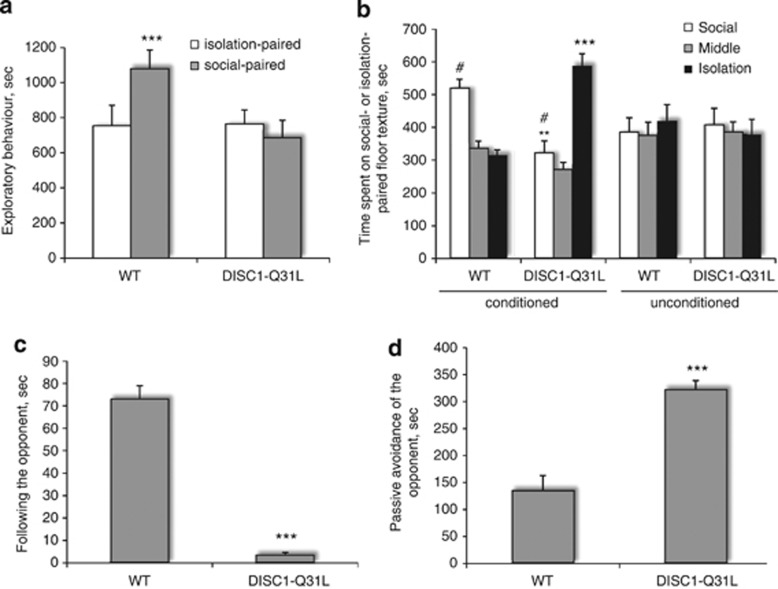
Figure 1
Figure 1
(a–d) Social anhedonia in DISC1-Q31L mutant mice. (a) No social facilitation was observed in DISC1-Q31L mutants (n=10) during the social-conditioning sessions of the social conditioning place preference (SCPP) test. DISC1-Q31L mutants do not increase their exploration during the socially paired sessions in contrast to their WT littermates (n=14 mice); ***p<0.001—in comparison with isolation-paired WT mice. (b) DISC1-Q31L mutants do not value socializing with familiar cagemates during the test session in SCPP. DISC1-Q31L mutants spent more time in the compartment where they were isolated during the conditioning sessions, whereas socially-conditioned WT mice had a strong preference for locations where social interactions took place. The number of transitions between the compartments is comparable between the genotypes. **p<0.01; ***p<0.001—in comparison with WT; #p<0.001—in comparison with isolation-paired compartment within each genotype; (c–d) DISC1-Q31L mutant mice showed social avoidance of the standard opponent assessed by Neutral Arena task. (c) Amount of time following the opponent was significantly reduced in DISC1-Q31L mutants (n=6) and (d) duration of passive avoidance of the opponent was increased in DISC1-Q31L mice in comparison with WT mice (n=6). ***p<0.001—in comparison with WT mice.
Figure 2
Figure 2
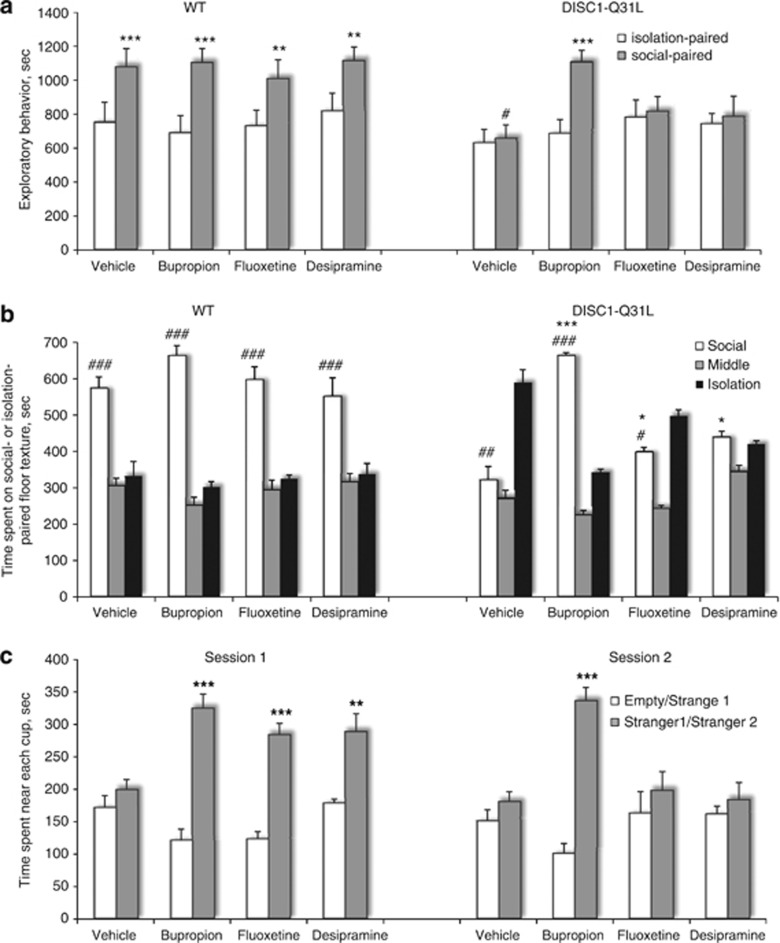
(a–c) Effects of bupropion, fluoxetine, and desipramine on deficient social behavior in DISC1-Q31L mice. (a)Bupropion-treated DISC1-Q31L mice significantly increased their exploratory behavior during the social-conditioning session, whereas fluoxetine- and desipramine-treated DISC1-Q31L mutants did not show social facilitation. N=6–8 mice per group; #p<0.001—in comparison with social-paired WT mice; **p<0.01, ***p<0.001—in comparison with isolation-paired mice within each experimental group. (b) Only bupropion-treated DISC1-Q31L mutant mice preferred to spend time on social-paired floor texture over the isolation-associated compartment during the test session in the SCPP task, whereas fluoxetine- and desipramine-treated DISC1-Q31L mice spent equal amount of time on both compartments of the SCPP chamber. N=6–8 per each group. #p<0.05; ##p<0.01; ###p<0.001—in comparison with isolation-paired context within each experimental group; *p<0.05; ***p<0.01—in comparison with vehicle-treated DISC1-Q31L mice. (c) All three antidepressant drugs significantly improved social motivation in DISC1-Q31L mice (N=7–8 mice per group) assessed in the ‘session 1' (social affiliation), whereas only bupropion, but not fluoxetine or desipramine, improved deficient social recognition in DISC1-Q31L mutants assessed in the ‘session 2' (social novelty). Antidepressants had no effect on motor activity of mice of both genotypes (Supplementary Table S2) and did not affect performance of WT mice (Supplementary Figure S1) (N=6–8 mice per group); **p<0.01; ***p<0.001—in comparison with either time spent near the ‘empty' cup in the ‘session 1' or near the cup containing ‘stranger 1' in the ‘session 2' within each drug treatment.
Figure 3
Figure 3
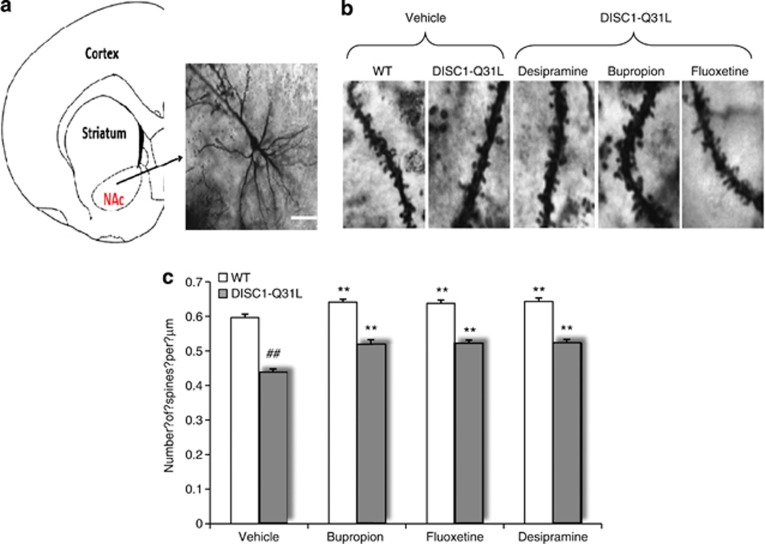
(a–c) The reduced spine density in the NAC of DISC1-Q31L mice was modestly meliorated by bupropion, fluoxetine, and desipramine. (a) Coronal section of mouse brain with a higher magnification image of neuron in the NAC. Golgi-stained images of spine protrusions at × 100 magnification in wild-type (WT) and DISC1-Q31L mutant mice. (b) High magnification ( × 100) of Golgi-stained images of spine protrusions on apical dendrites. (c) Quantitative analysis of spine density in the NAC in ADs-treated DISC1-Q31L and WT mice. ##p<0.01—in comparison with WT mice; **p<0.01—in comparison with vehicle-treated mice within each experimental group. N=75–100 neurons from 3–5 mice per each treatment group.
Figure 4
Figure 4
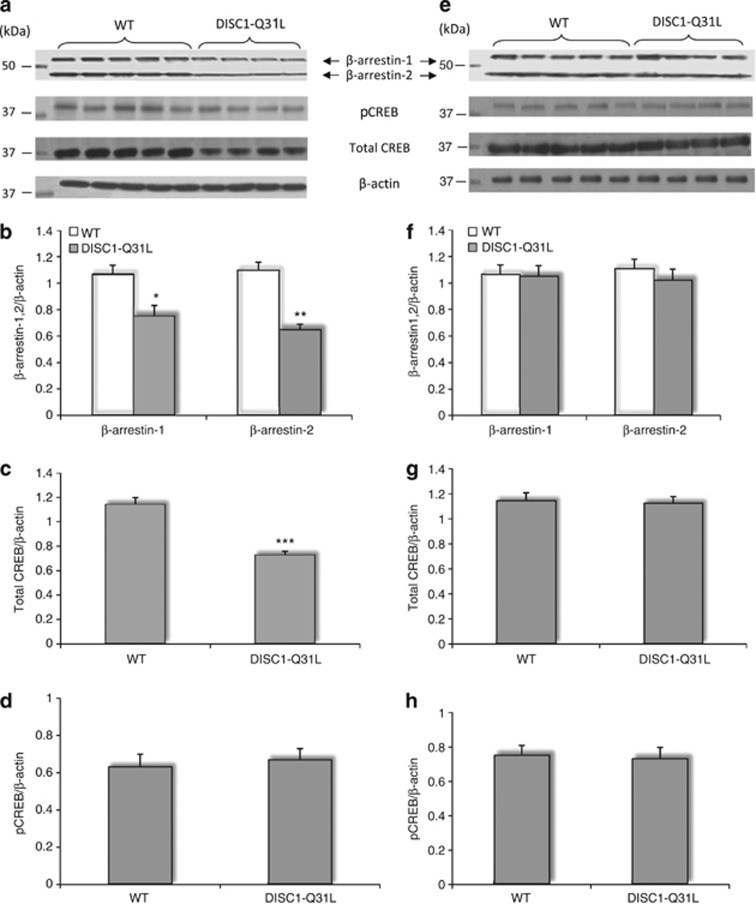
(a–h) The reduced protein levels of β-arrestin-1,2 and total CREB in the NAC but not in the hippocampus of DISC1-Q31L mice. (a) Representative immunoblots are shown, probed with antibodies against β-arrestin-1,2, total CREB, pCREB at Ser129/133, as well as β-actin as a loading control in the NAC of WT and DISC1-Q31L mice. Quantification of immunoblots data for β-arrestin-1, β-arrestin-2 as normalized to the total amount of β-actin (b); for pCREB at Ser129/133 as normalized to the total amount of β-actin (c), and for the total CREB as normalized to the total amount of β-actin (d). (e) Representative immunoblots are shown, probed with antibodies against β-arrestin-1,2, total CREB, pCREB at Ser129/133, as well as β-actin as a loading control in the hippocampus of WT and DISC1-Q31L mice. Quantification of immunoblots data for β-arrestin-1, β-arrestin-2 as normalized to the total amount of β-actin (f); for pCREB at Ser129/133 as normalized to the total amount of β-actin (g), and for the total CREB as normalized to the total amount of β-actin (h). N=8–12 animals per genotype; *p<0.05; **p<0.01; ***p<0.001—in comparison with WT.
Figure 5
Figure 5
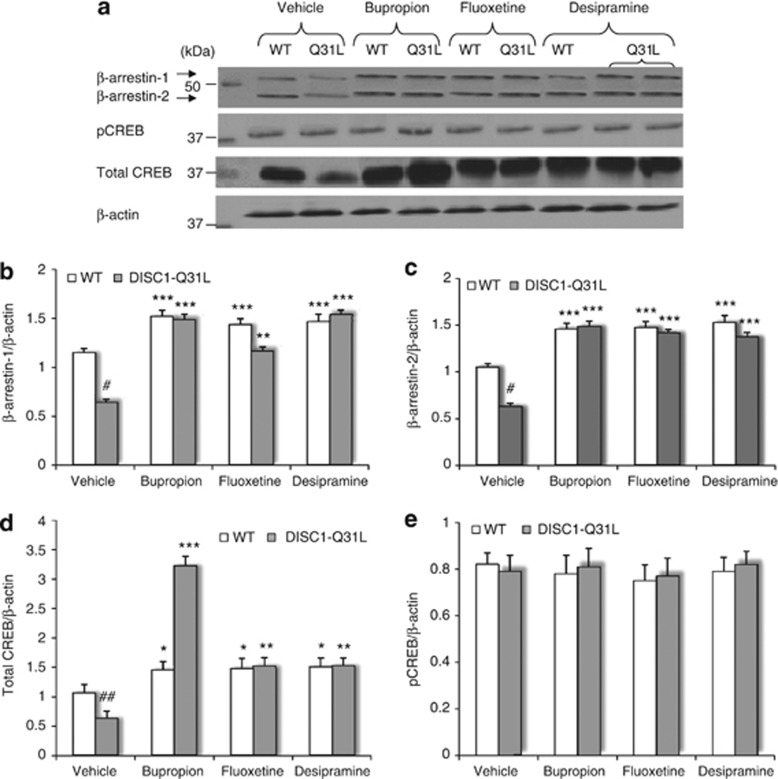
(a–e) Effects of bupropion, fluoxetine, and desipramine on protein amount of β-arrestin-1,2, total CREB, and phosphorylation of CREB at Ser 129/133 in the NAC of DISC1-Q31L mice. (a) Representative immunoblots are shown, probed with antibodies against β-arrestin-1,2, total CREB, pCREB at Ser 129/133, as well as β-actin as a loading control in antidepressants-treated DISC1-Q31L (Q31L) and WT mice. Quantification of immunoblots data for β-arrestin-1 and β-arrestin-2 as normalized to the total amount of β-actin (b–c); (d) for the total CREB as normalized to the total amount of β-actin and (e) for pCREB at Ser129/133 as normalized to the total amount of β-actin. N=6–7 mice per each group. #p<0.05; ##p<0.01; ###p<0.001—in comparison with vehicle-treated WT mice; *p<0.05; **p<0.01; ***p<0.001—in comparison with vehicle-treated mice within each genotype.

References

    1. Alfonso J, Frick LR, Silberman DM, Palumbo ML, Genaro AM, Frasch AC. Regulation of hippocampal gene expression is conserved in two species subjected to different stressors and antidepressant treatments. Biol Psychiatry. 2006;59:244–251. - PubMed
    1. Angermeir WR. Some basic aspects of social reinforcement in albaino rats. J Comp Physiol Psychol. 1960;58:364–367.
    1. Avissar S, Matuzany-Ruban A, Tzukert K, Schreiber G. Beta-Arrestin-1 levels: Reduced in leukocytes of patients with depression and elevated by antidepressants in rat brain. Am J Psychiatry. 2004;161:2066–2072. - PubMed
    1. Bartsch D, Ghirardi M, Skehel PA, Karl KA, Herder SP, Chen M, et al. Aplysia CREB2 represses long-term facilitation: relief of repression converts transient facilitation into long-term functional and structural change. Cell. 1995;83:979–992. - PubMed
    1. Beaulieu JM, Sotnikova TD, Marion S, Lefkowitz RJ, Gainetdinov RR, Caron MG. An Akt/beta-arrestin 2/PP2A signaling complex mediates dopaminergic neurotransmission and behavior. Cell. 2005;122:261–273. - PubMed

Publication types

MeSH terms