. 2012 Oct 9;109(41):16480-5.
doi: 10.1073/pnas.1117943109. Epub 2012 Sep 24.

Prolonged myelination in human neocortical evolution

Affiliations

Prolonged myelination in human neocortical evolution

Daniel J Miller et al. Proc Natl Acad Sci U S A. .

Abstract

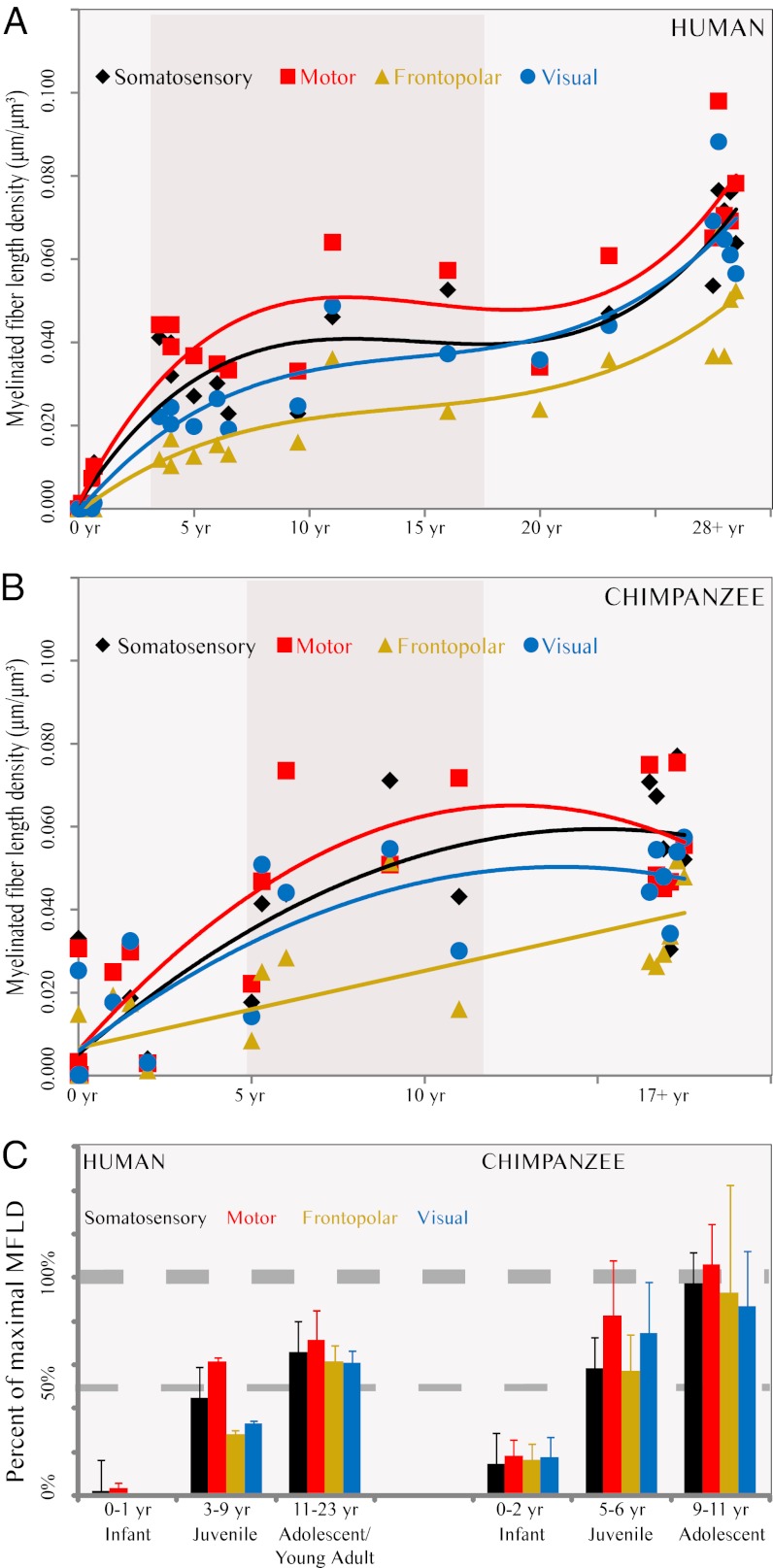
Nerve myelination facilitates saltatory action potential conduction and exhibits spatiotemporal variation during development associated with the acquisition of behavioral and cognitive maturity. Although human cognitive development is unique, it is not known whether the ontogenetic progression of myelination in the human neocortex is evolutionarily exceptional. In this study, we quantified myelinated axon fiber length density and the expression of myelin-related proteins throughout postnatal life in the somatosensory (areas 3b/3a/1/2), motor (area 4), frontopolar (prefrontal area 10), and visual (areas 17/18) neocortex of chimpanzees (N = 20) and humans (N = 33). Our examination revealed that neocortical myelination is developmentally protracted in humans compared with chimpanzees. In chimpanzees, the density of myelinated axons increased steadily until adult-like levels were achieved at approximately the time of sexual maturity. In contrast, humans displayed slower myelination during childhood, characterized by a delayed period of maturation that extended beyond late adolescence. This comparative research contributes evidence crucial to understanding the evolution of human cognition and behavior, which arises from the unfolding of nervous system development within the context of an enriched cultural environment. Perturbations of normal developmental processes and the decreased expression of myelin-related molecules have been related to psychiatric disorders such as schizophrenia. Thus, these species differences suggest that the human-specific shift in the timing of cortical maturation during adolescence may have implications for vulnerability to certain psychiatric disorders.


Conflict of interest statement

The authors declare no conflict of interest.

Figures
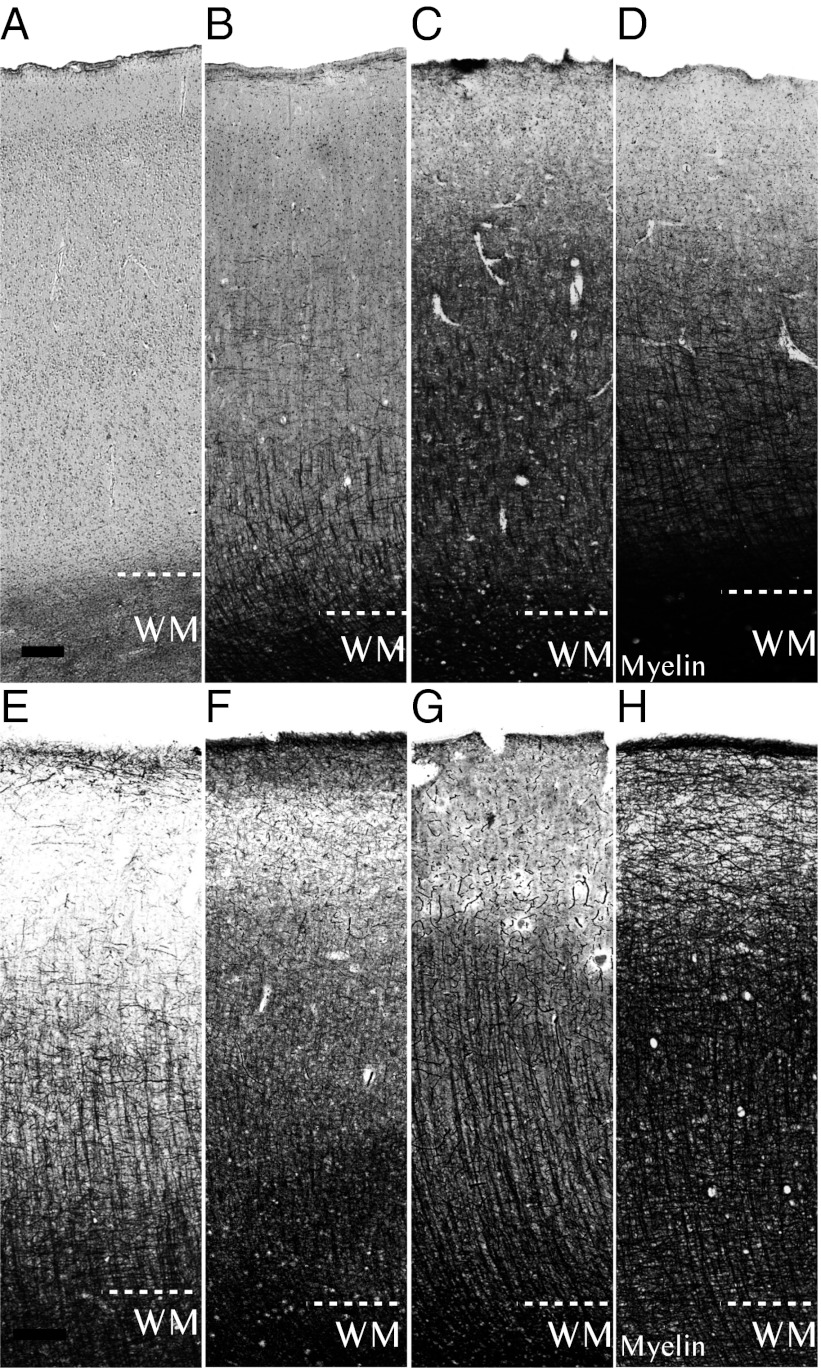
Fig. 1.
Fig. 1.
Developmental series of low-magnification photos of human and chimpanzee primary motor cortex. Sections from motor cortex (area 4) stained for myelinated axons (myelin) arranged by life-history stage. (AD) Representative sections of human neocortical myelin as an A: infant (0–1 y), (B) child/juvenile (3–9 y), (C) adolescent/young adult (13–23 y), and (D) adult (≥28 y). (EH) Sections of chimpanzee neocortical myelin as an E: infant (0–2 y), (F) juvenile (5–6 y), (G) adolescent (9–11 y), and (H) adult (≥17 y). White matter (WM) is demarcated at the bottom of the cortex. (Scale bar: 200 μm.)
Fig. 2.
Fig. 2.
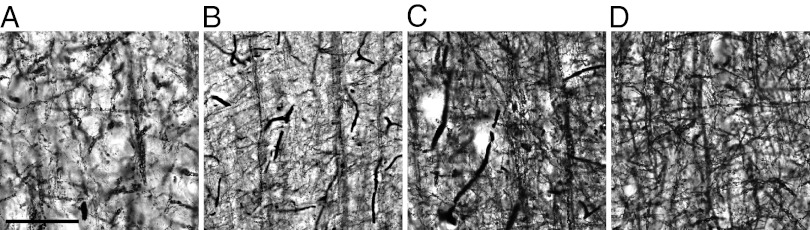
Developmental series of high-magnification photomicrographs of layer III in chimpanzee primary motor cortex. Representative photomicrographs of layer III of primary motor cortex (area 4) in chimpanzee tissue sections stained for myelin using the Gallyas preparation. Images are arranged by life-history stage: (A) infant (0–2 y), (B) juvenile (5–6 y), (C) adolescent (9–11 y), and (D) adult (≥17 y). (Scale bar: 50 μm.)
Fig. 3.
Fig. 3.
Developmental trajectory of MFLD. Graphs show best-fit curves for MFLD data in humans (A; n = 24) and chimpanzees (B; n = 20) arranged by age in years. The shaded vertical area represents time between weaning and full sexual maturation. Diamonds represent somatosensory area (area 3b), squares represent motor area (area 4), triangles represent frontopolar area (area 10), and circles represent visual area (area 18). (C) Bar graph depicts mean percent of maximum mature adult MFLD across development in humans (Left) and chimpanzees (Right). Error bars represent SEM. The thin and thick horizontal dashed lines represent 50% and 100%, respectively, of maximum MFLD. Black represents somatosensory area (area 3b), red represents motor area (area 4), gold represents frontopolar area (area 10), and blue represents visual area (area 18).
Fig. 4.
Fig. 4.
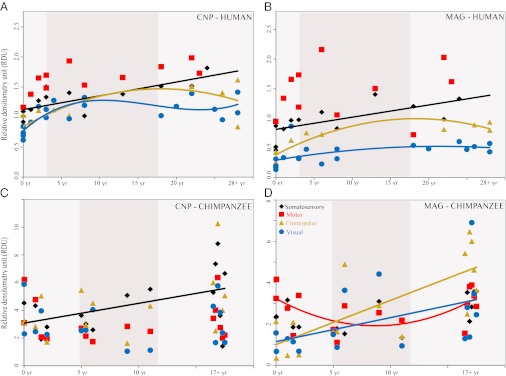
Developmental trajectory of MAG and CNP protein. Graphs depict best-fit curves for densitometric analyses in relative densitometry units of CNP (A and C) and MAG (B and D) protein expression in humans (A and B; n = 23) and chimpanzees (C and D: n = 16) arranged by age in years. The shaded vertical area represents time between weaning and full sexual maturation. Trend lines represent a significant effect of age at the P ≤ 0.05 level. Diamonds represent somatosensory area (area 3b/3a/1/2), squares represent motor area (area 4), triangles represent frontopolar area (area 10), and circles represent visual area (areas 17 and 18). Note the different scales for relative densitometry units between species because Western blotting was performed on frozen human cortical samples, whereas, in chimpanzees, samples were formalin-fixed.

References

    1. Leigh SR. Brain growth, life history, and cognition in primate and human evolution. Am J Primatol. 2004;62:139–164. - PubMed
    1. Somel M, et al. Transcriptional neoteny in the human brain. Proc Natl Acad Sci USA. 2009;106:5743–5748. - PMC - PubMed
    1. Huttenlocher PR, Dabholkar AS. Regional differences in synaptogenesis in human cerebral cortex. J Comp Neurol. 1997;387:167–178. - PubMed
    1. Petanjek Z, et al. Extraordinary neoteny of synaptic spines in the human prefrontal cortex. Proc Natl Acad Sci USA. 2011;108:13281–13286. - PMC - PubMed
    1. Gibson KR. Sequence of Myelinization in the Brain of Macaca mulatta. Berkeley: University of California; 1970.

Publication types

MeSH terms

Substances

LinkOut - more resources