. 2012 Oct 9;109(41):16582-7.
doi: 10.1073/pnas.1214936109. Epub 2012 Sep 24.

Retinoic acid induces Sertoli cell paracrine signals for spermatogonia differentiation but cell autonomously drives spermatocyte meiosis

Affiliations

Retinoic acid induces Sertoli cell paracrine signals for spermatogonia differentiation but cell autonomously drives spermatocyte meiosis

Mathilde Raverdeau et al. Proc Natl Acad Sci U S A. .

Abstract

Direct evidence for a role of endogenous retinoic acid (RA), the active metabolite of vitamin A in the initial differentiation and meiotic entry of spermatogonia, and thus in the initiation of spermatogenesis is still lacking. RA is synthesized by dedicated enzymes, the retinaldehyde dehydrogenases (RALDH), and binds to and activates nuclear RA receptors (RARA, RARB, and RARG) either within the RA-synthesizing cells or in the neighboring cells. In the present study, we have used a combination of somatic genetic ablations and pharmacological approaches in vivo to show that during the first, prepubertal, spermatogenic cycle (i) RALDH-dependent synthesis of RA by Sertoli cells (SC), the supporting cells of the germ cell (GC) lineage, is indispensable to initiate differentiation of A aligned into A1 spermatogonia; (ii) RARA in SC mediates the effects of RA, possibly through activating Mafb expression, a gene whose Drosophila homolog is mandatory to GC differentiation; (iii) RA synthesized by premeiotic spermatocytes cell autonomously induces meiotic initiation through controlling the RAR-dependent expression of Stra8. Furthermore, we show that RA of SC origin is no longer necessary for the subsequent spermatogenic cycles but essential to spermiation. Altogether, our data establish that the effects of RA in vivo on spermatogonia differentiation are indirect, via SC, but direct on meiotic initiation in spermatocytes, supporting thereby the notion that, contrary to the situation in the female, RA is necessary to induce meiosis in the male.


Conflict of interest statement

The authors declare no conflict of interest.

Figures
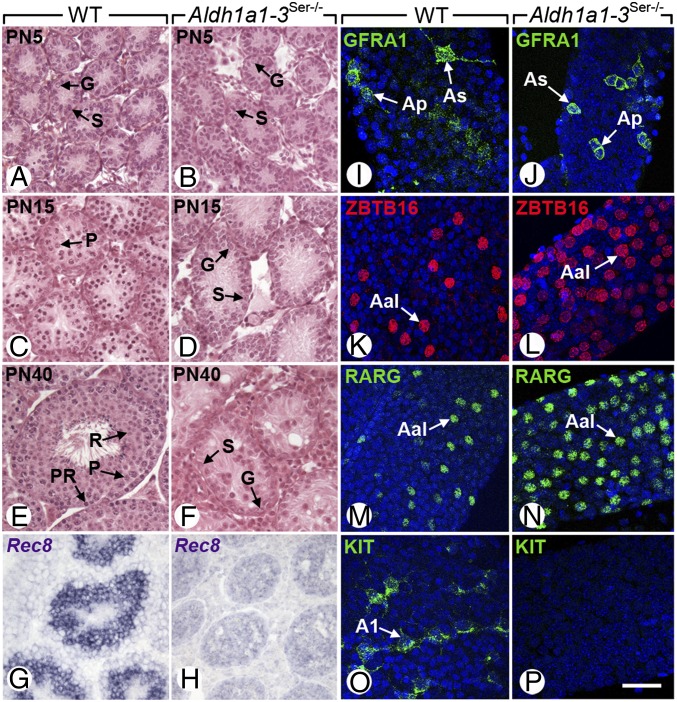
Fig. 1.
Fig. 1.
Spermatogenesis is impaired in Aldh1a1-3Ser−/− mutants because of an arrest of spermatogonia differentiation at the Aal stage. (A–F) Histological sections through testes of PN5, PN15, and PN40 WT and mutants. (G and H) ISH with antisense probes for Rec8 (purple signal) on testis sections of PN40 WT and mutant. (I–P) Whole-mount immunodetection of GFRA1 (green), ZBTB16 (red), and RARG and KIT (green) on seminiferous tubules of WT and mutants; the signals are superimposed with the DAPI nuclear counterstain. As, A single spermatogonia; Ap, A paired spermatogonia; Aal, A aligned spermatogonia; A1, A1 spermatogonia; G, spermatogonia; P, pachytene spermatocyte; PR, preleptotene spermatocyte; R, round spermatid; S, Sertoli cell. [Scale bar (in P for reference): G–P, 40 μm; in A–F, 60 μm.]
Fig. 2.
Fig. 2.
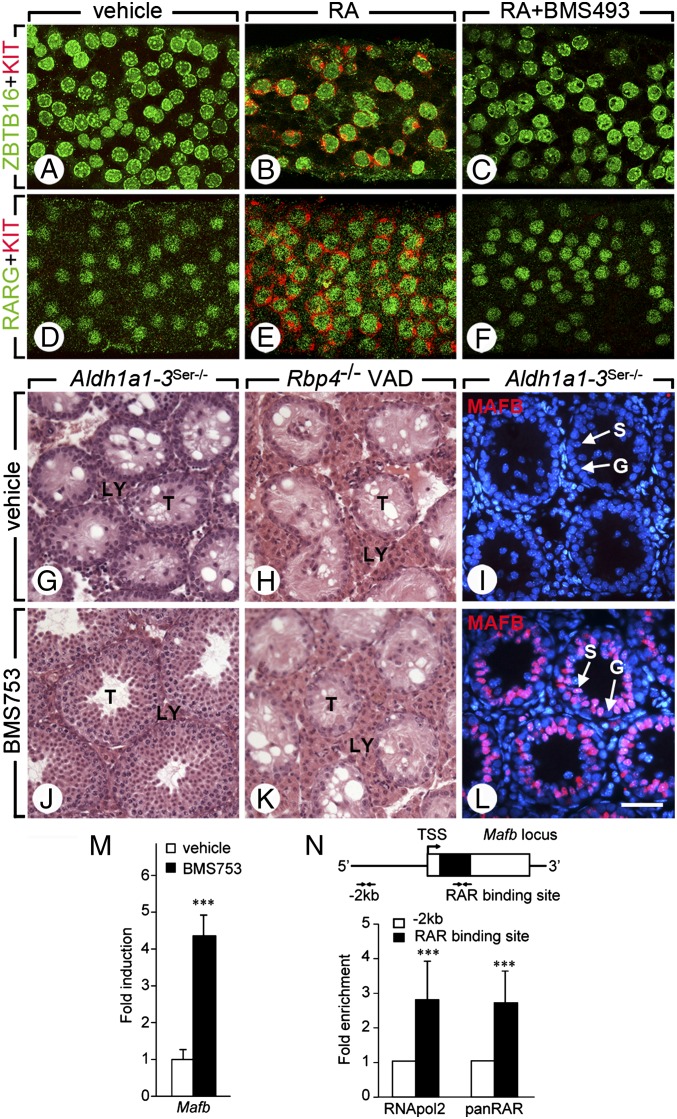
Initiation of the first wave of spermatogenesis requires RARA, which controls Mafb expression in SCs. (A–F) Whole-mount immunodetection of ZBTB16 or RARG (green) and KIT (red) on seminiferous tubules of Aldh1a1-3Ser−/− mutants 24 h after treatment with vehicle, RA, or RA+BMS493. (G and H; J and K) Histological sections through testes of Aldh1a1-3Ser−/− and Rbp4−/− mutants 3 wk after treatment with vehicle or BMS753. (I and L) Immunodetection of MAFB on testes sections from Aldh1a1-3Ser−/− mutants 8 h after treatment with vehicle or BMS753. (M) Relative expression of Mafb mRNA quantified by quantitative RT-PCR in testes of Aldh1a1-3Ser−/− mutants cultured in the presence of cycloheximide and treated for 2 h with vehicle (white bars) and BMS753 (black bars). (N) Schematic representation of Mafb locus and quantitative analysis by qPCR of DNA recovered from MSC-1 cell chromatin immunoprecipitated using antibodies directed against RNApol2 or all RAR isotypes (pan-RAR) at Mafb locus. It is a single exon-containing gene. The untranslated and translated regions are depicted by open and closed boxes, respectively, and the transcription start site (TSS) by a broken arrow. The locations of primers used for qPCR are indicated at −2 kb and in Mafb. Mean fold enrichment of three experiments at RAR binding site (black bars) is relative to the amount of DNA recovered at −2 kb (set at 1, white bars). Error bars represent SEM (n = 4); ***P < 0.001. G, spermatogonia; LY, Leydig cell; S, Sertoli cell; T, seminiferous tubule. [Scale bar (in L for reference): A–F, 15 μm; G–K, 50 μm; I–L, 20 μm.]
Fig. 3.
Fig. 3.
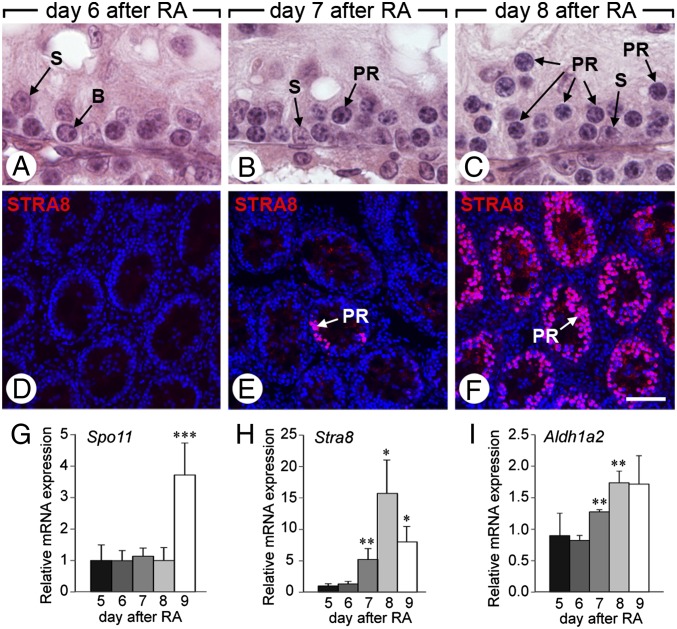
Meiosis initiates 7 d after the Aal-A1 transition in Aldh1a1-3Ser−/− mutants rescued by a single injection of RA. (AC) Histological sections through testes of Aldh1a1-3Ser−/− mutants 6, 7, and 8 d after treatment with RA. (D–F) Immunodetection of STRA8 (red) superimposed to the DAPI nuclear counterstain (blue) in the same samples. (G–I) Relative expression of Spo11, Stra8, and Aldh1a2 mRNA quantified by RT-qPCR in testes of Aldh1a1-3Ser−/− mutants between 5 and 9 d after treatment with RA. Error bars represent SEM (n = 4); *P < 0.05, **P < 0.01, ***P < 0.001. B, B spermatogonia; PR, preleptotene spermatocyte; S, Sertoli cell. [Scale bar (in F for reference): AC, 10 μm; DF, 70 μm.]
Fig. 4.
Fig. 4.
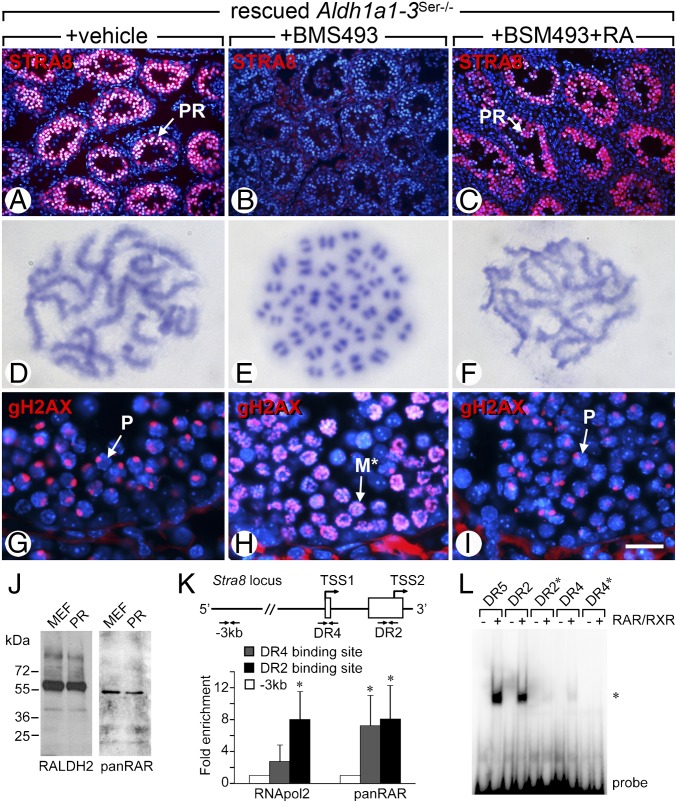
Meiotic initiation requires RA-activated RAR in preleptotene spermatocytes to induce Stra8 expression. (A–C) Immunodetection of STRA8 (red) and DAPI nuclear counterstain (blue) at the onset of meiosis (day 8 after rescue) on histological sections from testes of Aldh1a1-3Ser−/− mutants rescued by RA (day 0), and then treated with vehicle, BMS493, or BMS493+RA from days 6 to 8. (D–F) Giemsa-stained metaphase spreads at the pachytene stage (day 12 after rescue). (G–I) Immunodetection of gH2AX (red) and DAPI nuclear counterstain (blue) on histological sections at the pachytene stage (day 12 after rescue). (J) Western blot analysis of protein extracts from FACS-purified preleptotene spermatocytes from rescued Aldh1a1-3Ser−/− mutants (PR), using antibodies directed against RALDH2 or all RAR isotypes (pan-RAR). Protein extracts from mouse embryonic fibroblasts (MEF) transfected with RALDH2- and RAR-coding plasmids were used as positive controls. (K) Schematic representation of Stra8 locus and quantitative analysis by qPCR of DNA recovered from testis chromatin (prepared using RA-rescued Aldh1a1-3Ser−/− mutants at day 8) immunoprecipitated using antibodies directed against RNApol2 or all RAR isotypes (pan-RAR) at Stra8 locus. The untranslated exons and the two transcription start sites (TSS1 and TSS2) are depicted by open boxes and broken arrows, respectively. The locations of primers used for qPCR are indicated at −3 kb and in Stra8. Mean fold enrichment of three experiments at DR4 (gray bars) and DR2 (black bars) binding sites is relative to the amount of DNA recovered at −3 kb (set at 1, white bars). (L) EMSA showing that RAR/RXR heterodimers bind strongly to the DR2 and weakly to the DR4 of Stra8 (asterisk). Binding is abolished when DR2 and DR4 sequences are changed (DR2* and DR4*, respectively). Binding to canonical RARE of Rarb2 gene was used as a positive control (DR5). Error bars represent SEM (n = 5); *P < 0.05. M*, metaphase-like cells; P, pachytene spermatocytes; PR, preleptotene spermatocyte. [Scale bar (in I for reference): AC, 100 μm; D–F, 1.5 μm; G–I, 10 μm.]

References

    1. Nakagawa T, Sharma M, Nabeshima Y, Braun RE, Yoshida S. Functional hierarchy and reversibility within the murine spermatogenic stem cell compartment. Science. 2010;328:62–67. - PMC - PubMed
    1. de Rooij DG, Russell LD. All you wanted to know about spermatogonia but were afraid to ask. J Androl. 2000;21:776–798. - PubMed
    1. Hogarth CA, Griswold MD. The key role of vitamin A in spermatogenesis. J Clin Invest. 2010;120:956–962. - PMC - PubMed
    1. Bowles J, Koopman P. Retinoic acid, meiosis and germ cell fate in mammals. Development. 2007;134:3401–3411. - PubMed
    1. Griswold MD, Hogarth CA, Bowles J, Koopman P. Initiating meiosis: The case for retinoic acid. Biol Reprod. 2012;86:35. - PMC - PubMed

Publication types

MeSH terms

LinkOut - more resources