


Using a communication model to collect measurement data through mobile devices
- PMID: 23012542
- PMCID: PMC3444100
- DOI: 10.3390/s120709253
Using a communication model to collect measurement data through mobile devices
Abstract
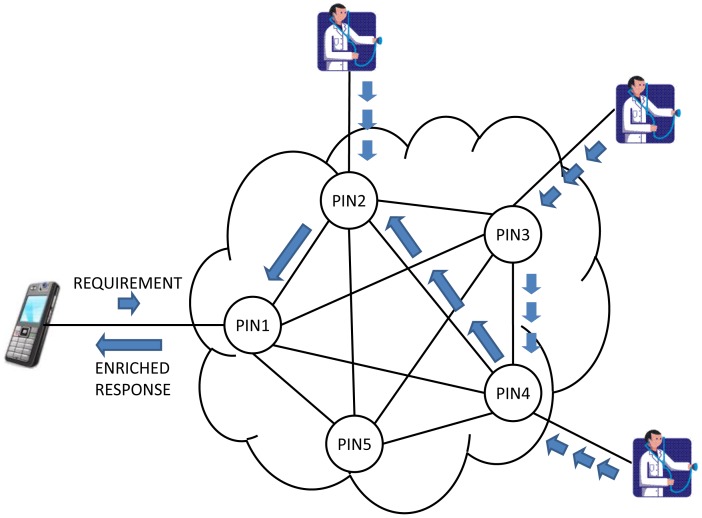
Wireless systems and services have undergone remarkable development since the first mobile phone system was introduced in the early 1980s. The use of sensors in an Ambient Intelligence approach is a great solution in a medical environment. We define a communication architecture to facilitate the information transfer between all connected devices. This model is based in layers to allow the collection of measurement data to be used in our framework monitoring architecture. An overlay-based solution is built between network elements in order to provide an efficient and highly functional communication platform that allows the connection of a wide variety of devices and technologies, and serves also to perform additional functions such as the possibility to perform some processing in the network that may help to improve overall performance.
Keywords: communication model; data transmission; mobile devices; sensors integration.
Figures
References
-
- Georgia Institute of Technology AWARE HOME. Available online: http://awarehome.imtc.gatech.edu/ (accessed on 10 December 2011)
-
- Kientz J.A., Patel S.N., Jones B., Price E., Mynatt E.D., Abowd G.D. The Georgia Tech Aware Home. Proceedings of CHI' 08 Extended Abstracts on Human Factors in Computing Systems; Florence, Italy. 5–10 April 2008; pp. 3675–3680.
-
- Choi M., Jones B.D. Remote Home Health Monitoring Management Using Smartphones; Poster Presented at mHealth Summit 2010; Washington DC, USA. 8– 10 November 2010.
-
- University of Virginia Smart IN-HOME Monitoring System. Available online: http://marc.med.virginia.edu/projectssmarthomemonitor.html (accessed on 5 November 2011)
-
- Intel Corporation HealthCare. Available online: http://www.intel.com/about/companyinfo/healthcare/people/research/approa... (accessed on 10 November 2011)
Publication types
LinkOut - more resources
Full Text Sources
