Ultrasound measurements in hypertrophic pyloric stenosis: don't let the numbers fool you
- PMID: 23012595
- PMCID: PMC3442757
- DOI: 10.7812/TPP/12.966
Ultrasound measurements in hypertrophic pyloric stenosis: don't let the numbers fool you
Abstract
Background: Ultrasound guidelines for hypertrophic pyloric stenosis (HPS) have fixed minimum measurements and do not account for variation in patient weight or age. We sought to determine if preoperative pyloric measurements correlated with weight and age in patients with surgically proven HPS.
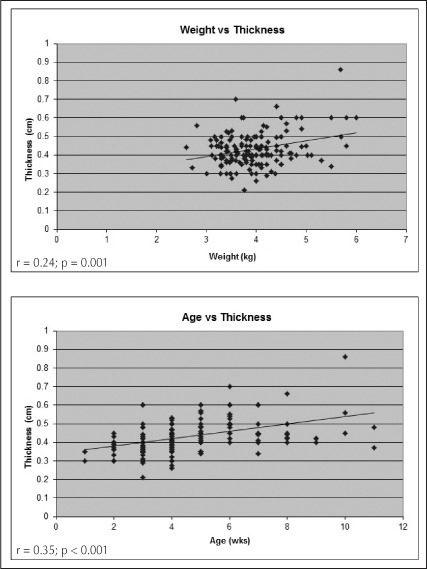
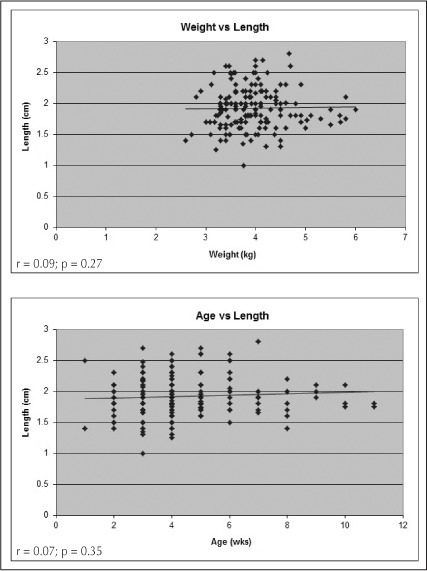
Methods: A retrospective analysis was conducted of 189 patients with HPS treated at a single institution over a 5-year period (2005 to 2010). Pearson correlation and linear regression analyses were used to determine if there were statistically significant associations between these combinations of factors: age and pyloric muscle thickness, weight and pyloric muscle thickness, age and pyloric length, and weight and pyloric length.
Results: Patients' mean age was 4.6 weeks (range, 1 to 17 weeks). Their mean weight was 3.9 kg (range, 2.5 to 8.0 kg). Mean pyloric muscle thickness was 0.42 cm (range, 0.18 to 0.86 cm), and mean pyloric length was 1.89 cm (range, 0.8 to 2.8 cm). Pearson correlation coefficient analysis showed a significant relationship between age and muscle thickness (r = 0.35, p < 0.001) as well as weight and muscle thickness (r = 0.24, p = 0.001). No significant relationship existed between pyloric length and age or weight. Linear regression analysis demonstrated similar results.
Conclusion: In patients with HPS, pyloric muscle thickness was directly related to age and weight. Practitioners should be aware that smaller and younger infants with a clinical diagnosis of HPS may still truly have HPS even though the minimum diagnostic criterion for muscle thickness or length is not found on ultrasound.
Figures
References
-
- Rohrschneider WK, Mittnacht H, Darge K, Tröger J. Pyloric muscle in asymptomatic infants: sonographic evaluation and discrimination from idiopathic hypertrophic pyloric stenosis. Pediatr Radiol. 1998 Jun;28(6):429–34. - PubMed
-
- Strauss S, Itzchak Y, Manor A, Heyman Z, Graif M. Sonography of hypertrophic pyloric stenosis. AJR Am J Roentgenol. 1981 Jun;136(6):1057–8. - PubMed
-
- Blumhagen JD, Maclin L, Krauter D, Rosenbaum DM, Weinberger E. Sonographic diagnosis of hypertrophic pyloric stenosis. AJR Am J Roentgenol. 1988 Jun;150(6):1367–70. - PubMed
-
- Forster N, Haddad RL, Choroomi S, Dilley AV, Pereira J. Use of ultrasound in 187 infants with suspected infantile hypertrophic pyloric stenosis. Australas Radiol. 2007 Dec;51(6):560–3. - PubMed
-
- Haider N, Spicer R, Grier R. Ultrasound diagnosis of infantile hypertrophic pyloric stenosis: determinants of pyloric length and effect of prematurity. Clin Radiol. 2002 Feb;57(2):136–9. - PubMed
MeSH terms
LinkOut - more resources
Full Text Sources
Medical