. 2013 Jan;41(1):33-9.
doi: 10.1124/dmd.112.048322. Epub 2012 Sep 26.

Function of the blood-brain barrier and restriction of drug delivery to invasive glioma cells: findings in an orthotopic rat xenograft model of glioma

Affiliations

Function of the blood-brain barrier and restriction of drug delivery to invasive glioma cells: findings in an orthotopic rat xenograft model of glioma

Sagar Agarwal et al. Drug Metab Dispos. 2013 Jan.

Abstract

Despite aggressive treatment with radiation and chemotherapy, recurrence of glioblastoma multiforme (GBM) is inevitable. The objective of this study was to show that the blood-brain barrier (BBB), through a combination of tight junctions and active efflux transporters in the brain microvasculature, can significantly restrict delivery of molecularly targeted agents to invasive glioma cells. Transgenic mice lacking P-glycoprotein (P-gp) and breast cancer resistance protein (Bcrp) were used to study efflux of erlotinib at the BBB. A U87 rat xenograft model of GBM was used to investigate the regional distribution of erlotinib to the tumor, and brain regions surrounding the tumor. The effect of concurrent administration of elacridar on regional tumor distribution of erlotinib was evaluated. We show that erlotinib transport across an intact BBB is significantly restricted due to P-gp- and Bcrp-mediated efflux transport. We then show that the BBB is sufficiently intact in areas of brain adjacent to the tumor core to significantly restrict erlotinib delivery. Inhibition of P-gp and Bcrp by the dual inhibitor elacridar dramatically increased erlotinib delivery to the tumor core, rim, and normal brain. These results provide conclusive evidence of the impact that active efflux at the BBB has on the delivery of molecularly targeted therapy to different tumor regions in glioma. These data also support the possibility that the repeated failure of clinical trials of new drugs for gliomas may be in part due to a failure to achieve effective concentrations in invasive tumor cells that reside behind an intact BBB.


Figures
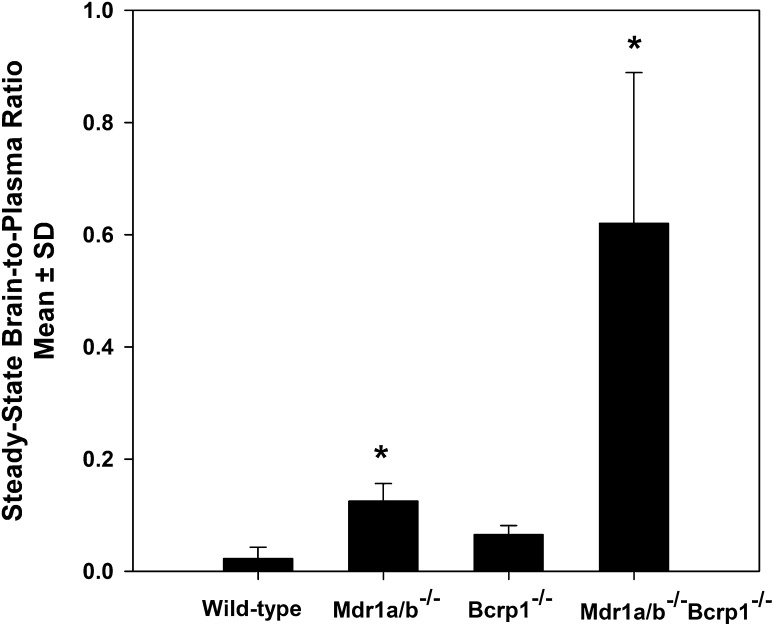
Fig. 1.
Fig. 1.
Steady-state brain distribution of erlotinib in FVB wild-type, Mdr1a/b−/−, Bcrp1−/−,and Mdr1a/b−/−Bcrp1−/− mice. Brain-to-plasma ratios after a 0.6-mg/h/kg intraperitoneal infusion for 48 hours. The values are presented as the mean ± S.D. *P < 0.05, compared with wild-type; n = 4 per mouse genotype.
Fig. 2.
Fig. 2.
Effect of perfusion on regional distribution of erlotinib. Erlotinib concentrations (A) and brain-to-plasma ratios (B) in the tumor core, rim, and normal brain were significantly lower in rats that were perfused with saline (gray bars) prior to collection of brain tissue compared with the nonperfused rats (black bars). This indicates that residual drug in brain vasculature can contribute significantly to total brain levels. Therefore, drug concentration measurements in brain tissues that are not perfused or corrected can be misleading and should be cautiously interpreted. The values are presented as the mean ± S.D. *P < 0.05, compared with tumor core; †P < 0.05, compared with nonperfused group; n = 6 per group.
Fig. 3.
Fig. 3.
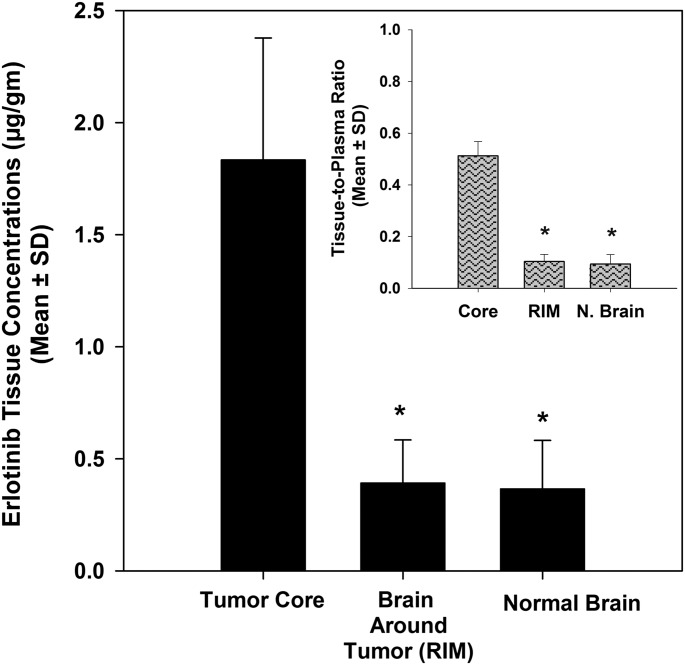
Regional distribution of erlotinib in the U87 rat xenograft model. Erlotinib concentrations in the tumor core were significantly greater than those in the brain around the tumor and normal brain (contralateral hemisphere). The corresponding brain-to-plasma ratios (inset) suggests that the BBB may be intact in areas away from the tumor, indicated by the restricted delivery of erlotinib to the brain around the tumor and the normal contralateral hemisphere. The values are presented as the mean ± S.D. *P < 0.05, compared with tumor core; n = 6.
Fig. 4.
Fig. 4.
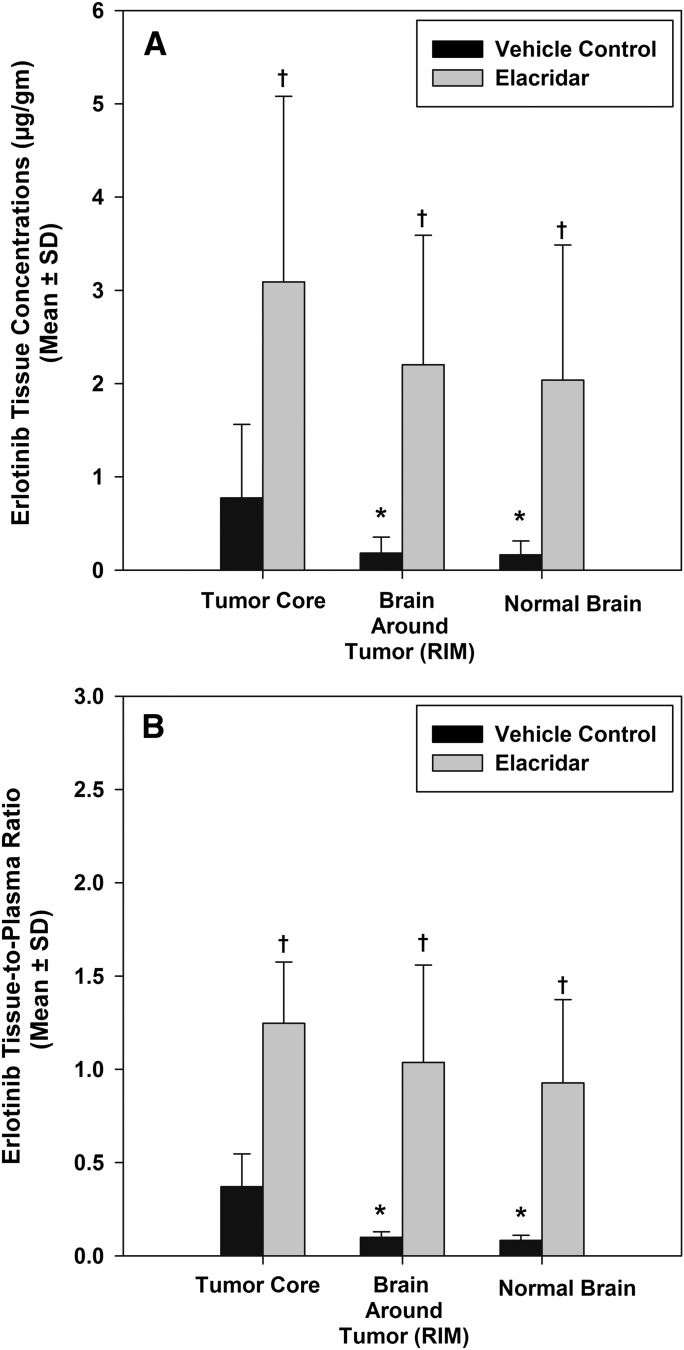
Influence of elacridar on regional distribution of erlotinib. Erlotinib concentrations (A) in the tumor core, rim, and normal brain increased significantly in the elacridar-treated group (gray bars) compared with the control (black bars). The erlotinib brain-to-plasma ratio (B) increased significantly and was approximately 1 in all three brain regions, indicating that when these two transporters are inhibited, there is no restriction of the delivery of erlotinib to the brain. This indicates that concurrent administration of a modulator of drug transporters, such as elacridar, can be used as a strategy to enhance delivery of substrate chemotherapeutic agents to the brain. The values are presented as the mean ± S.D. *P < 0.05, compared with tumor core; †P < 0.05, compared with vehicle control; n = 4 per group.

References

    1. Agarwal S, Hartz AM, Elmquist WF, Bauer B. (2011a) Breast cancer resistance protein and P-glycoprotein in brain cancer: two gatekeepers team up. Curr Pharm Des 17:2793–2802 - PMC - PubMed
    1. Agarwal S, Sane R, Gallardo JL, Ohlfest JR, Elmquist WF. (2010) Distribution of gefitinib to the brain is limited by P-glycoprotein (ABCB1) and breast cancer resistance protein (ABCG2)-mediated active efflux. J Pharmacol Exp Ther 334:147–155 - PMC - PubMed
    1. Agarwal S, Sane R, Oberoi R, Ohlfest JR, Elmquist WF. (2011b) Delivery of molecularly targeted therapy to malignant glioma, a disease of the whole brain. Expert Rev Mol Med 13:e17. - PMC - PubMed
    1. Agarwal S, Sane R, Ohlfest JR, Elmquist WF. (2011c) The role of the breast cancer resistance protein (ABCG2) in the distribution of sorafenib to the brain. J Pharmacol Exp Ther 336:223–233 - PMC - PubMed
    1. Agarwal S, Uchida Y, Mittapalli RK, Sane R, Terasaki T, Elmquist WF. (2012) Quantitative proteomics of transporter expression in brain capillary endothelial cells isolated from P-glycoprotein (P-gp), breast cancer resistance protein (Bcrp), and P-gp/Bcrp knockout mice. Drug Metab Dispos 40:1164–1169 - PMC - PubMed

Publication types