Review
doi: 10.1007/978-1-62703-005-2_7.
The Helicobacter pylori cag Pathogenicity Island
Affiliations
- PMID: 23015490
- PMCID: PMC3547679
- DOI: 10.1007/978-1-62703-005-2_7
Item in Clipboard
Review
The Helicobacter pylori cag Pathogenicity Island
Methods Mol Biol.
2012.
Abstract
The cag pathogenicity island is a well-characterized virulence determinant. It is composed of 32 genes that encode a type IV bacterial secretion system and is linked with a more severe clinical outcome. The following chapters will explore the manipulation of bacterial factors in order to understand their role in gastric mucosal disease.
Figures
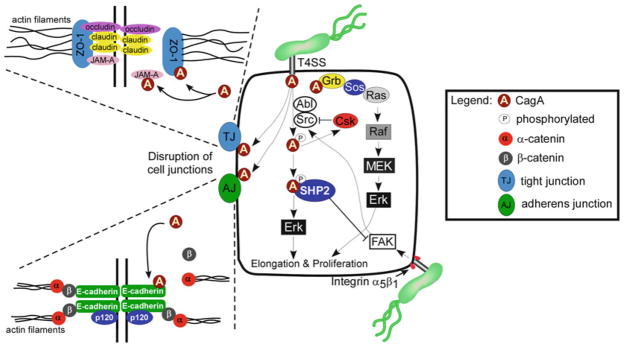
Molecular signaling alterations induced by intracellular delivery of CagA. Translocation of CagA by the H. pylori cag type IV secretion system leads to activation of host signaling pathways that promote epithelial responses with carcinogenic potential. CagA is phosphorylated by Src and Abl kinases, which is followed by a decrease in levels of phosphorylated-CagA via the inhibitory kinase c-src kinase (Csk). Phosphorylated CagA activates SHP2 and Erk leading to morphological changes, such as cellular elongation. Additionally, the interaction between phosphorylated-CagA and SHP2 results in inactivation of focal adhesion kinase (FAK), which can activate Src. Unphosphorylated CagA also leads to changes in epithelial cell motility and proliferation through binding Grb/Sos/Ras and activation of the Raf/MEK/Erk pathway. Unmodified CagA can also associate with the tight junction proteins ZO-1 and JAM-A as well as the adherens junction protein E-cadherin, leading to dysregulated junctional complexes.
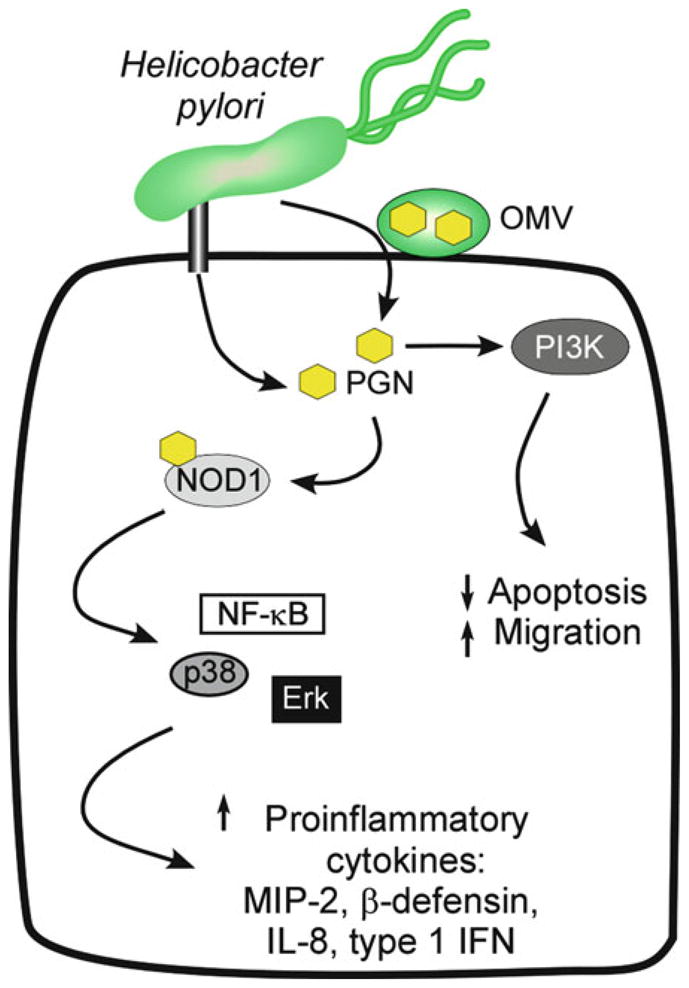
Molecular signaling alterations induced by intracellular delivery of peptidoglycan. In addition to CagA, the H. pylori cag type IV secretion system can deliver peptidoglycan (PGN) into host cells. Another mechanism of PGN delivery is via outer membrane vesicles (OMV). Delivery of PGN results in activation of the intracellular receptor nucleotide oligomerization domain 1 (NOD1) and triggers multiple signaling pathways that culminate in NF-κB activation and subsequent production of inflammatory and immune effectors, such as IL-8 and Type 1 IFN. Further, PGN can also activate PI3K, leading to decreased levels of apoptosis and increased cell migration.
References
-
- Tomb JF, White O, Kerlavage AR, Clayton RA, Sutton GG, Fleischmann RD, et al. The complete genome sequence of the gastric pathogen Helicobacter pylori. Nature. 1997;388:539–547. - PubMed
Publication types
MeSH terms
Substances
Grants and funding
LinkOut - more resources
Full Text Sources