


Is admission blood glucose concentration a more powerful predictor of mortality after myocardial infarction than diabetes diagnosis? A retrospective cohort study
- PMID: 23015602
- PMCID: PMC3467654
- DOI: 10.1136/bmjopen-2012-001596
Is admission blood glucose concentration a more powerful predictor of mortality after myocardial infarction than diabetes diagnosis? A retrospective cohort study
Abstract
Objective: To explore the relative association of admission blood glucose levels and antecedent diabetes on early and long-term survival in a contemporary UK population of patients with ST elevation myocardial infarction (STEMI) and non-STEMI (NSTEMI).
Design: Retrospective cohort study based on the Myocardial Ischaemia National Audit Project dataset.
Setting: Tertiary care centre.
Participants: 4111 (20.3% known diabetes) consecutive patients admitted with acute myocardial infarction (58.3% STEMI) between October 2002 and September 2008.
Primary and secondary outcome measures: All-cause mortality at 30 days and 1 year. The relative association of admission blood glucose and of antecedent diabetes with mortality was assessed using multivariate Cox regression analysis. Furthermore, we compared these relationships in patients with STEMI to those with NSTEMI.
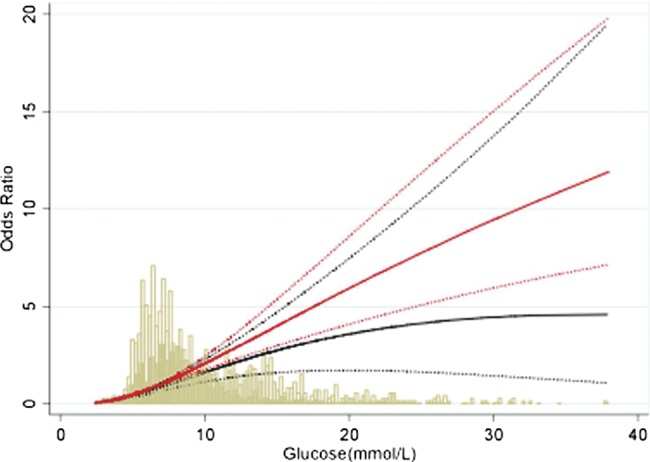
Results: By 30 days and 1 year, 409 (9.9%) and 677 (16.5%) of patients died. After adjusting for covariates, diabetes did not show independent association with mortality at any time point, in the entire cohort (HR 30 days 0.93 (95% CI 0.63 to 1.38); 1 year 1.00 (0.77 to 1.30)) or in subgroups of STEMI (HR 30 days 1.03 (0.65 to 1.64); 1 year 1.08 (0.77 to 1.51)) and NSTEMI (HR 30 days 0.62 (0.26 to 1.50); 1 year 0.87 (0.56 to 1.36)). In contrast, after adjusting for covariates, admission glucose showed robust and independent association with mortality in the entire cohort (HR: 30 days 1.07 (1.04 to 1.10); 1 year 1.05 (1.03 to 1.08)), and in the subgroup of STEMI (30 days 1.07 (1.03 to 1.10); 1 year 1.07 (1.04 to 1.10)), and NSTEMI (HR 30 days 1.07 (1.00 to 1.14); 1 year 1.02 (0.97 to 1.06)).
Conclusions: Admission glucose is strongly associated with mortality in all presentations of acute myocardial infarction (AMI), irrespective of established diabetes diagnosis. The increased risk is maintained up to 1 year. Future studies are required to assess the impact of active management of elevated blood glucose in improving mortality in individuals admitted with AMI.
Figures
References
-
- Malmberg K, Yusuf S, Gerstein HC, et al. Impact of diabetes on long-term prognosis in patients with unstable angina and non-Q-wave myocardial infarction: results of the OASIS Registry. Circulation 2000;102:1014–19 - PubMed
-
- McGuire DK, Emanuelsson H, Granger CB, et al. Influence of diabetes mellitus on clinical outcomes across the spectrum of acute coronary syndromes. Findings from the GUSTO IIb study. Eur Heart J 2000;21:1750–8 - PubMed
-
- Svensson A-M, McGuire DK, Abrahamsson P, et al. Association between hyper- and hypoglycaemia and 2-year all-cause mortality risk in diabetic patients with acute coronary events. Eur Heart J 2005;26:1255–61 - PubMed
-
- Capes SE, Hunt D, Malmberg K, et al. Stress hyperglycaemia and increased risk of death after myocardial infarction in patients with and without diabetes: a systematic overview. Lancet 2000;355:773–8 - PubMed
-
- Wahab NN, Cowden EA, Pearce NJ, et al. Is blood glucose an independent predictor of mortality in acute myocardial infarction in the thrombolytic era? J Am Coll Cardiol 2002;40:1748–54 - PubMed
Grants and funding
LinkOut - more resources
Full Text Sources
