


Hamstring injuries in professional football players: magnetic resonance imaging correlation with return to play
- PMID: 23016038
- PMCID: PMC3445213
- DOI: 10.1177/1941738111403107
Hamstring injuries in professional football players: magnetic resonance imaging correlation with return to play
Abstract
Background: Magnetic resonance imaging (MRI) allows for detailed evaluation of hamstring injuries; however, there is no classification that allows prediction of return to play.
Purpose: To correlate time for return to play in professional football players with MRI findings after acute hamstring strains and to create an MRI scoring scale predictive of return to sports.
Study design: Descriptive epidemiologic study.
Methods: Thirty-eight professional football players (43 cases) sustained acute hamstring strains with MRI evaluation. Records were retrospectively reviewed, and MRIs were evaluated by 2 musculoskeletal radiologists, graded with a traditional radiologic grade, and scored with a new MRI score. Results were correlated with games missed.
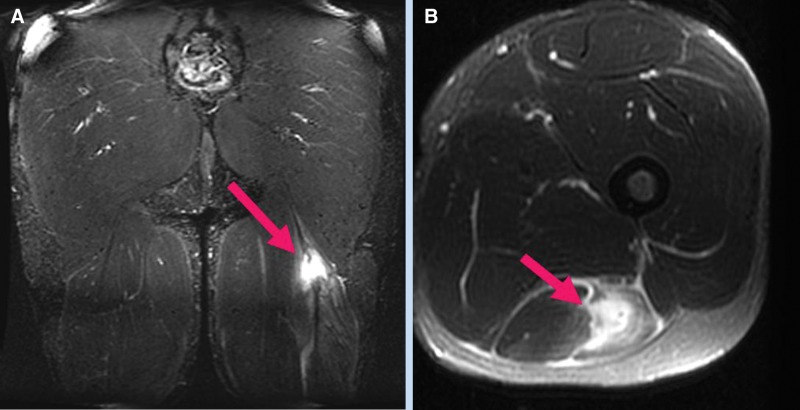
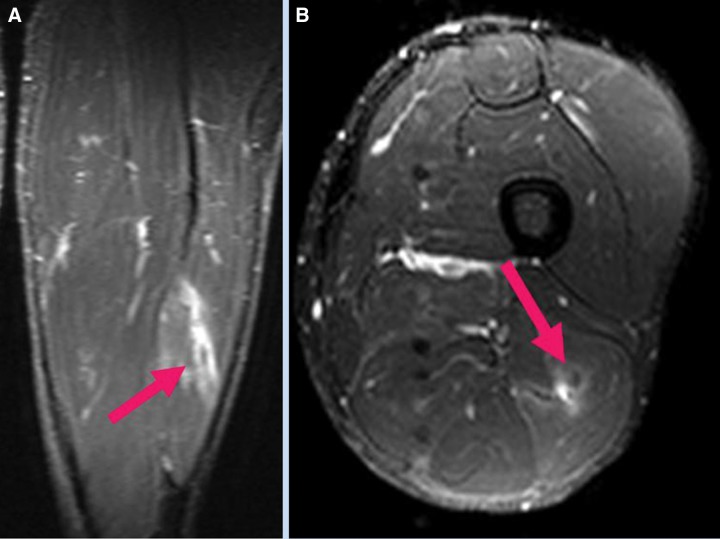
Results: Players missed 2.6 ± 3.1 games. Based on MRI, the hamstring injury involved the biceps femoris long head in 34 cases and the proximal and distal hamstrings in 25 and 22 cases, respectively. When < 50% of the muscle was involved, the average number of games missed was 1.8; if > 75%, then 3.2. Ten players had retraction, missing 5.5 games. By MRI, grade I injuries yielded an average of 1.1 missed games; grade II, 1.7; and grade III, 6.4. Players who missed 0 or 1 game had an MRI score of 8.2; 2 or 3 games, 11.1; and 4 or more games, 13.9.
Conclusions: Rapid return to play (< 1 week) occurred with isolated long head of biceps femoris injures with < 50% of involvement and minimal perimuscular edema, correlating to grade I radiologic strain (MRI score < 10). Prolonged recovery (missing > 2 or 3 games) occurs with multiple muscle injury, injuries distal to musculotendinous junction, short head of biceps injury, > 75% involvement, retraction, circumferential edema, and grade III radiologic strain (MRI score > 15).
Clinical relevance: MRI grade and this new MRI score are useful in determining severity of injury and games missed-and, ideally, predicting time missed from sports.
Keywords: hamstring strain; magnetic resonance imaging; professional football; return to sports.
Conflict of interest statement
No potential conflict of interest declared.
Figures
References
-
- Agre JC. Hamstring injuries: proposed aetiological factors, prevention, and treatment. Sports Med. 1985;2:21-33 - PubMed
-
- Askling CM, Tengvar M, Saartok T, Thorstensson A. Acute first-time hamstring strains during high-speed running: a longitudinal study including clinical and magnetic resonance imaging findings. Clin J Sports Med. 2007;35:197-206 - PubMed
-
- Brooks JH, Fuller CW, Kemp SP, Reddin DB. Incidence, risk, and prevention of hamstring muscle injuries in professional rugby union. Am J Sports Med. 2006;34:1297-1306 - PubMed
-
- Cohen SB, Bradley JP. Acute proximal hamstring rupture. J Am Acad Ortho Surg. 2007;15:350-355 - PubMed
-
- Cooper DE, Conway JE. Distal semitendinosus ruptures in elite-level athletes: low success rates of nonoperative treatment. Am J Sports Med. 2010;38:1174-1178 - PubMed
LinkOut - more resources
Full Text Sources
