Review
doi: 10.2174/138161213804581954.
Rejuvenating sirtuins: the rise of a new family of cancer drug targets
Affiliations
- PMID: 23016857
- PMCID: PMC3549556
- DOI: 10.2174/138161213804581954
Item in Clipboard
Review
Rejuvenating sirtuins: the rise of a new family of cancer drug targets
Curr Pharm Des.
2013.
Free PMC article
Abstract
Sirtuins are a family of NAD+-dependent enzymes that was proposed to control organismal life span about a decade ago. While such role of sirtuins is now debated, mounting evidence involves these enzymes in numerous physiological processes and disease conditions, including metabolism, nutritional behavior, circadian rhythm, but also inflammation and cancer. SIRT1, SIRT2, SIRT3, SIRT6, and SIRT7 have all been linked to carcinogenesis either as tumor suppressor or as cancer promoting proteins. Here, we review the biological rationale for the search of sirtuin inhibitors and activators for treating cancer and the experimental approaches to their identification.
Figures
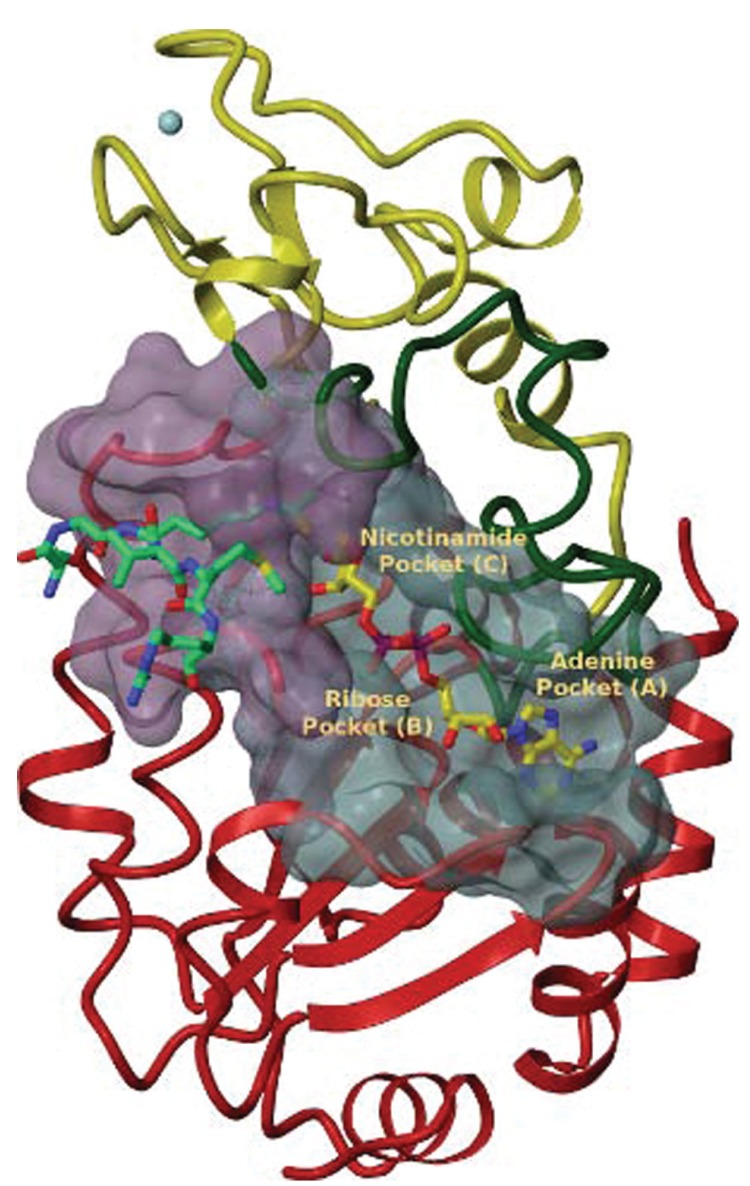
X-ray structure of human SIRT3 in complex with ADPR
bound to Acetyl-coenzyme A synthetase 2 peptide containing a
thioacetyl lysine (PDB code 3GLT). Different domains of the protein
are color-coded (red for the Rossman-fold domain, yellow for
zinc-binding domain, green for the cofactor-binding loop. The molecular
structure of substrate peptide (green) and cofactor (yellow)
are reported. The surfaces of substrate-binding site (purple) and
NAD+-binding site (light blue) are also highlighted. (The color
version of the figure is available in the electronic copy of the article).
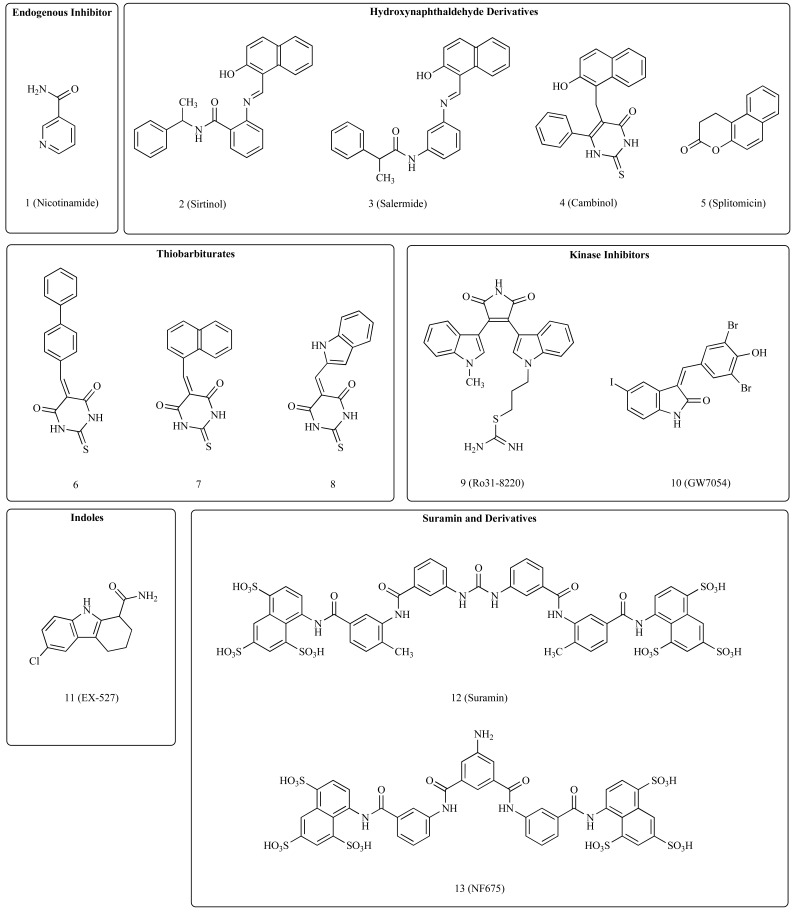
Sirtuin inhibitors.
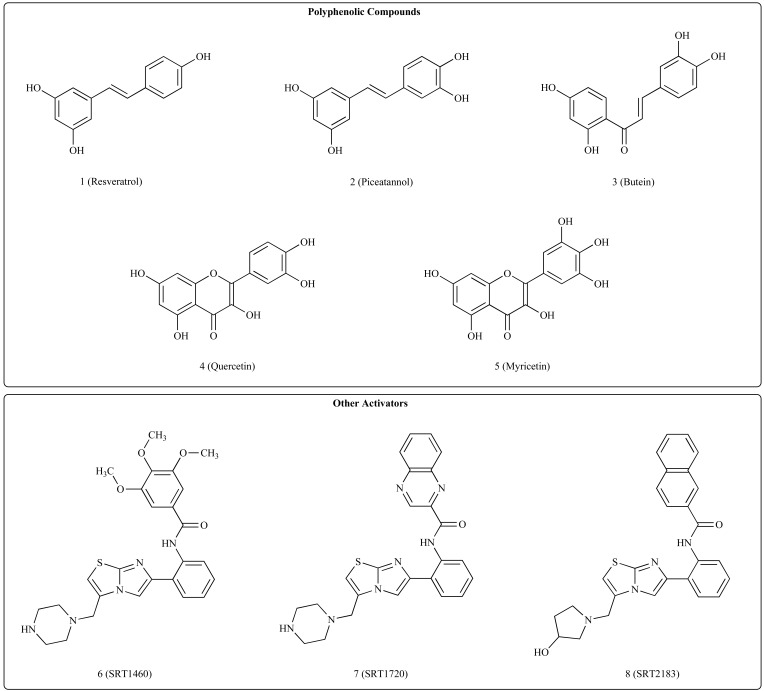
Sirtuins activators.
References
-
- Frye RA. Characterization of five human cDNAs with homology to the yeast SIR2 gene: Sir2-like proteins (sirtuins) metabolize NAD and may have protein ADP-ribosyltransferase activity. Biochem Biophys Res Commun. 1999;260:273–9. - PubMed
-
- Tanny JC, Dowd GJ, Huang J, Hilz H, Moazed D. An enzymatic activity in the yeast Sir2 protein that is essential for gene silencing. Cell. 1999; 99:735–45. - PubMed
-
- Imai S, Armstrong CM, Kaeberlein M, Guarente L. Transcriptional silencing and longevity protein Sir2 is an NAD-dependent histone deacetylase. Nature. 2000; 403:795–800. - PubMed
-
- Dani N, Barbosa AJM, Del Rio A, Di Girolamo M. ADPribosylated proteins as old and new drug targets for anticancer therapy: the example of ARF6. Curr Pharm Des. 2013;19(4):624–33. - PubMed
Publication types
MeSH terms
Substances
LinkOut - more resources
Full Text Sources
Other Literature Sources