


Temporal trends in the frequency of twins and higher-order multiple births in Canada and the United States
- PMID: 23017111
- PMCID: PMC3533860
- DOI: 10.1186/1471-2393-12-103
Temporal trends in the frequency of twins and higher-order multiple births in Canada and the United States
Abstract
Background: The dramatic increase in multiple births is an important public health issue, since such births have elevated risks for adverse perinatal outcomes. Our objective was to explore the most recent temporal trends in rates of multiple births in Canada and the United States.
Methods: Live birth data from Canada (excluding Ontario) and the United States from 1991-2009 were used to calculate rates of twins, and triplet and higher-order multiples (triplet+). Temporal trends were assessed using tests for linear trend and absolute and relative changes in rates.
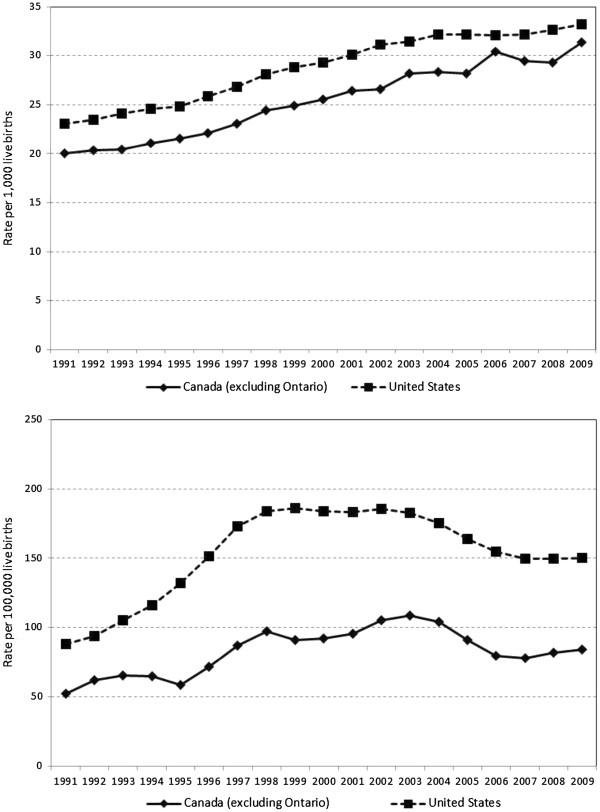
Results: Twin live births in the United States increased from 23.1 in 1991 to 32.2 per 1,000 live births in 2004, remained stable between 2004 and 2007, and then increased slightly to an all-time high of 33.2 per 1,000 live births in 2009. In Canada, rates also increased from 20.0 in 1991 to 28.3 per 1,000 live births in 2004, continued to increase modestly between 2004 and 2007, and rose to a high of 31.4 per 1,000 in 2009. Rates of triplet+ live births in the United States increased dramatically from 81.4 in 1991 to 193.5 per 100,000 live births in 1998, remained stable between 1998 and 2003 and then decreased to 148.9 per 100,000 in 2007. The rate declined marginally in 2008, but then rose again in 2009 to 153.5 per 100,000. Rates of triplet+ live births were much lower in Canada, although the temporal pattern of change was similar.
Conclusion: The rate of twin live births in the United States and Canada continues to increase, though more modestly than during the 1990s. Recent declines in rates of triplet+ live births in both countries have been followed by unstable trends.
Figures
References
-
- Public Health Agency of Canada. Canadian Perinatal Health Report. 2008. Ottawa: Minister of Health; 2008. Catalogue No HP10-12/2008E.
-
- Martin JA, Hamilton BE, Ventura SJ, Osterman MJK, Kirmeyer S, Mathews TJ, Wilson E. Division of Vital Statistics. Births: final data for 2009, table 27. Natl Vital Stat Rep. 2011;60:1–70. http://www.cdc.gov/nchs/data/nvsr/nvsr60/nvsr60_01.pdf. Accessed August 7, 2012. - PubMed
-
- Martin JA, Hamilton BE, Osterman MJK. Three Decades of Twin Births in the United States, 1980-2009. MD: National Center for Health Statistics, Hyattsville; 2012. (NCHS data brief, no 80). - PubMed
-
- Martin JA, Park MM. Trends in twin and triplet births: 1980-97. Natl Vital Stat Rep. 1999;47:1–16. - PubMed
Publication types
MeSH terms
LinkOut - more resources
Full Text Sources
