


doi: 10.3201/eid1810.120594.
Human infection with Candidatus Neoehrlichia mikurensis, China
Affiliations
- PMID: 23017728
- PMCID: PMC3471638
- DOI: 10.3201/eid1810.120594
Item in Clipboard
Human infection with Candidatus Neoehrlichia mikurensis, China
Emerg Infect Dis.
2012 Oct.
Abstract
To identify Candidatus Neoehrlichia mikurensis infection in northeastern China, we tested blood samples from 622 febrile patients. We identified in 7 infected patients and natural foci for this bacterium. Field surveys showed that 1.6% of ticks and 3.8% of rodents collected from residences of patients were also infected.
Figures
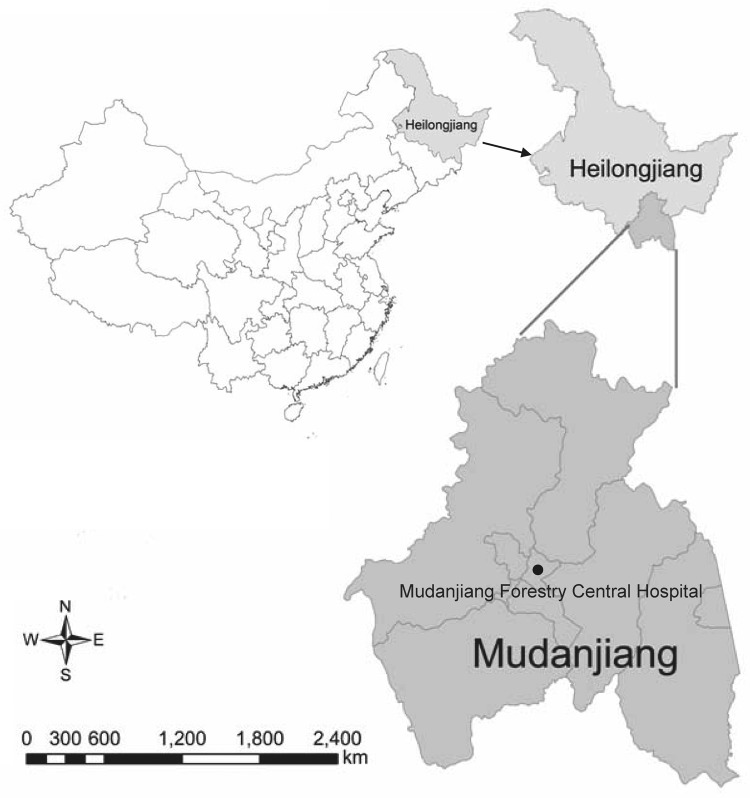
Location of Mudanjiang, Heilongjiang Province, China, where Candidatus Neoehrlichia mikurensis was detected.
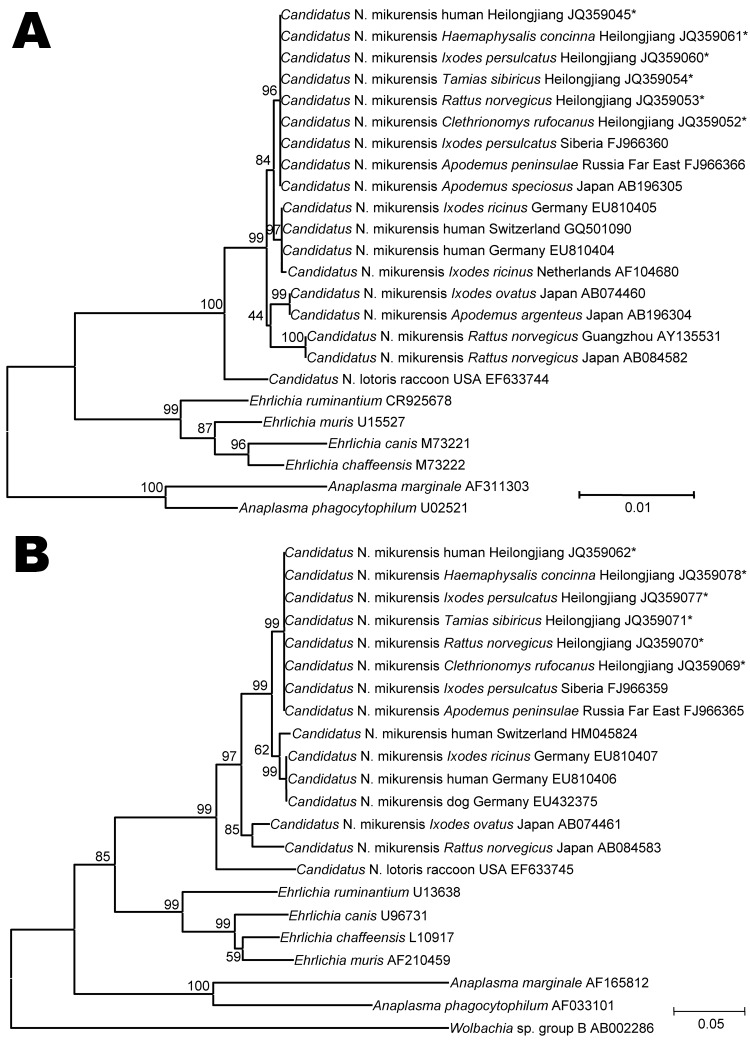
A) Neighbor-joining trees based on the 16S rRNA gene (rrs) and B) the 60-kDa heat shock protein gene (groEL) of Candidatus Neoehrlichia mikurensis, China, generated by using Molecular Evolutionary Genetics Analysis software version 4.0, (www.megasoftware.net/ ) the maximum composite-likelihood method, and bootstrap analysis of 1,000 replicates. Asterisks indicate nucleotide sequences of Candidatus N. mikurensis determined in this study. Numbers on branches indicate percentage of replicates that reproduced the topology for each clade. Scale bars indicate estimated evolutionary distance. A total of 1,303 positions for rrs and 953 positions for groEL were analyzed. Sources of Candidatus N. mikurensis sequences are shown between species names and GenBank accession numbers.
References
-
- Kawahara M, Rikihisa Y, Isogai E, Takahashi M, Misumi H, Suto C, et al. Ultrastructure and phylogenetic analysis of ‘Candidatus Neoehrlichia mikurensis’ in the family Anaplasmataceae, isolated from wild rats and found in Ixodes ovatus ticks. Int J Syst Evol Microbiol. 2004;54:1837–43. 10.1099/ijs.0.63260-0 - DOI - PubMed
Publication types
MeSH terms
Substances
LinkOut - more resources
Full Text Sources
Other Literature Sources
Molecular Biology Databases