


Comment
doi: 10.1016/j.cub.2012.07.046.
DNA damage: placing BRCA1 in the proper context
Affiliations
- PMID: 23017997
- PMCID: PMC3827951
- DOI: 10.1016/j.cub.2012.07.046
Item in Clipboard
Comment
DNA damage: placing BRCA1 in the proper context
Curr Biol.
.
Abstract
How does BRCA1's evolutionarily conserved E3 ligase activity contribute to DNA damage responses? Genetically engineered cells containing a BRCA1 RING domain mutation have been used to identify Claspin as a new target of BRCA1 E3 ligase activity in response to specific forms of DNA damage.
Copyright © 2012 Elsevier Ltd. All rights reserved.
Figures
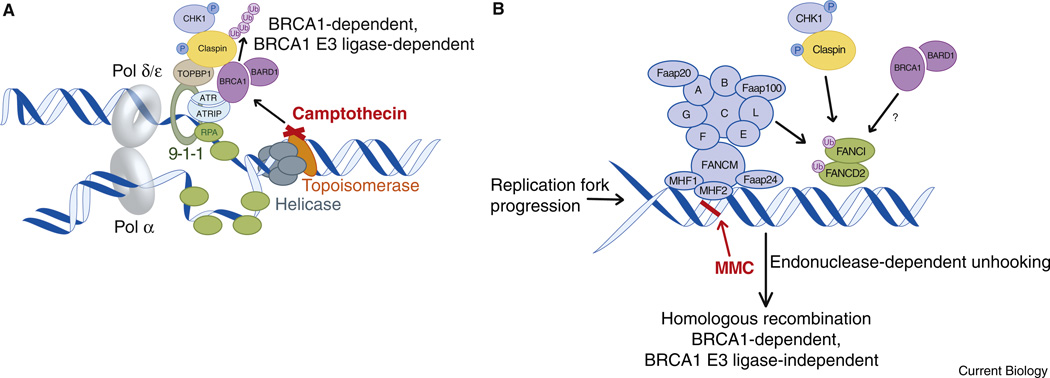
(A) Topoisomerase poisons such as camptothecin induce replication-associated DNA double strand breaks and trigger a DNA damage response, which includes BRCA1-dependent ubiquitination of Claspin and activation of CHK1. (B) Forms of DNA damage involving inter-strand crosslinks are recognized by several Fanconi Anemia proteins, culminating in the monoubiquitination of the FANCD2/FANCI complex. Endo-nuclease processing of crosslinks is a prerequisite for subsequent repair of the lesion by homologous recombination. Claspin and BRCA1 also participate in promoting FANCD2 activation and BRCA1 is required for the later steps of homologous recombination after DNA double strand break formation.
Comment on
-
A DNA-damage selective role for BRCA1 E3 ligase in claspin ubiquitylation, CHK1 activation, and DNA repair.Curr Biol. 2012 Sep 25;22(18):1659-66. doi: 10.1016/j.cub.2012.07.034. Epub 2012 Aug 2. Curr Biol. 2012. PMID: 22863316
References
-
- Bryant HE, Schultz N, Thomas HD, Parker KM, Flower D, Lopez E, Kyle S, Meuth M, Curtin NJ, Helleday T. Specific killing of BRCA2-deficient tumours with inhibitors of poly(ADP-ribose) polymerase. Nature. 2005;434:913–917. - PubMed
-
- Farmer H, McCabe N, Lord CJ, Tutt AN, Johnson DA, Richardson TB, Santarosa M, Dillon KJ, Hickson I, Knights C, et al. Targeting the DNA repair defect in BRCA mutant cells as a therapeutic strategy. Nature. 2005;434:917–921. - PubMed
-
- Fong PC, Boss DS, Yap TA, Tutt A, Wu P, Mergui-Roelvink M, Mortimer P, Swaisland H, Lau A, O’Connor MJ, et al. Inhibition of poly(ADP-ribose) polymerase in tumors from BRCA mutation carriers. N. Engl. J. Med. 2009;361:123–134. - PubMed
-
- Tutt A, Robson M, Garber JE, Domchek SM, Audeh MW, Weitzel JN, Friedlander M, Arun B, Loman N, Schmutzler RK, et al. Oral poly(ADP-ribose) polymerase inhibitor olaparib in patients with BRCA1 or BRCA2 mutations and advanced breast cancer: a proof-of-concept trial. Lancet. 2010;376:235–244. - PubMed
-
- Manke IA, Lowery DM, Nguyen A, Yaffe MB. BRCT repeats as phosphopeptide-binding modules involved in protein targeting. Science. 2003;302:636–639. - PubMed
Publication types
MeSH terms
Substances
Grants and funding
LinkOut - more resources
Full Text Sources
Miscellaneous
