


Injury markers predict time to dementia in subjects with MCI and amyloid pathology
- PMID: 23019259
- PMCID: PMC3475623
- DOI: 10.1212/WNL.0b013e3182704056
Injury markers predict time to dementia in subjects with MCI and amyloid pathology
Abstract
Objectives: Alzheimer disease (AD) can now be diagnosed in subjects with mild cognitive impairment (MCI) using biomarkers. However, little is known about the rate of decline in those subjects. In this cohort study, we aimed to assess the conversion rate to dementia and identify prognostic markers in subjects with MCI and evidence of amyloid pathology.
Methods: We pooled subjects from the VU University Medical Center Alzheimer Center and the Development of Screening Guidelines and Criteria for Predementia Alzheimer's Disease (DESCRIPA) study. We included subjects with MCI, an abnormal level of β-amyloid(1-42) (Aβ(1-42)) in the CSF, and at least one diagnostic follow-up visit. We assessed the effect of APOE genotype, CSF total tau (t-tau) and tau phosphorylated at threonine 181 (p-tau) and hippocampal volume on time to AD-type dementia using Cox proportional hazards models and on decline on the Mini-Mental State Examination (MMSE) using linear mixed models.
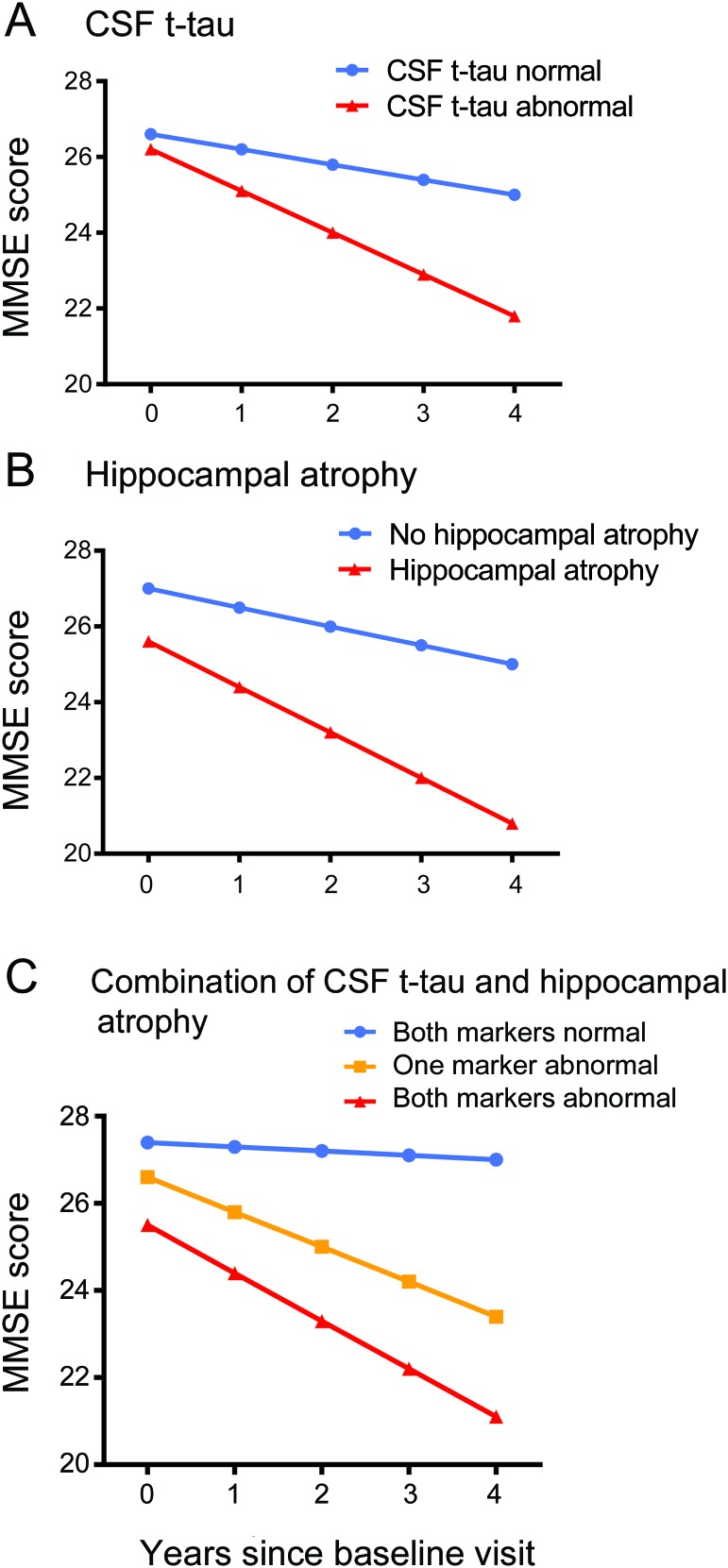
Results: We included 110 subjects with MCI with abnormal CSF Aβ(1-42) and a mean MMSE score of 26.3 ± 2.8. During a mean follow-up of 2.2 ± 1.0 (range 0.4-5.0) years, 63 subjects (57%) progressed to AD-type dementia. Abnormal CSF t-tau (hazard ratio [HR] 2.3, 95% confidence interval [CI] 1.1-4.6, p = 0.03) and CSF p-tau (HR 3.5, 95% CI 1.3-9.2, p = 0.01) concentration and hippocampal atrophy (HR 2.5, 95% CI 1.1-5.6, p = 0.02) predicted time to dementia. For subjects with both abnormal t-tau concentration and hippocampal atrophy, HR was 7.3 (95% CI 1.0-55.9, p = 0.06). Furthermore, abnormal CSF t-tau and p-tau concentrations and hippocampal atrophy predicted decline in MMSE score.
Conclusions: In subjects with MCI and evidence of amyloid pathology, the injury markers CSF t-tau and p-tau and hippocampal atrophy can predict further cognitive decline.
Figures

References
-
- Albert MS, Dekosky ST, Dickson D, et al. The diagnosis of mild cognitive impairment due to Alzheimer's disease: recommendations from the National Institute on Aging-Alzheimer's Association workgroups on diagnostic guidelines for Alzheimer's disease. Alzheimers Dement 2011; 7: 270– 279 . - PMC - PubMed
-
- Dubois B, Feldman HH, Jacova C, et al. Research criteria for the diagnosis of Alzheimer's disease: revising the NINCDS-ADRDA criteria. Lancet Neurol 2007; 6: 734– 746 . - PubMed
-
- van Rossum IA, Visser PJ, Knol DL, et al. Injury markers but not amyloid markers are associated with rapid progression from mild cognitive impairment to dementia in Alzheimer's disease. J Alzheimers Dis 2012; 29: 319 327 . - PubMed
Publication types
MeSH terms
Substances
LinkOut - more resources
Full Text Sources
Other Literature Sources
Medical
Miscellaneous
