Review
doi: 10.1210/jc.2012-3080.
Epub 2012 Sep 27.
Update in TSH receptor agonists and antagonists
Affiliations
- PMID: 23019348
- PMCID: PMC3513532
- DOI: 10.1210/jc.2012-3080
Item in Clipboard
Review
Update in TSH receptor agonists and antagonists
J Clin Endocrinol Metab.
2012 Dec.
Abstract
The physiological role of the TSH receptor (TSHR) as a major regulator of thyroid function is well understood, but TSHRs are also expressed in multiple normal extrathyroidal tissues, and the physiological roles of TSHRs in these tissues are unclear. Moreover, TSHRs play a major role in several pathological conditions including hyperthyroidism, hypothyroidism, and thyroid tumors. Small molecule, "drug-like" TSHR agonists, neutral antagonists, and inverse agonists may be useful as probes of TSHR function in extrathyroidal tissues and as leads to develop drugs for several diseases of the thyroid. In this Update, we review the most recent findings regarding the development and use of these small molecule TSHR ligands.
Figures
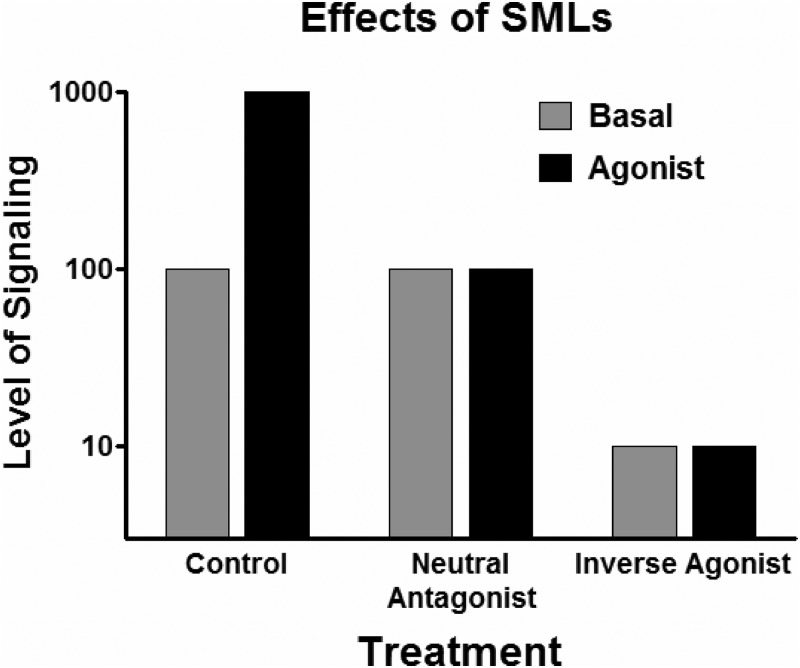
Effects on receptor signaling by agonists, neutral antagonists, and inverse agonists. Control illustrates signaling in the absence of neutral antagonists or inverse agonists. Basal signaling, which represents agonist-independent (or constitutive) signaling, is set as 100. (TSHR is a receptor that exhibits significant basal signaling activity.) Antagonist is a general term that includes neutral antagonists and inverse agonists, which have also been named negative antagonists.

Domains of binding to TSHR of TSH, TSAbs, and SMLs. TSHR, like the receptors for FSH and LH, has a large amino-terminal ectodomain that protrudes from the surface of the cells. TSH and TSAbs bind primarily to the TSHR ectodomain. By contrast, SMLs bind to a pocket within the transmembrane domain, which contains the seven α-helical bundles that are characteristic of GPCRs. Ectodomain, Red. Ntt shows the amino terminus of TSHR. Transmembrane domain: Individual helices are ribbons in different colors. The terminal part of the intracellular carboxyl tail (Ctt) is not shown. This model was kindly provided by Gunnar Kleinau, Ph.D., Charité Campus Virchow Klinikum, Berlin, Germany.
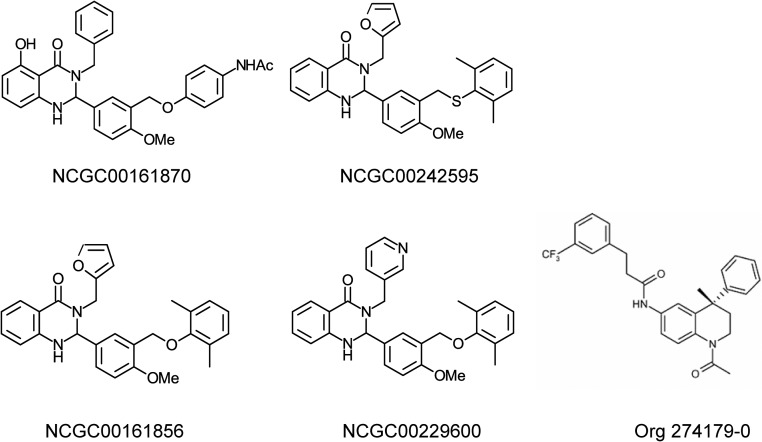
Structures of TSHR SMLs. TSHR agonist: NCGC00161870, N-(4-(5-(3-benzyl-5-hydroxy-4-oxo-1,2,3,4-tetrahydroquinazolin-2-yl)-2-methoxybenzyloxy)-phenyl)acetamide. TSHR neutral antagonist: NCGC00242595, 2-(3-((2,6-dimethylphenylthio)methyl)-4-methoxyphenyl)-3-(furan-2-ylmethyl)-2,3-dihydroquinazolin-4(1H)-one. TSHR inverse agonists: NCGC00161856, 2-(3-((2,6-dimethylphenoxy)methyl)-4-methoxyphenyl)-3-(furan-2-ylmethyl)-2,3-dihydroquinazolin-4(1H)-one]; NCGC00229600, 2-(3-((2,6-dimethylphenoxy)methyl)-4-methoxyphenyl)-3-(pyridin-3-ylmethyl)-2,3-dihydroquinazolin-4(1H)-one; and Org 274179-0, (S)-N-(1-acetyl-4-methyl-4-phenyl-1,2,3,4-tetrahydro-quinolin-6-yl)-3-(3-trifluoromethyl-phenyl)-propionamide.
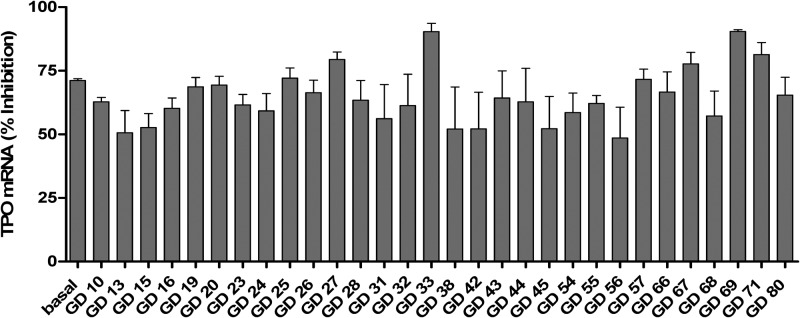
Inhibition of basal and TSAb-induced up-regulation of the expression of thyroperoxidase mRNA in primary cultures of human thyrocytes. NCGC00229600 inhibited the levels by 65 ± 2.0% (mean ± sem ). Importantly, although the thyrocytes were exposed to NCGC00229600 for 48 h, there was no evidence of toxicity. [Reproduced from S. Neumann et al.: A new small-molecule antagonist inhibits Graves' disease antibody activation of the TSH receptor. J Clin Endocrinol Metab 96:548–554, 2011 (36), with permission. © The Endocrine Society.]
References
-
- Bassett JH, Williams GR. 2008. Critical role of the hypothalamic-pituitary-thyroid axis in bone. Bone 43:418–426 - PubMed
-
- Blair HC, Robinson LJ, Sun L, Isales C, Davies TF, Zaidi M. 2011. Skeletal receptors for steroid-family regulating glycoprotein hormones: a multilevel, integrated physiological control system. Ann NY Acad Sci 1240:26–31 - PubMed
-
- Bassett JH, Williams AJ, Murphy E, Boyde A, Howell PG, Swinhoe R, Archanco M, Flamant F, Samarut J, Costagliola S, Vassart G, Weiss RE, Refetoff S, Williams GR. 2008. A lack of thyroid hormones rather than excess thyrotropin causes abnormal skeletal development in hypothyroidism. Mol Endocrinol 22:501–512 - PMC - PubMed
-
- Rapoport B, McLachlan SM. 2007. The thyrotropin receptor in Graves' disease. Thyroid 17:911–922 - PubMed
Publication types
MeSH terms
Substances
Grants and funding
LinkOut - more resources
Full Text Sources
Other Literature Sources
Molecular Biology Databases