. 2012 Dec;11(6):1065-73.
doi: 10.1111/acel.12008. Epub 2012 Oct 19.

Molecular events in matrix protein metabolism in the aging kidney

Affiliations

Molecular events in matrix protein metabolism in the aging kidney

Kavithalakshmi Sataranatarajan et al. Aging Cell. 2012 Dec.

Abstract

We explored molecular events associated with aging-induced matrix changes in the kidney. C57BL6 mice were studied in youth, middle age, and old age. Albuminuria and serum cystatin C level (an index of glomerular filtration) increased with aging. Renal hypertrophy was evident in middle-aged and old mice and was associated with glomerulomegaly and increase in mesangial fraction occupied by extracellular matrix. Content of collagen types I and III and fibronectin was increased with aging; increment in their mRNA varied with the phase of aging. The content of ZEB1 and ZEB2, collagen type I transcription inhibitors, and their binding to the collagen type Iα2 promoter by ChIP assay also showed age-phase-specific changes. Lack of increase in mRNA and data from polysome assay suggested decreased degradation as a potential mechanism for kidney collagen type I accumulation in the middle-aged mice. These changes occurred with increment in TGFβ mRNA and protein and activation of its SMAD3 pathway; SMAD3 binding to the collagen type Iα2 promoter was also increased. TGFβ-regulated microRNAs (miRs) exhibited selective regulation. The renal cortical content of miR-21 and miR-200c, but not miR-192, miR-200a, or miR-200b, was increased with aging. Increased miR-21 and miR-200c contents were associated with reduced expression of their targets, Sprouty-1 and ZEB2, respectively. These data show that aging is associated with complex molecular events in the kidney that are already evident in the middle age and progress to old age. Age-phase-specific regulation of matrix protein synthesis occurs and involves matrix protein-specific transcriptional and post-transcriptional mechanisms.


Figures

Fig 1
Fig 1
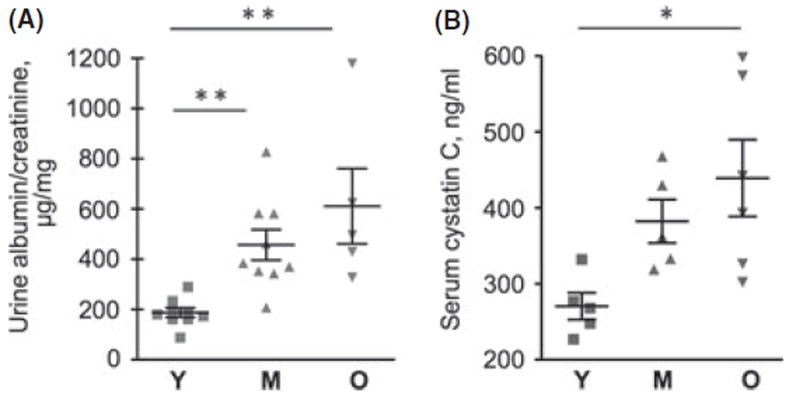
Albuminuria and serum cystatin C levels in young (Y), middle-aged (M), and old (O) mice. (A) Urinary albumin to creatinine ratio in young (Y), middle-aged (M), and old (O) mice. Data from 5 to 9 mice in each group are shown (**P < 0.01 vs. young mice by ANOVA). (B) Serum cystatin C level bears an inverse relation to glomerular filtration function. Data from 5 to 6 mice in each group are shown (*P < 0.05 vs. young by ANOVA).
Fig 2
Fig 2
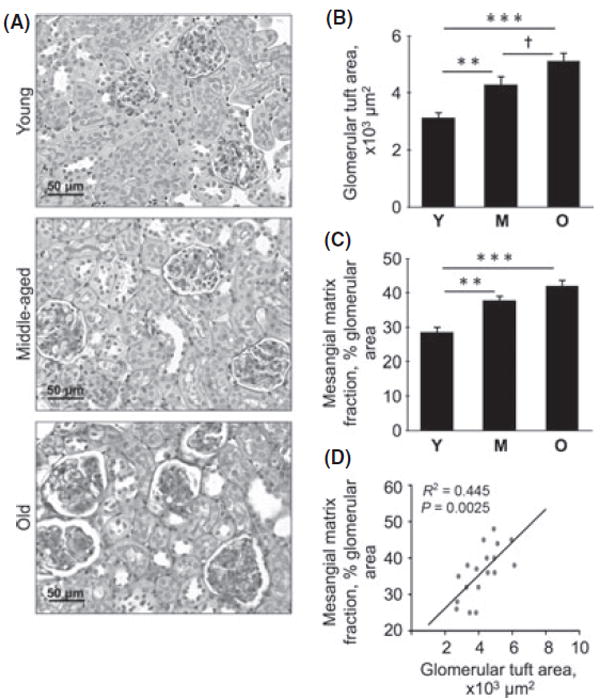
Glomerular area and mesangial matrix fraction in young (Y), middle-aged (M), and old (O) mice. Kidney sections were stained with PAS (A), and glomerular area (B) and mesangial matrix fraction of the glomerulus (C) were measured by computer-aided morphometry. Representative micrographs from six mice in each of the three age groups are shown. Composite mean ± SE data from six mice in each group are shown in a histogram (**P < 0.01, ***P < 0.001 vs. young mice; †P < 0.05 vs. middle-aged mice by ANOVA). (D) Correlation between glomerular tuft area and mesangial matrix fraction of the glomerulus.
Fig 3
Fig 3
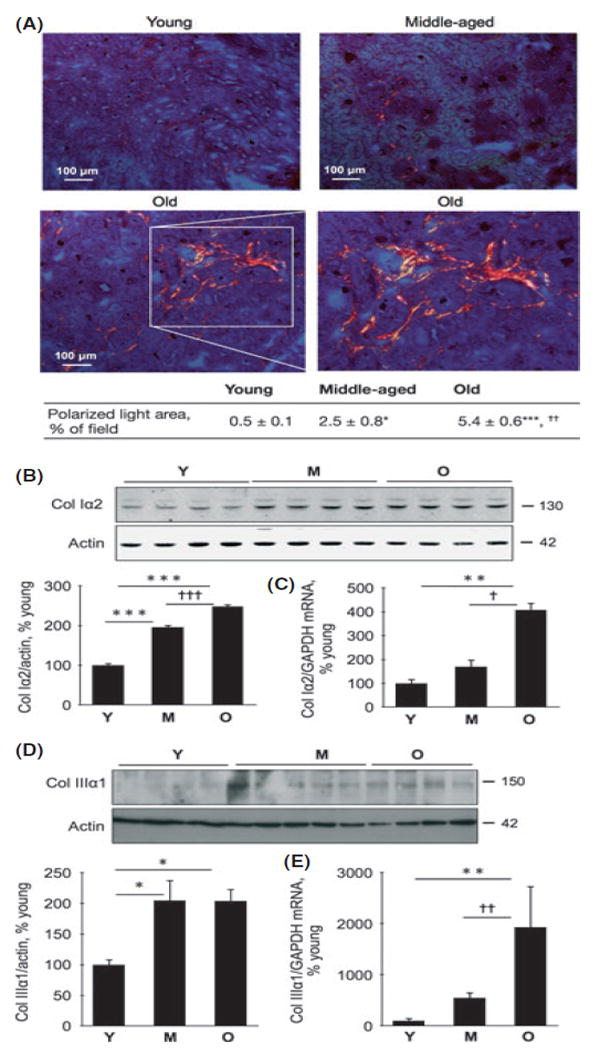
Expression of collagen types I and III in renal parenchyma in young (Y), middle-aged (M), and old (O) mice. (A) Kidney sections were stained with Sirius Red and examined under polarized light to detect cross-linked type I and type III collagens. The boxed area in the bottom left panel is enlarged in the bottom right panel to show anatomical details of the stained area. Composite mean ± SE data from 3 to 4 mice in each group are shown in a table (*P < 0.05, ***P < 0.001 vs. young mice; ††<0.01 vs. middle-aged mice by ANOVA). (B, D) Equal amounts of renal cortical homogenates from mice were separated by SDS-PAGE and immunoblotted with a specific antibody against either collagen type Iα2 chain or collagen type IIIα1 chain. Composite mean ± SE data from 4 to 5 mice in each group are shown in a histogram (*P < 0.05, ***P < 0.001 vs. young mice; †††<0.001 vs. middle-aged mice by ANOVA). (C) Quantitative RT–PCR was performed to assess changes in mRNA for collagen types Iα2 chain; **P < 0.01 vs. young mice, †P < 0.05 vs. middle-aged mice (n = 10 mice in each group). (E) Quantitative RT-PCR for type IIIα1 chain mRNA (**P < 0.01 vs. young, ††P < 0.01 vs. middle-aged mice by ANOVA, n = 5-9 mice in each group).
Fig 4
Fig 4
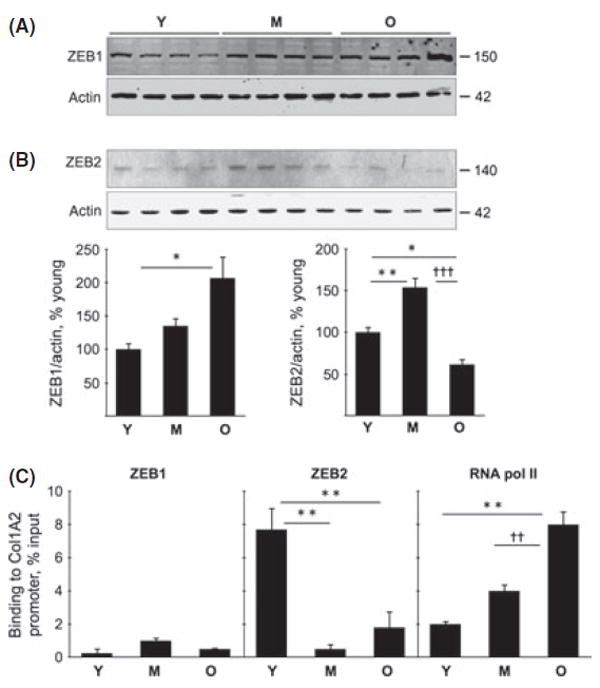
ZEB1 and ZEB2 contents and their binding to the collagen Iα2 promoter in young (Y), middle-aged (M), and old (O) mice. Immunoblotting of equal amounts of renal cortical homogenates was performed to assess changes in the expression of ZEB1 (A) and ZEB2 (B) (*P < 0.05, **P < 0.01 vs. young, †††P < 0.001 vs. middle-aged mice by ANOVA, n = 6 mice in each group). Histograms of composite data for each protein are shown in the lower panels. (C) Chromatin immunoprecipitation (ChIP) assay was performed for the binding of ZEB1, ZEB2, and RNA polymerase II (RNA Pol II) to the collagen type Iα2 promoter as described in Methods. There was no significant change in ZEB1 binding to the promoter. ZEB2 binding to the promoter was decreased in the middle-aged and old mice (**P < 0.01 vs. young by ANOVA, n = 4–6 mice in each group). RNA Pol II binding to the promoter was increased progressively with aging (**P < 0.01 vs. young, ††P < 0.01 vs. middle-aged mice by ANOVA, n = 4–6 mice in each group).
Fig 5
Fig 5
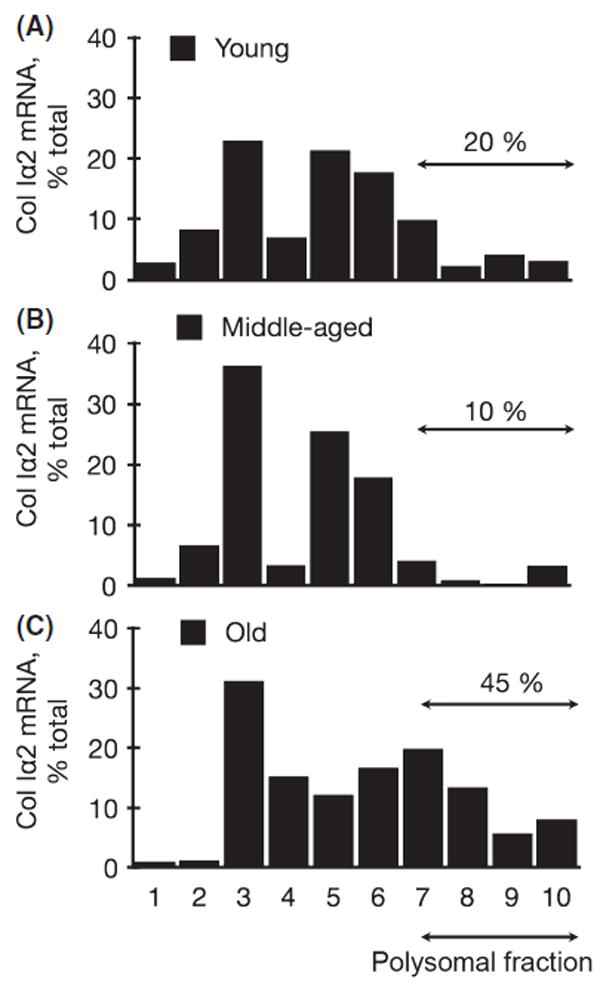
Polysomal assay in young (Y), middle-aged (M), and old (O) mice. Postnuclear preparations from the renal cortex of mice were separated into ten fractions on a 15–40% sucrose gradient, and mRNA for collagen type Iα2 was detected by RT–PCR. The percentage of total mRNA for collagen type Iα2 distributed to fractions 7–10 represents that bound to 80S ribosome and ready for translation; note the increment in this fraction of mRNA in the old mice. Mean data from two mice from each group are shown.
Fig 6
Fig 6
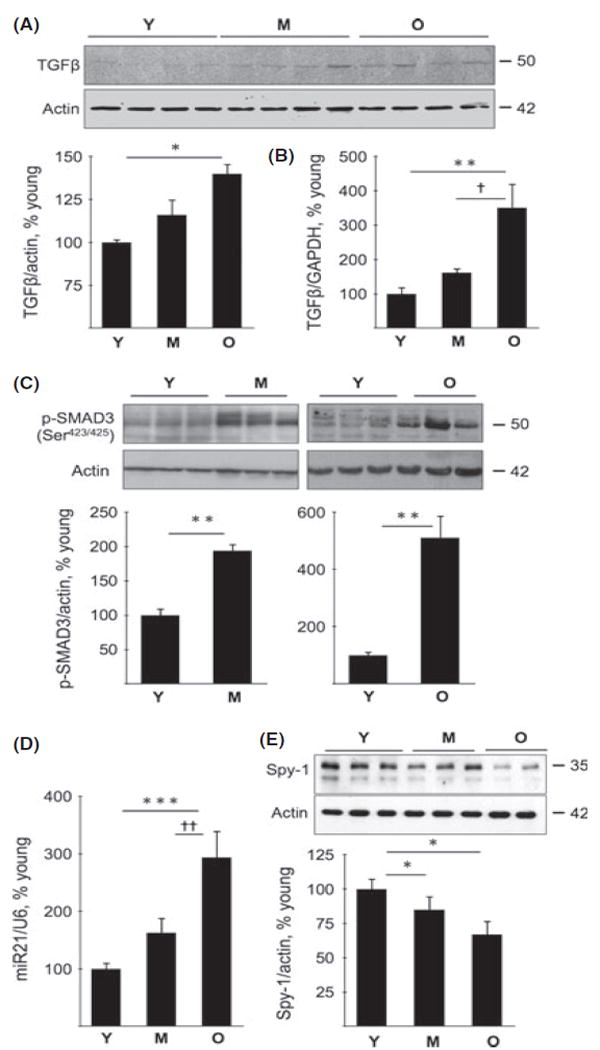
TGFβ expression and activation, miR21 and Sprouty expression in young (Y), middle-aged (M), and old (O) mice. (A) Immunoblotting of renal cortical homogenates was performed to assess changes in the expression of TGFβ in the middle-aged and old mice. Composite mean ± SE data from four mice in each group are shown in a histogram (*P < 0.05 vs. young mice by ANOVA). (B) Quantitative RT-PCR was performed to assess TGFβ mRNA. Composite mean ± SE data from 5 to 6 mice in each group are shown in a histogram (**P < 0.01 vs. young mice; †P < 0.05 vs. middle-aged mice by ANOVA). (C) Immunoblot analysis of Smad3 phosphorylation in kidney cortical homogenates (representative data from 3 to 6 mice in each group, **P < 0.01 vs. young mice). (D) Real-time PCR was performed to assess changes in miR-21 and U6, the latter serving as control. Composite mean ± SE data from 7 to 8 mice in each group are shown in a histogram (***P < 0.001 vs. young mice, ††P < 0.01 vs. middle-aged mice by ANOVA). (E) Immunoblot analysis of Sprouty-1 (Spy-1) expression in kidney cortical lysates. Composite mean ± SE data from 6 to 8 mice in each group are shown in a histogram (*P < 0.05 vs. young mice by ANOVA).
Fig 7
Fig 7
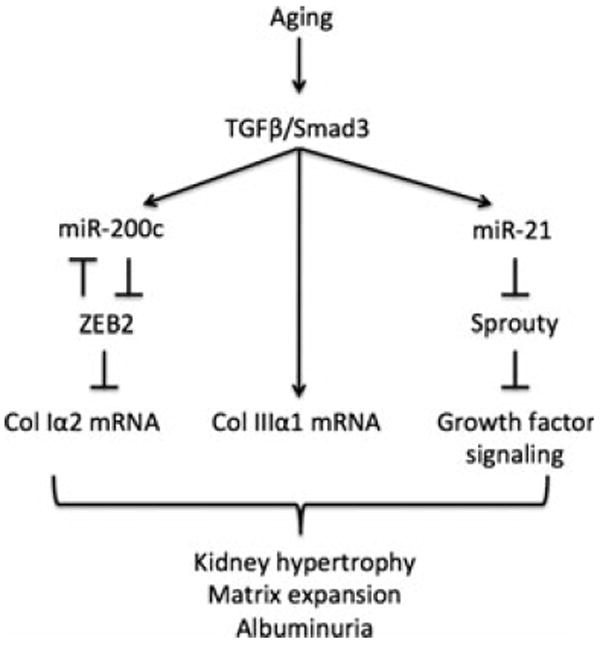
A schematic diagram shows pathways involved in changes in the kidney in old mice reported in this study.

References

    1. Abrass CK, Adcox MJ, Raugi GJ. Aging-associated changes in renal extracellular matrix. Am J Pathol. 1995;146:742–752. - PMC - PubMed
    1. Abrass CK, Hansen K, Popov V, Denisenko O. Alterations in chromatin are associated with increases in collagen III expression in aging nephropathy. Am J Physiol Renal Physiol. 2011;300:F531–F539. - PubMed
    1. Brabletz S, Brabletz T. The ZEB/miR-200 feedback loop-a motor of cellular plasticity in development and cancer? EMBO Rep. 2010;11:670–677. - PMC - PubMed
    1. Cabrita MA, Christofori G. Sprouty proteins, masterminds of receptor tyrosine kinase signaling. Angiogenesis. 2008;11:53–62. - PubMed
    1. Chau BN, Xin C, Hartner J, Ren S, Castano AP, Linn G, Li J, Tran PT, Kaimal V, Huang X, Chang AN, Li S, Kalra A, Grafals M, Portilla D, MacKenna DA, Orkin SH, Duffield JS. MicroRNA-21 promotes fibrosis of the kidney by silencing metabolic pathways. Sci Transl Med. 2012;4:21ra118. - PMC - PubMed

Publication types

MeSH terms

Substances