


Global trends in exclusive breastfeeding
- PMID: 23020813
- PMCID: PMC3512504
- DOI: 10.1186/1746-4358-7-12
Global trends in exclusive breastfeeding
Abstract
Background: Infant and young child feeding is critical for child health and survival. Proportion of infants 0-5 months who are fed exclusively with breast milk is a common indicator used for monitoring and evaluating infant and young child feeding in a given country and region. Despite progress made since 1990, a previous review in 2006 of global and regional trends found improvement to be modest. The current study provides an update in global and regional trends in exclusive breastfeeding from 1995 to 2010, taking advantage of the wealth of data from recent household surveys.
Methods: Using the global database of infant and young child feeding maintained by the United Nations Children's Fund, the authors examined estimates from 440 household surveys in 140 countries over the period between 1995 and 2010 and calculated global and regional averages of the rate of exclusive breastfeeding among infants 0-5 months for the two time points to assess the trends.
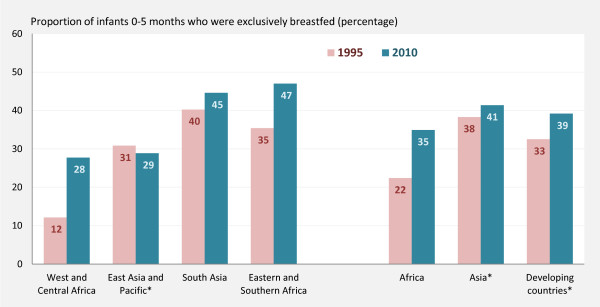
Results: Trend data suggest the prevalence of exclusive breastfeeding among infants younger than six months in developing countries increased from 33% in 1995 to 39% in 2010. The prevalence increased in almost all regions in the developing world, with the biggest improvement seen in West and Central Africa.
Conclusions: In spite of the well-recognized importance of exclusive breastfeeding, the practice is not widespread in the developing world and increase on the global level is still very modest with much room for improvement. Child nutrition programmes worldwide continue to require investments and commitments to improve infant feeding practices in order to have maximum impact on children's lives.
Figures
References
-
- Butte NF, Lopez-Alarcon MG, Garza C. Nutrient adequacy of exclusive breastfeeding for the term infant during the first six months of life. Geneva, Switzerland: World Health Organization; 2002.
-
- World Health Organization. United Nations Children’s Fund: Global Strategy for Infantand Young Child Feeding. Geneva, Switzerland: World Health Organization; 2003.
-
- Singh K. The effect of colostrum on infant mortality: urban rural differentials. Health and Population. 1992;15:94–100.
LinkOut - more resources
Full Text Sources
