


A 2-stage genome-wide association study to identify single nucleotide polymorphisms associated with development of erectile dysfunction following radiation therapy for prostate cancer
- PMID: 23021708
- PMCID: PMC3616619
- DOI: 10.1016/j.ijrobp.2012.08.003
A 2-stage genome-wide association study to identify single nucleotide polymorphisms associated with development of erectile dysfunction following radiation therapy for prostate cancer
Abstract
Purpose: To identify single nucleotide polymorphisms (SNPs) associated with development of erectile dysfunction (ED) among prostate cancer patients treated with radiation therapy.
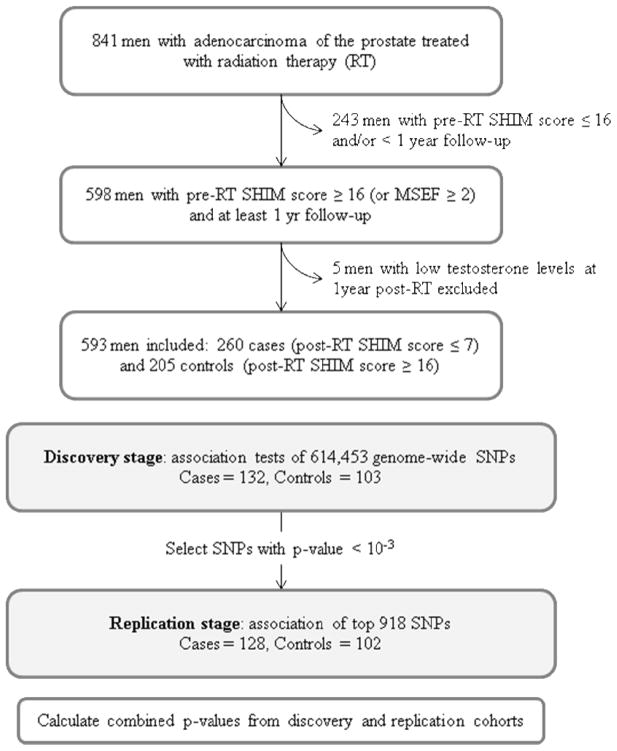
Methods and materials: A 2-stage genome-wide association study was performed. Patients were split randomly into a stage I discovery cohort (132 cases, 103 controls) and a stage II replication cohort (128 cases, 102 controls). The discovery cohort was genotyped using Affymetrix 6.0 genome-wide arrays. The 940 top ranking SNPs selected from the discovery cohort were genotyped in the replication cohort using Illumina iSelect custom SNP arrays.
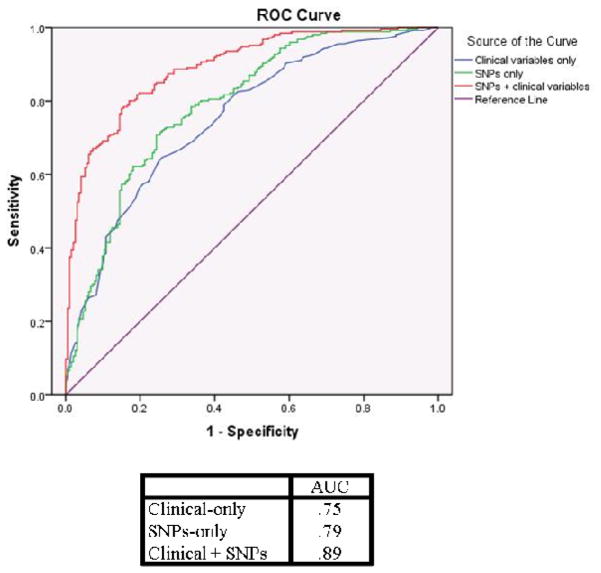
Results: Twelve SNPs identified in the discovery cohort and validated in the replication cohort were associated with development of ED following radiation therapy (Fisher combined P values 2.1×10(-5) to 6.2×10(-4)). Notably, these 12 SNPs lie in or near genes involved in erectile function or other normal cellular functions (adhesion and signaling) rather than DNA damage repair. In a multivariable model including nongenetic risk factors, the odds ratios for these SNPs ranged from 1.6 to 5.6 in the pooled cohort. There was a striking relationship between the cumulative number of SNP risk alleles an individual possessed and ED status (Sommers' D P value=1.7×10(-29)). A 1-allele increase in cumulative SNP score increased the odds for developing ED by a factor of 2.2 (P value=2.1×10(-19)). The cumulative SNP score model had a sensitivity of 84% and specificity of 75% for prediction of developing ED at the radiation therapy planning stage.
Conclusions: This genome-wide association study identified a set of SNPs that are associated with development of ED following radiation therapy. These candidate genetic predictors warrant more definitive validation in an independent cohort.
Copyright © 2013 Elsevier Inc. All rights reserved.
Conflict of interest statement
Conflict of interest: N.S. has received consulting fees or honorarium from Amgen, Ferring, Janssen, Diversified Conference Management, Prologics LLC, and Nihon MediPhysics. RS has received fees for lectures and development of educational presentations from Bard.
Figures
References
-
- Grimm P, Billiet I, Bostwick D, et al. Comparative analysis of prostate-specific antigen free survival outcomes for patients with low, intermediate and high risk prostate cancer treatment by radical therapy. Results from the Prostate Cancer Results Study Group. BJU Int. 2012 Feb;109 (Suppl 1):22–29. - PubMed
-
- Merrick GS, Butler WM, Wallner KE, et al. Erectile function after prostate brachytherapy. International journal of radiation oncology, biology, physics. 2005 Jun 1;62(2):437–447. - PubMed
-
- Potters L, Torre T, Fearn PA, Leibel SA, Kattan MW. Potency after permanent prostate brachytherapy for localized prostate cancer. International journal of radiation oncology, biology, physics. 2001 Aug 1;50(5):1235–1242. - PubMed
-
- Robinson JW, Moritz S, Fung T. Meta-analysis of rates of erectile function after treatment of localized prostate carcinoma. International journal of radiation oncology, biology, physics. 2002 Nov 15;54(4):1063–1068. - PubMed
Publication types
MeSH terms
Substances
Grants and funding
LinkOut - more resources
Full Text Sources
Other Literature Sources
Medical
Molecular Biology Databases
