. 2013 Jan:90:35-42.
doi: 10.1016/j.brainresbull.2012.09.009. Epub 2012 Sep 26.

Ascorbic acid efficiently enhances neuronal synthesis of norepinephrine from dopamine

Affiliations

Ascorbic acid efficiently enhances neuronal synthesis of norepinephrine from dopamine

James M May et al. Brain Res Bull. 2013 Jan.

Abstract

Ascorbic acid enhances synthesis of norepinephrine from dopamine in adrenal chromaffin cells by serving as a co-factor for chromaffin granule dopamine β-hydroxylase (DβH). However, there is controversy regarding in situ kinetics of the ascorbate effect in chromaffin cells, as well as whether they apply to neuronal cells. In this study we evaluated the stimulation of norepinephrine synthesis from dopamine in cultured SH-SY5Y neuroblastoma cells. These cells contained neither ascorbate nor norepinephrine in culture, but when provided with dopamine, they generated intracellular norepinephrine at rates that were stimulated several-fold by intracellular ascorbate. Ascorbate-induced increases in norepinephrine synthesis in dopamine-treated cells were linear over 60 min, despite saturation of intracellular ascorbate. Norepinephrine accumulation after 60 min of incubation with 100 μM dopamine was half-maximal at intracellular ascorbate concentrations of 0.2-0.5 mM, which fits well with the literature K(m) for ascorbate of DβH using dopamine as a substrate. Moreover, these ascorbate concentrations were generated by initial extracellular ascorbate concentrations of less than 25 μM due to concentrative accumulation by the ascorbate transporter. Treatment with 100 μM dopamine acutely increased cellular superoxide generation, which was prevented by ascorbate loading, but associated with a decrease in intracellular ascorbate when the latter was present at concentrations under 1 mM. These results show that ascorbate promptly enhances norepinephrine synthesis from dopamine by neuronal cells that it does so at physiologic intracellular concentrations in accord with the kinetics of DβH, and that it both protects cells from superoxide and by providing electrons to DβH.


Conflict of interest statement

Conflict of Interest Statement

The authors declare that there are no conflicts of interest.

Figures
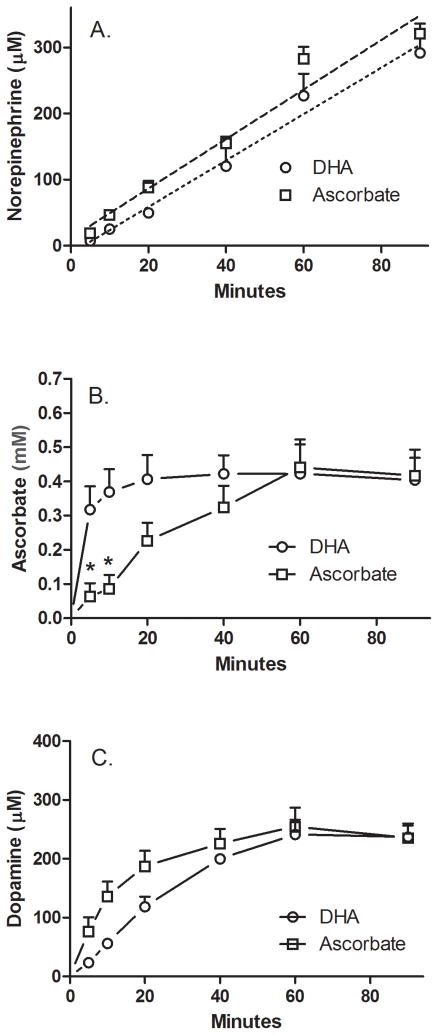
Figure 1
Figure 1. Time-dependent stimulation by AA of DA conversion to NE by SH-SY5Y cells in culture
Cells in culture were incubated with 100 μM concentrations of AA (circles) or DHA (squares) followed immediately by 100 μM DA. Incubations were carried out in culture and at the times indicated, the wells were rinsed twice with 2 ml of KRH and the cells were removed from the plate for assay of NE (Panel A), AA (Panel B), and DA (Panel C) as described under Methods. Results are shown from 3 experiments for DHA loading and 5 experiments for AA loading, with an “*” indicating p < 0.05 compared to DHA-treated cells at the same time point.
Figure 2
Figure 2. Ascorbate effects on NE generation from relatively high DA concentrations
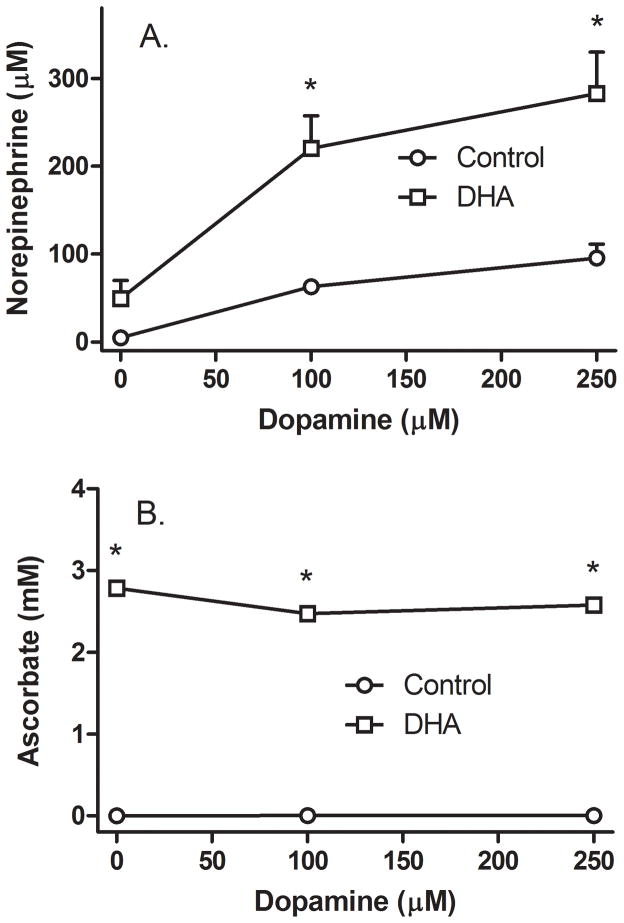
Cells in culture were incubated in the absence (circles) or presence (squares) of 500 μM DHA, followed in 30 minutes by addition of the indicated concentration of DA. After another 60 minutes in culture the cells were rinsed twice in 2 ml of KRH and removed from the plate for assay of NE (Panel A) and AA (Panel B) as described under Methods. Results are shown from 6 experiments, with an “*” indicating p < 0.05 compared to cells not treated with AA at the same DA concentration by two-way ANOVA. Both concentrations of DA significantly enhanced NE generation compared to cells not treated with DA in the presence or absence of AA (one-way repeated measures ANOVA, Tukey’s post-hoc test, p < 0.05).
Figure 3
Figure 3. Ascorbate effects on NE generation from relatively low DA concentrations
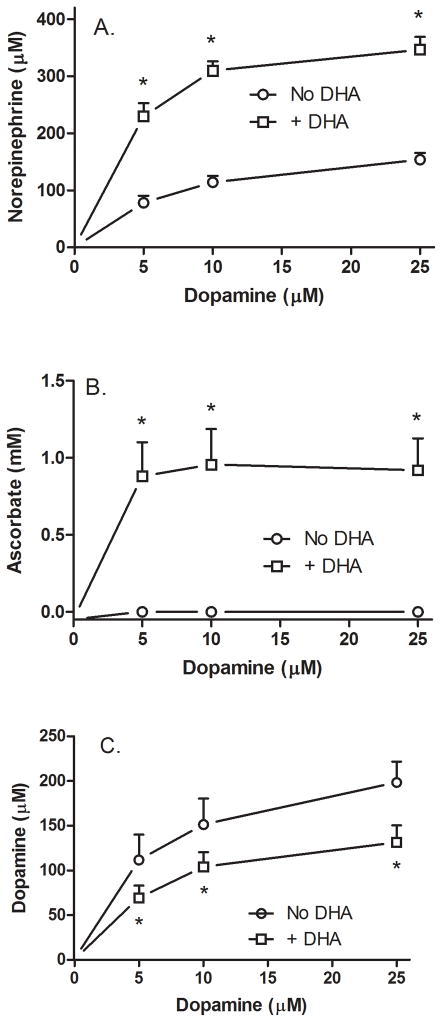
Cells in culture were incubated in the absence (circles) or presence (squares) of 100 μM DHA, followed in 30 min by addition of the indicated concentration of DA. After another 60 minutes in culture the cells were rinsed twice in 2 ml of KRH and removed from the plate for assay of NE (Panel A), AA (Panel B), and DA (Panel C) as described under Methods. Results are shown from 4 experiments, with an “*” indicating p < 0.05 compared to cells not treated with AA at the same DA concentration.
Figure 4
Figure 4. AA concentration-dependence of NE generation from DA in SH-SY5Y cells
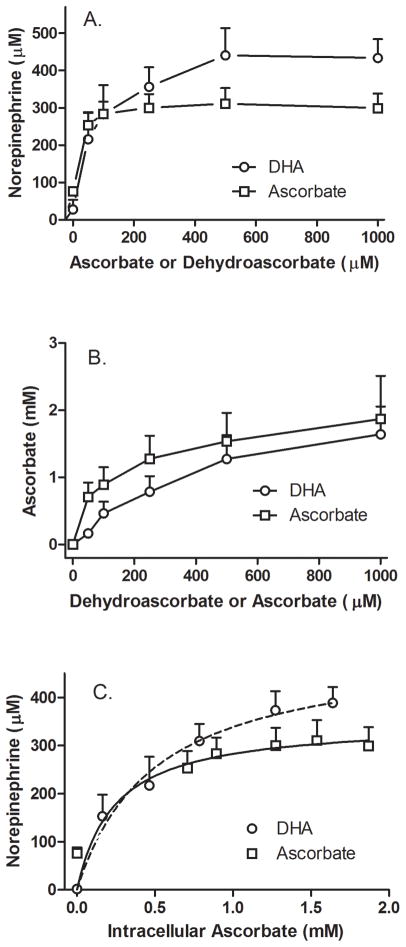
Cells in culture were incubated with increasing concentrations of DHA (circles) or AA (squares), followed in 30 minutes by addition of 50 μM DA. After another 60 minutes in culture the cells were rinsed twice in 2 ml of KRH and removed from the plate for assay of NE (Panel A) and AA (Panel B) as described under Methods. In Panel C, the cellular contents of NE (Panel A) were plotted as a function of the measured intracellular AA concentrations at each loading concentration of each form of the vitamin (Panel B). The dashed lines in Panel C show hyperbolic fits to the data. For DHA loading, the calculated AA concentration at which NE accumulation was half-maximal was 0.5 mM, with a maximum of 506 μM. For AA loading, these values were 0.24 mM and 350 μM, respectively. Results are shown from experiments with each form of AA.
Figure 5
Figure 5. Generation of oxidative stress by DA in SH-SY5Y cells
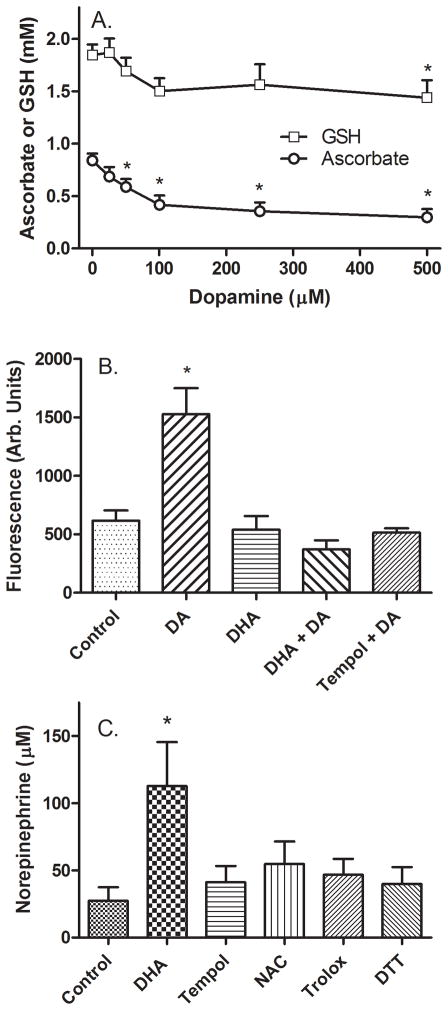
Panel A: Cells in culture were loaded with AA by treatment with 100 μM DHA for 30 minutes and then treated for an additional 120 minutes with the indicated concentration of DA. Cells were then rinsed twice in 2 ml of KRH and removed from the plate for assay of AA (Panel A, circles) and GSH (Panel A, squares). Data are shown from 5 experiments, with an “*” indicating p < 0.05 compared to cells not treated with DA by one-way repeated measures ANOVA. Panel B: Cells in culture were incubated at 37 °C and treated as indicated with 100 μM DHA (AA) or 50 μM TEMPOL for 30 minutes, followed by 100 μM DA. After 60 minutes, the cells were rinsed twice in KRH and dihydroethidium was added to a concentration of 10 μM. After an additional 30 minutes, the fluorescence of 2-hydroxyethidium was determined as described in Methods. Results are shown as relative fluorescence of 8 determinations, with an “*” indicating p < 0.05 compared to the control sample by one-way repeated measures ANOVA. Panel C: Cells in culture were treated without (Control) or with agents at the following concentrations: DHA, 50 μM; TEMPOL, 50 μM; N-acetylcysteine (NAC), 500 μM; Trolox, 250 μM; and dithiothreitol (DTT), 250 μM. After 30 minutes, DA was added to a concentration of 100 μM for an additional 60 minutes before 2 rinses in KRH and removal of the cells for assay of NE. Data are shown from 6 experiments, with an “*” indicating p < 0.05 compared to control by one-way repeated measures ANOVA.

References

    1. Harrison FE, May JM. Vitamin C function in the brain: Vital role of the ascorbate transporter (SVCT2) Free Radic Biol Med. 2009;45:719–730. - PMC - PubMed
    1. Stone KJ, Townsley BH. The effect of L-ascorbate on catecholamine biosynthesis. Biochem J. 1973;131:611–613. - PMC - PubMed
    1. Mallet J. The TiPS/TINS Lecture. Catecholamines: from gene regulation to neuropsychiatric disorders. Trends Neurosci. 1996;19:191–196. - PubMed
    1. Levin EY, Levenberg B, Kaufman S. The enzymatic conversion of 3,4-dihydroxyphenylethylamine to norepinephrine. J Biol Chem. 1960;235:2080–2086. - PubMed
    1. Diliberto EJ, Jr, Daniels AJ, Viveros OH. Multicompartmental secretion of ascorbate and its dual role in dopamine beta-hydroxylation. Am J Clin Nutr. 1991;54:1163S–1172S. - PubMed

Publication types

MeSH terms