


Of blood cells and the nervous system: hematopoiesis in the Drosophila larva
- PMID: 23022764
- PMCID: PMC3519660
- DOI: 10.4161/fly.22267
Of blood cells and the nervous system: hematopoiesis in the Drosophila larva
Abstract
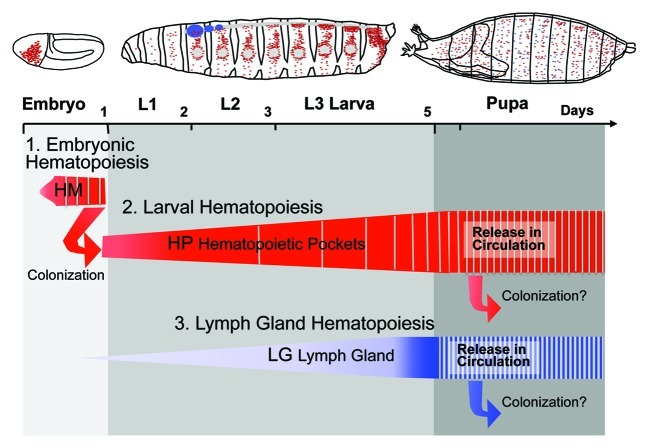
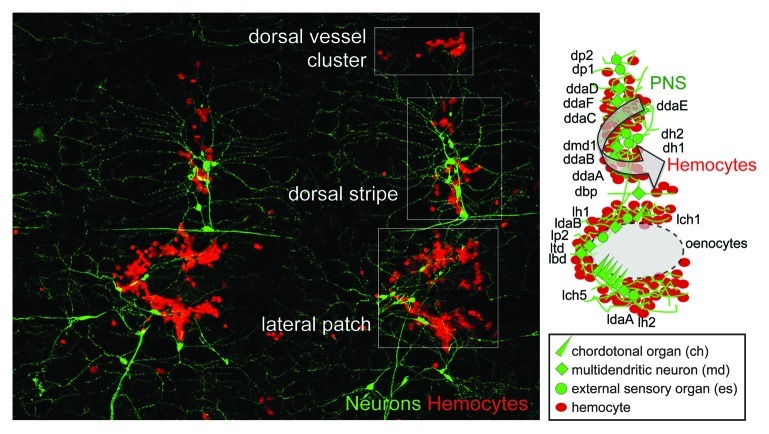
Hematopoiesis is well-conserved between Drosophila and vertebrates. Similar as in vertebrates, the sites of hematopoiesis shift during Drosophila development. Blood cells (hemocytes) originate de novo during hematopoietic waves in the embryo and in the Drosophila lymph gland. In contrast, the hematopoietic wave in the larva is based on the colonization of resident hematopoietic sites by differentiated hemocytes that arise in the embryo, much like in vertebrates the colonization of peripheral tissues by primitive macrophages of the yolk sac, or the seeding of fetal liver, spleen and bone marrow by hematopoietic stem and progenitor cells. At the transition to the larval stage, Drosophila embryonic hemocytes retreat to hematopoietic "niches," i.e., segmentally repeated hematopoietic pockets of the larval body wall that are jointly shared with sensory neurons and other cells of the peripheral nervous system (PNS). Hemocytes rely on the PNS for their localization and survival, and are induced to proliferate in these microenvironments, expanding to form the larval hematopoietic system. In this process, differentiated hemocytes from the embryo resume proliferation and self-renew, omitting the need for an undifferentiated prohemocyte progenitor. Larval hematopoiesis is the first Drosophila model for blood cell colonization and niche support by the PNS. It suggests an interface where innocuous or noxious sensory inputs regulate blood cell homeostasis or immune responses. The system adds to the growing concept of nervous system dependence of hematopoietic microenvironments and organ stem cell niches, which is being uncovered across phyla.
Figures
Comment on
- Makhijani K, Alexander B, Tanaka T, Rulifson E, Brückner K. The peripheral nervous system supports blood cell homing and survival in the Drosophila larva. Development. 2011;138:5379–91. doi: 10.1242/dev.067322 . doi: 10.1242/dev.067322
References
-
- Tepass U, Fessler LI, Aziz A, Hartenstein V. Embryonic origin of hemocytes and their relationship to cell death in Drosophila. Development. 1994;120:1829–37. - PubMed
-
- Abrams JM, White K, Fessler LI, Steller H. Programmed cell death during Drosophila embryogenesis. Development. 1993;117:29–43. - PubMed
Publication types
MeSH terms
Grants and funding
LinkOut - more resources
Full Text Sources
Molecular Biology Databases
